PULLMAN, Wash. – Scientists at Washington State University and Kansas State University have isolated and cloned a gene that provides resistance to Fusarium head blight, or wheat scab, a crippling disease that caused $7.6 billion in losses in U.S. wheat fields between 1993 and 2001.
Their findings are published online in the journal Nature Genetics (https://www.nature.com/ng/journal/vaop/ncurrent/full/ng.3706.html). The report details about 20 years of research that included scientists in China and several American universities.
“The breakthrough that we’re reporting is the cloning of a resistance gene,” said lead author Bikram Gill, KSU. “Cloning is the key to unlock quicker progress for control of this disease.”
“Fusarium is a huge problem for wheat and barley production around the world and one that has been particularly hard to combat,” said Mike Pumphrey, associate professor and director of the spring wheat breeding and genetics program at WSU.
What also is exciting, he said, is that the gene, called Fhb1, appears unique: “It’s a novel gene structure that has not been associated with resistance to diseases in plants.”
Toxin epidemics sicken people, animals
Fusarium head blight is caused by the fungus Fusarium graminearum, which produces a toxin that makes the crop unfit for human and animal consumption. James Anderson, a professor of wheat breeding and genetics at the University of Minnesota, said there are frequent epidemics of the disease reported in the United States, Canada, Europe, Asia and South America.
“Fusarium produces a toxin that causes nausea, vomiting and other digestive disorders and has even been linked to reproductive defects,” said Pumphrey. The blight has been known to sicken tens of thousands of subsistence farmers in developing nations.
Thanks to the discovery, “it’s my hope that in places like India, China and parts of Africa, people will someday no longer be inadvertently eating high levels of this toxin,” he added.
Sifting through millions of samples
Previously, the wheat variety known to best resist Fusarium head blight was a Chinese cultivar named Sumai 3. But while scientists knew Sumai 3 provided resistance, they didn’t know what DNA sequence was responsible – until now.
KSU faculty and students used sophisticated wheat genome sequencing techniques to isolate the gene. Eduard Akhunov at KSU prepared millions of clones of Sumai 3 DNA. Lead scientists Pumphrey and Nidhi Rawat at the University of Maryland sifted through them.
“It’s like searching for the proverbial needle in the haystack to find one clone that contained the resistance gene,” Gill said.
Safe crops grown more quickly
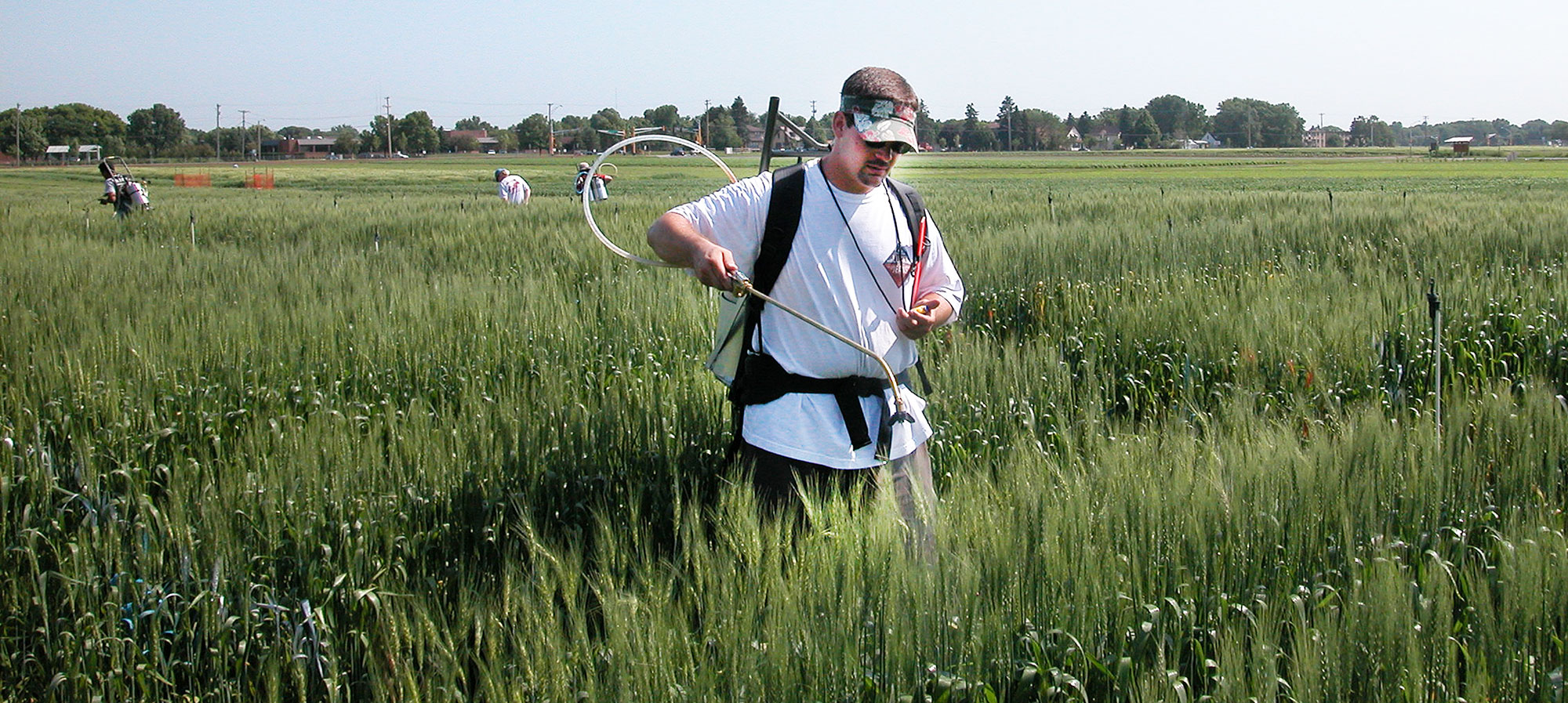
Traditional and molecular wheat breeding will benefit from the finding, Gill said. Without knowing the DNA source of this resistance, scientists would have to grow wheat in a field, hope for the right growing conditions to test new varieties against the disease and then reproduce successful varieties for future years. Instead, processes that would take years to replicate can be done in a fairly short amount of time in a diagnostics lab.
“Knowing how this specific gene works is really important,” said Pumphrey. “It lets us think deeper: Can it be more easily put into wheat varieties or translated to crops like corn and barley?”
Pumphrey began researching Fusarium resistance more than 15 years ago as a master’s student at the University of Minnesota under Anderson and later with Gill at KSU.
The project was funded by the U.S. Department of Agriculture’s Wheat and Barley Scab Initiative and the National Science Foundation. The agricultural experiment stations at each of the participating universities also provided support.
News media contacts:
Michael Pumphrey, WSU Department of Crop and Soil Sciences, 509-335-0509, m.pumphrey@wsu.edu
Bikram Gill, KSU Department of Plant Pathology, 785-341-4901, bsgill@k-state.edu