RICHLAND, Wash. — Washington State University’s Institute for Northwest Energy Futures (INEF) has received a $2.4 million grant from the Washington State Department of Commerce to demonstrate the economic and agricultural feasibility of using solar panels concurrent with apple production in Washington.
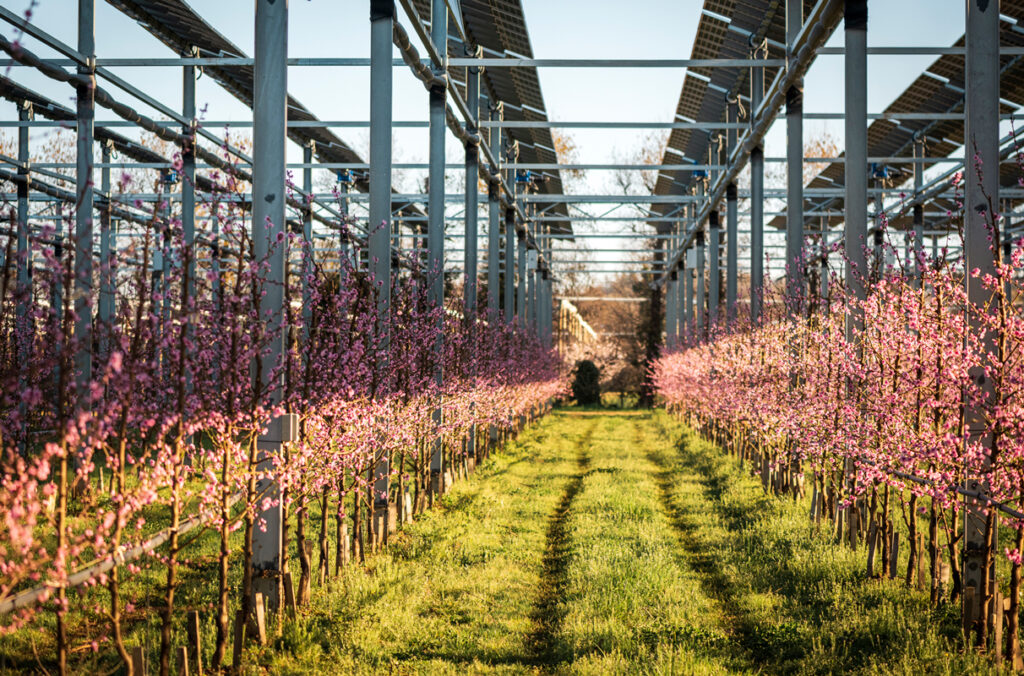
The grant will fund a 1-acre 610 kW dynamic agrivoltaic (DAV) demonstration system at the WSU Sunrise Research Orchard near Wenatchee, Washington in partnership with Sun’Agri, a European company that constructs solar panel systems and the software that controls them. The dual-use demonstration site is being designed to provide strategic orchard shading to help reduce summer sunburn risks while also generating solar power for agriculture operations.
“This demonstration will provide the basis for ongoing evaluation of the mutual benefits of dual-use solar in high-value orchards,” said Chad Kruger, assistant director of agriculture, extension and outreach, WSU Tri-Cities Institute for Northwest Energy Futures.
Kruger notes that demand for zero-carbon foods and renewable energy could soon move agriculture into electrifying more aggressively if the use case can be proven effective and economical. Solar panels in an agricultural setting, also known as agrivoltaics, could be a viable and self-reliant way to power irrigation pumps, frost-inhibiting wind machines, automated robotics, and electric tractors.
An added benefit, alluded to in the dual-use wording, is the shade these solar panels can provide for high-value crops. “If mitigation practices are not in place, up to 50% of the fruit can be affected by sunburn,” said Stefano Musacchi, Tree Fruit Endowed Chair in tree fruit physiology and management in the WSU Department of Horticulture. “DAV systems can modify the microclimate by shading the tree and reducing sunburn and water use. Reducing tree stress will also improve fruit quality,” added Musacchi. The prospect of high-quality, zero-carbon premium fruit could excite Washington growers and help them stay competitive in a global market.

High-value apple orchards in Washington growing familiar varieties such as Honeycrisp, Granny Smith and WA 38 (Cosmic Crisp®) represent approximately 35% of U.S. domestic apple sales and are estimated to be produced on more than 50,000 acres in Washington State. Covering 10,000 acres of these orchards with dynamic agrivoltaic systems could provide an impressive 6,100 MW of installed power generation capacity, located where there is potential to return power to the grid.
This DAV demonstration will provide valuable insight into the commercial viability of these systems. “These and other innovative, mutually beneficial solutions are needed as part of an integrated systems approach to meeting the clean energy demands of the future. INEF is excited to be leading this effort,” remarked Noel Schulz, INEF’s inaugural director.
Find more information online about how WSU is helping prepare for the warming climate.
Media Contacts:
- Leslie Streeter, WSU Tri-Cities Marketing and Communication leslie.streeter@wsu.edu, 509-372-7333
- Chad Kruger, assistant director of agriculture, extension and outreach, cekruger@wsu.edu, 509-335-4605