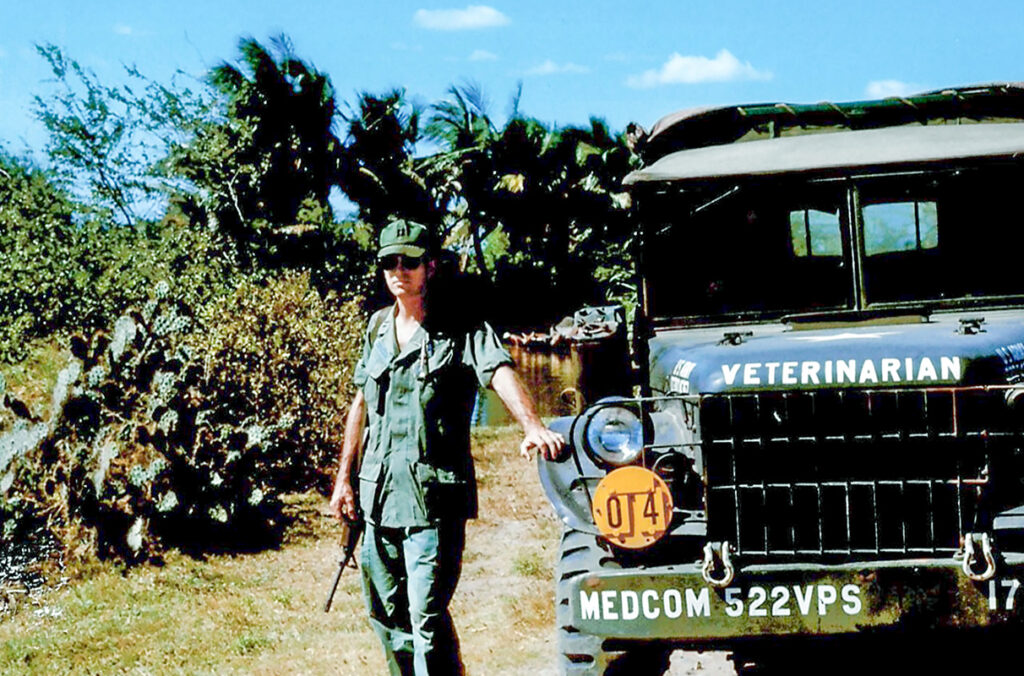
For more than an hour in the dark of night, veterinarian Dr. Neill Johnson, armed with only a .45-caliber pistol, was holed up alone just inside the entrance to an empty bunker as some 500 Vietnamese troops forced their way onto the small U.S. helicopter gunship base.
It was May 3, 1970, at Landing Zone Betty, a U.S. military base in South Vietnam. Guided by local Viet Cong rebels, the attackers launched more than 120 mortar rounds and countless rockets, ambushed the base’s small reserve force, and set fire to all its gunships.
It was Johnson’s eleventh day in Vietnam and his first visit to the remote installation. With reserve forces wiped out, the Pullman native and alumnus of both Washington State University’s College of Veterinary Medicine and Honors College, feared it was only a matter of time before he and his fellow soldiers were overrun and killed. It was a brutal introduction to the dangers of the Vietnam War, where even veterinarians like Johnson, tasked with caring for animals and protecting the military’s food supply, could find themselves in the thick of combat.
“The idea was they were going to send in more assault troops and finish off the rest of us, but Puff the Magic Dragon arrived at the last minute,” Johnson said.
Puff the Magic Dragon was a Douglas AC-47 Spooky, a converted cargo plane equipped with machine guns capable of firing 6,000 rounds per minute. With every fifth round being a tracer bullet, the plane was known for its bright orange-red lines of fire cutting across the night sky, helping shooters readjust their aim on enemy targets.
“I never saw such a sight in my life. I mean, it was like a giant water hose of pure color in the sky. I’m not surprised at all that the enemy decamped immediately,” Johnson said.
Despite serving as a veterinarian in the war and never receiving proper rifle training, that was the last day Johnson didn’t keep a rifle at his side — even when he slept.
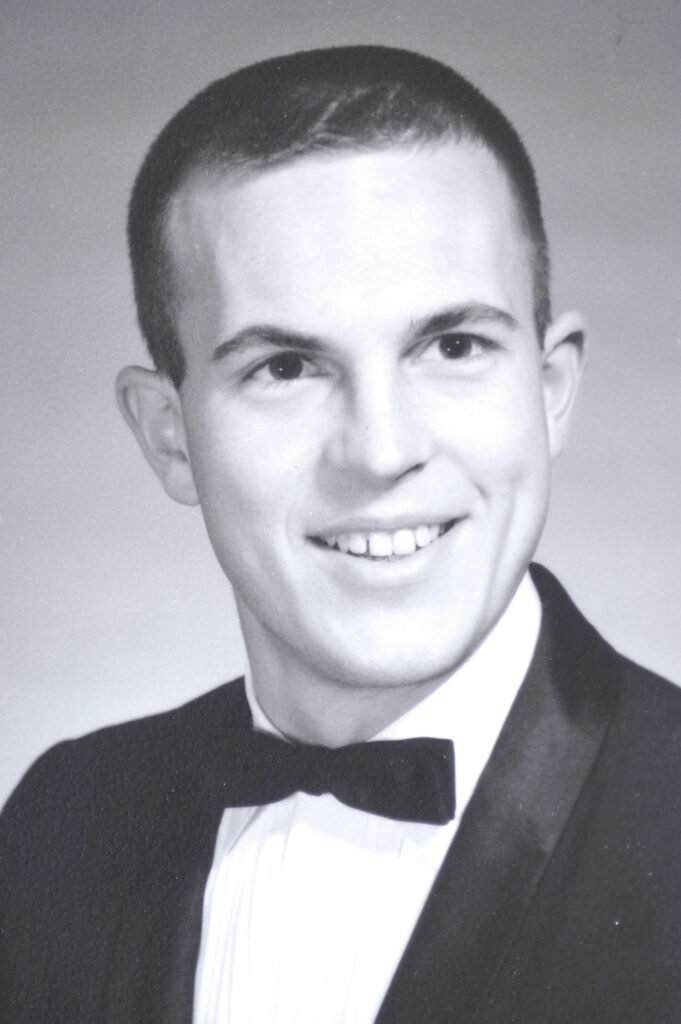
Johnson earned his Doctor of Veterinary Medicine from WSU in 1969 and was one of about 300 veterinarians who served during the Vietnam War. Like other military veterinarians, Johnson was tasked with food safety and procurement, as well as caring for the more than 5,000 military dogs estimated to have served in Vietnam safeguarding American lives.
“Tracker dogs, tunnel dogs, mine detector dogs, scout dogs, guard dogs, all kinds of different dogs,” Johnson said. “I was given 20% of Vietnam and mostly I was on the road, but I had a small animal clinic in Cam Ranh Bay where I treated pet animals.”
The attack at Landing Zone Betty was hardly Johnson’s last brush with death. During another night attack, he nearly entered a dark, abandoned bunker containing a nest of venomous pit vipers. On another occasion, his veterinary truck missed a landmine by inches, but the vehicle following him wasn’t so lucky.
“All the people who were in that other vehicle were killed. I never took the sandy roads again,” Johnson said. “The only veterinarian killed in Vietnam hit a landmine, and I was almost No. 2 if I’d been a few inches over.”
Some of Johnson’s most difficult experiences, however, involved the animals he had been sent to protect.
Rabies was a constant concern in Vietnam. Wild dogs wandered onto military bases and through areas where soldiers were stationed, sometimes showing signs of the disease. Johnson and other military veterinarians were responsible for identifying suspected cases and limiting the risk to troops.
Then, at an engineering base in a remote part of Vietnam, a pet dog died and tested positive for rabies. No pet dogs on the base had ever been vaccinated. There wasn’t any choice. Johnson had to euthanize every pet dog on the base.
“Some of the guys would be going up and down the road on the convoys, and they would pick up a little puppy by the roadside, and it became their closest companion,” Johnson said. “They hated the Army, they hated Vietnam, they hated the war, but they loved that dog and it was the one thing they had. I killed their touch to sanity.”
More than 50 years removed from the war, Johnson vividly remembers that day as one of his worst.
To ensure it never happened again, he set out on his own mission: vaccinate every soldier’s canine companion on every far-flung base.
“I was going to try to get to every little base I could for those dogs and vaccinate the heck out of them,” he said. “I would tell them ‘I’ll be landing in a helicopter gunship so have all your guys at those bases ready with their dogs because a veterinarian is coming.”
I would tell them ‘I’ll be landing in a helicopter gunship so have all your guys at those bases ready with their dogs because a veterinarian is coming.
Dr. Neill Johnson, alumnus
Washington State University
But dogs were far from the only animals Johnson encountered during his time in Vietnam.
His clinic at Cam Ranh Bay was next to a preventive medicine unit tasked with monitoring the base for infectious diseases, particularly plague, which was carried by rats and their fleas. The unit trapped rats, collected all their blood to test for the plague bacteria and then combed off the rat fleas for the same testing. They had a lot of dead rats to dispose of.
Then someone came up with a solution for all the dead rats.
“Let’s buy a Burmese python and he can eat them all,” Johnson said.
The snake was purchased and eventually became one of Johnson’s only exotic patients.
Johnson was honorably discharged in April of 1971 with a Bronze Star and shifted his veterinary career back to what drew him to it in the first place: research. While his wife and WSU Honors College alumna, Dr. Julia Johnson (‘71 Biology), now also a veterinarian, completed veterinary school, Johnson earned a PhD in veterinary science from the University of Wisconsin. He later became a faculty member at the University of Georgia, working in its diagnostic lab and went on to become a board-certified veterinary pathologist working for a variety of pharmaceutical companies.
Decades after returning home, Johnson documented his wartime experiences in a slideshow, now available to view online. He has also maintained close ties to his hometown of Pullman and to WSU, where his family’s history stretches back to the university’s founding.
Johnson is a descendant of Judge Thomas Neill, who played an instrumental role in bringing what was then Washington Agricultural College and School of Science to Pullman and for whom WSU’s historic Neill Hall is named. He continues to support WSU and opportunities for aspiring veterinarians, particularly those interested in research.
Johnson’s appreciation for the university dates to his own years as a veterinary student, when a prolonged illness threatened to derail his education. He struggled with mononucleosis for two years and credits his professors with helping him stay on track.
“Only halfway through my junior year did the disease abate, and I knew I was back when I got the highest grade on a test about cattle diseases. During this difficult time, I relied on a number of professors who watched out for me, alerting me to any work in which I was behind and making sure I got all my requirements completed,” Johnson said.
It’s one of the many reasons Johnson and his wife still support WSU today.
“My professors really cared about their students and helped us to achieve our goals. I will always be grateful to them,” he said.
Media Contacts
- Josh Babcock, WSU College of Veterinary Medicine, 509-339-3423, joshua.babcock@wsu.edu