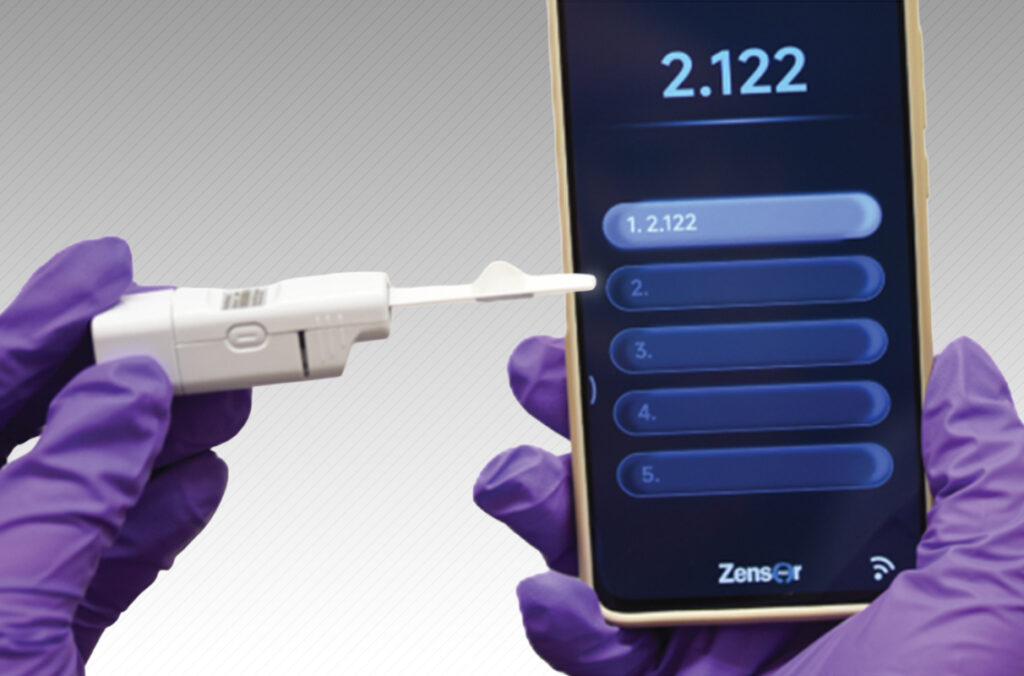
PULLMAN, Wash. — A wearable biosensor developed by Washington State University researchers could improve wireless glucose monitoring for people with diabetes, making it more cost-effective, accurate, and less invasive than current models.
The WSU researchers have developed a wearable and user-friendly sensor that uses microneedles and sensors to measure sugar in the fluid around cells, providing an alternative to continuous glucose monitoring systems. Reporting in the journal Analyst, the researchers were able to accurately detect sugar levels and wirelessly transmit the information to a smartphone in real-time.
“We were able to amplify the signal through our new single-atom catalyst and make sensors that are smaller, smarter, and more sensitive,” said Annie Du, research professor in WSU’s College of Pharmacy and Pharmaceutical Sciences and co-corresponding author on the work. “This is the future and provides a foundation for being able to detect other disease biomarkers in the body.”
Measuring glucose levels is important for diabetes, helping to keep patients healthy and preventing complications. Continuous glucose monitors on the market require the use of small needles to insert the monitor, and people can get skin irritation or rashes from the chemical processes that are done under the skin. Furthermore, they’re not always sensitive enough.
Unlike other glucose monitors that can cause inflammation and pain at the testing site, the testing process occurs outside the body, lowering potential toxicity for patients.
The researchers used 3D printing to create their sensor, which makes it relatively inexpensive compared to typical monitors. The sensor uses a button-activated pump and tiny hollow microneedles to extract fluid from around the cells and tissue below the skin for testing. Unlike other glucose monitors that can cause inflammation and pain at the testing site, the testing process occurs outside the body, lowering potential toxicity for patients.
“Ours is much more benign for customers and users,” said Kaiyan Qiu, Berry Assistant Professor in WSU’s School of Mechanical and Materials Engineering and corresponding author on the work.
The hollow microneedle arrays are less than a millimeter in length as compared to typical glucose monitoring needles that are several times longer.
“The hollow microneedles are painless and minimally invasive, making them next-generation medical devices,” said Qiu.
The glucose monitor is also highly sensitive because it uses a single-atom catalyst and enzymatic reactions, called nanozymes, to enhance the sugar’s signal and measure low levels of the biomarkers.
“The nanozymes make our signal much stronger and can detect a minimal amount of any biomarker,” said Qiu.
The researchers have filed a provisional patent in the Office of Innovation and Entrepreneurship. They are planning to test the glucose monitors on animals and are investigating its use with additional or multiple biomarkers. The revenue from continuous glucose monitor market in the United States is forecasted to nearly quadruple, from $7.2 billion in 2024 to $26.8 billion in 2033.
“My goal is to make advanced sensing technology more practical for everyday healthcare,” said Yonghao Fu, co-first author on the paper and a PhD student in the School of Mechanical and Materials Engineering. “I enjoy working on a project that can combine different technologies so that we can take advantage of their strengths.”
The work was funded by the National Science Foundation and the Centers for Disease Control and Prevention.
Media Contacts
- Annie Du, WSU College of Pharmacy and Pharmaceutical Sciences, 509-368-6700, annie.du@wsu.edu
- Kaiyan Qui, WSU School of Mechanical and Materials Engineering, 509-335-3223, kaiyan.qiu@wsu.edu
- Tina Hilding, Voiland College of Engineering and Architecture Communications, 509-335-5095, thilding@wsu.edu