It was 1988. Scott Crump was in his Torrance, California, kitchen, using his wife’s hot glue gun to fashion a toy frog for their two-year-old daughter, when the idea struck. What if he could print an object layer by layer?
“The label says glue sticks, but they’re actually thermoplastic,” explains Scott, who used the molten plastic to craft a four-inch frog figurine, drawing eyes and a smiley face on the toy with a black marker. “I think there was a sort of a-ha moment where I discovered the plastic had the consistency of honey and it wouldn’t flow off the model but would stick. If we could automate that, we could reduce the time it took to build an engineering prototype.”
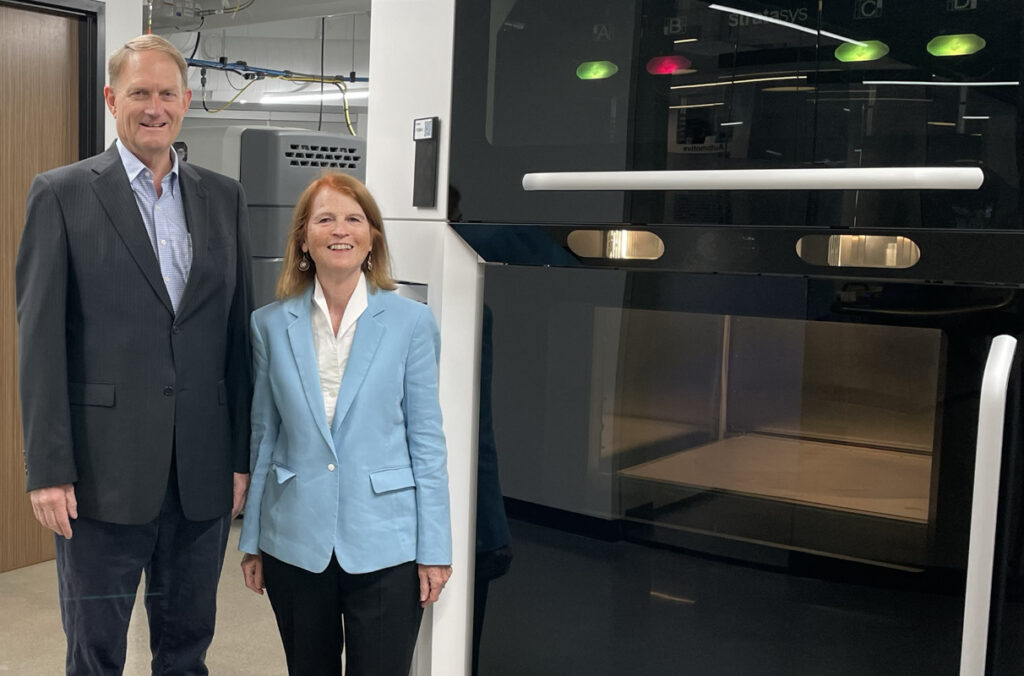
Today, building rapid protoypes makes up the bulk of the business Scott helped establish based on the process he invented, and Froggy sits in his home office near Minneapolis — a reminder of how the company got its start. Scott created Fused Deposition Modeling, or FDM, which involves melting thermoplastic material, then extruding it through a nozzle to craft an object. He and his wife, Lisa, co-founded Stratasys, one of the world’s leading 3D printing companies.
The Crumps’ special combination of invention, ingenuity, and entrepreneurship helped lead to an entirely new industry. For that, Scott (’76 Mech. Eng.) and Lisa (Healy) Crump (’75 Ed.) are the 2026 recipients of the Regents’ Distinguished Alumni Award, the highest honor bestowed upon Washington State University alumni. The couple will be in Pullman on November 5 to receive the award.
“We’re very honored,” Scott said. “We both feel really fondly of our time at WSU. It was a very good time in our lives. This means a lot to us.”
Scott remembers discussing plastics and how they react to temperature in his material science class at WSU. “And that had a big effect on me,” he said, praising the hands-on instruction he received in mechanical engineering, especially in the machine shop.
His senior project team won a Lincoln Electric award for the industrial freeze dryer that members designed and successfully built.
Scott was a member of Delta Sigma Phi, and Lisa worked at Ferdinand’s Ice Cream Shoppe. She had grown up in Seattle and lived in Pullman at Regent’s Hall as well as on Oak Street across from Scott’s fraternity. He was born in California but grew up in Connecticut and was serving as his fraternity’s house manager when he ran into her carrying buckets of water for her garden and offered to direct an irrigation spigot on it.
Both went on to earn advanced degrees and were working at the same company ten years into their marriage when they missed a market window. “That was a visceral way of saying, ‘If you can’t get a prototype out quickly, there are severe consequences,’” Lisa said.
Scott kept tinkering with the glue gun, moving on from glue sticks to better waxes and plastics which he melted and mixed in pots and pans on the stovetop before moving his experimentation to the garage and then a leaky, rented workshop. “We got to a point in our spending where we had to decide to stop or incorporate. We decided to stop tinkering and start an actual company,” Scott said.
“We believed in what Scott was doing, and it absolutely made sense to us to move forward and take the risk,” Lisa said. “We used savings to start Stratasys.”
After the toy frog, Scott built a small version of a laundry detergent bottle, then progressed to forging a tiny replica of a human head, which required “much more complex geometry and tech.”
Their biggest challenge wasn’t math or technology or creativity. It was funding. “Lisa and I pretty much spent all the money we had” getting Stratasys up and running, Scott said. “We got to a point where we had to decide to either close the business or do a public offering to raise money. So we did a public offering.”
Scott was the inventor and innovator. Lisa, a former special education teacher, was deeply involved in marketing, communications, and sales. “I was the more inside person,” Scott said. “Lisa was the more outside person, getting press releases going and figuring out which trade shows to go to, and what products to sell as well as setting up sales distribution.”
Said Lisa, “My education at WSU was a great foundation. Some of the basic skills I learned translated well to business. Teaching is about trying to have someone understand a concept. Consultative selling is also about teaching. And this was a nascent field. A lot of things had to happen in order for additive manufacturing to be established and for people to understand it’s not just for prototypes. You can do short-turnaround parts, tooling, and production parts.”
FDM’s relatively low cost and ease of use made it the most popular 3D printing method for home as well as some commercial use. Scott saw potential applications in robotics and automation, architecture and construction, consumer goods and fashion, education and research, aerospace, and medical, automotive, and other industries.
Stratasys continues to develop and innovate in 3D printing and now employs some 1,700 people in more than 30 offices around the world.
Scott left his leadership position in 2020 and remains on the board of directors. Lisa acts as an ambassador for the company. She’s also a managing partner in a firm that invests in women-led tech businesses. Both remain shareholders in Stratasys. They’ve been married 48 years and are focused on the future.
“Scott and I believe in paying it forward,” Lisa said. “We’re intent on giving back to the next generation, like supporting tech-focused youth programs. And, we believe the team at Stratasys will continue to innovate and be technology leaders going forward.”