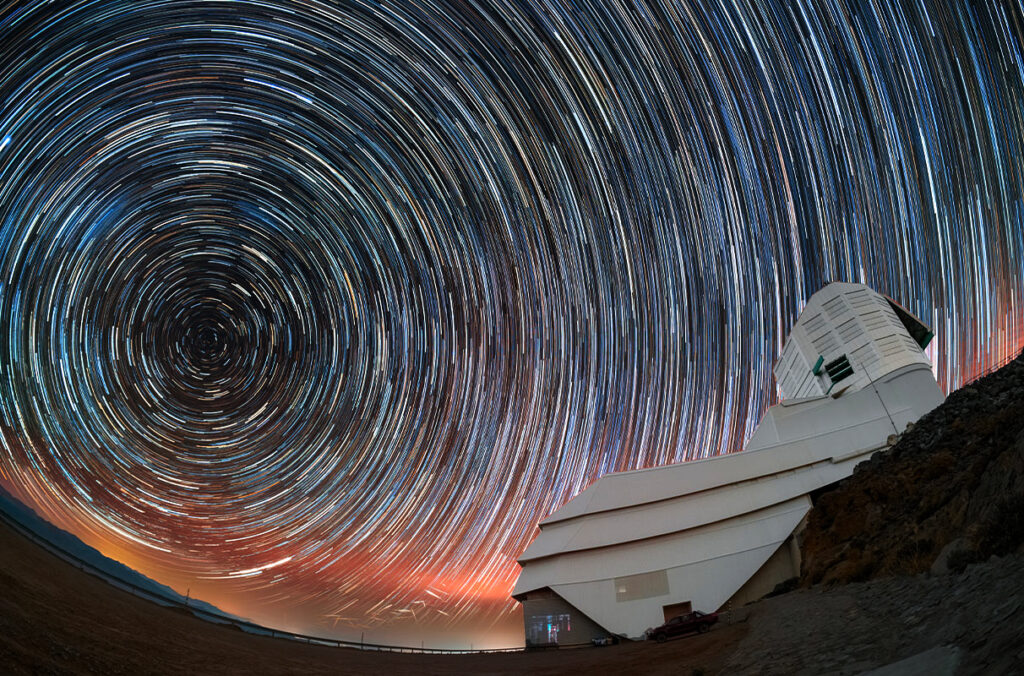
Equipped with the largest digital camera ever built, the newly opened Vera C. Rubin Observatory in Chile will photograph the southern night sky every few nights for the next decade. Washington State University astronomer Vivienne Baldassare plans to search that time-lapse movie of the universe for the flickering signatures of elusive black holes.
Baldassare, an associate professor of physics and astronomy, received a $90,000 grant from the LSST Discovery Alliance to use early observatory data to identify intermediate-mass black holes in dwarf galaxies, which contain far fewer stars than galaxies such as the Milky Way. These black holes fall in size between those created by dying stars and the supermassive black holes at the centers of large galaxies. Finding and potentially weighing them could reveal how the universe’s first massive black holes formed and grew.
“We know there are supermassive black holes in relatively large galaxies, but we don’t know how they formed,” Baldassare said. “Did they start out small and have to do a lot of growing, or did they start out big and only have to grow a little to reach their current sizes?”
The Rubin Observatory will repeatedly scan the sky as part of the 10-year Legacy Survey of Space and Time. Its 3,200-megapixel camera will allow researchers to track objects and events that change in brightness.
Baldassare will use that capability to search for black holes ranging from thousands to hundreds of thousands of times the mass of the sun. Though enormous by everyday standards, they are relatively small in the world of massive black holes. Their faint signals can be overwhelmed by light from the surrounding galaxy, making them difficult to detect.
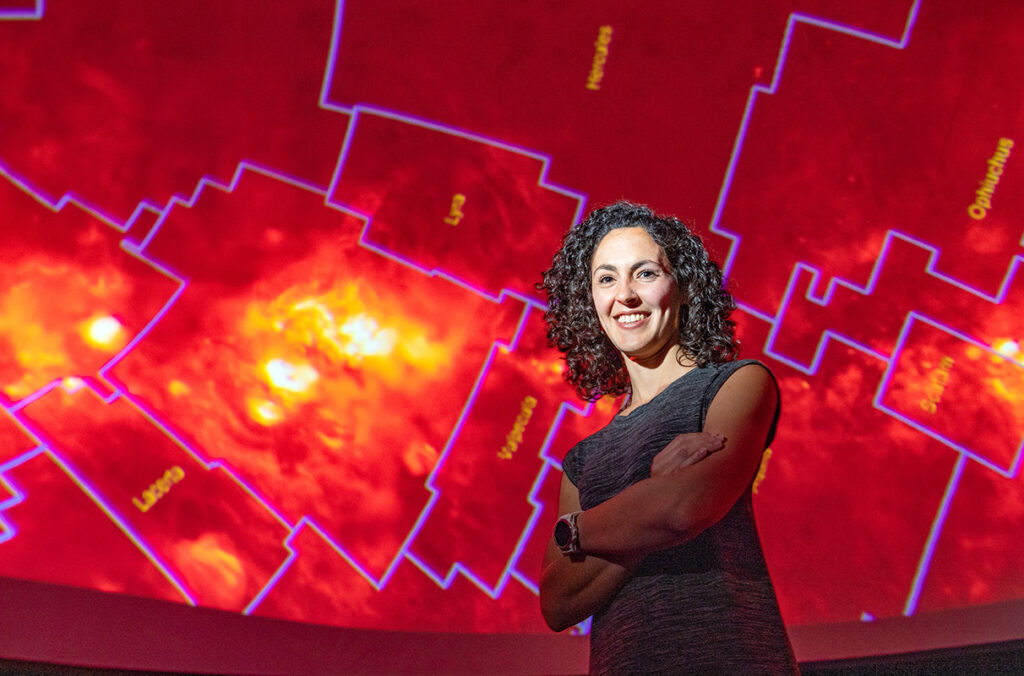
The observatory’s repeated observations could help Baldassare’s team find black holes that have been too faint to see. The researchers will look for changes in brightness that occur as a black hole consumes gas and the material around it gives off light in a recognizable pattern.
The team will begin by studying galaxies known to contain black holes that are growing by consuming gas. They will then use those findings to search dwarf galaxies where black holes have not previously been found.
The grant, supported by the Heising-Simons Foundation, also provides assistance from a professional software engineer. This will enable the team to develop and release tools to help isolate faint, changing light at the centers of galaxies, supporting research across the Rubin astronomy community. The project will also support a WSU graduate student and contribute to her doctoral thesis.
One of the possibilities that most excites Baldassare is that the pattern of changing light could help her team estimate the masses of black holes, something astronomers can currently do only under certain conditions and for a small fraction of known black holes.
“We may be able to say not just that a galaxy has a black hole, but to weigh it,” Baldassare said. “That is currently very difficult to do for black holes like the ones we’re searching for.”