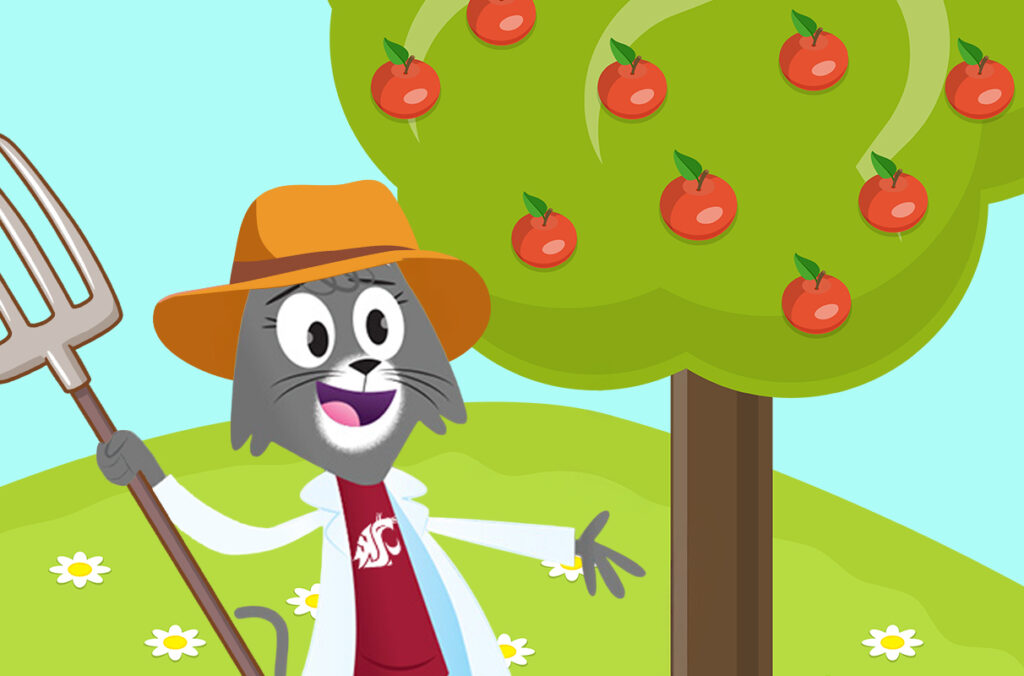
Washington State University’s resident feline scientist, Dr. Universe, digs into a backyard mystery to answer a question from Alyssa, 11, of Washington state: Why do some apple trees produce lots of apples while others make very few or none at all?
With help from WSU plant biologist and apple breeder Kate Evans, Dr. Universe explains that it all starts with pollination. Apple trees rely on bees to move pollen from one tree’s blossoms to another. When pollen lands on the right part of a flower, it can fertilize an ovule and begin forming a seed and eventually an apple. Because most apple trees are not self-fertile, they need a compatible partner nearby. Without the right match, blossoms may never turn into fruit.
Readers also learn that weather and tree biology play a big role. Late freezes can damage blossoms before apples ever form, while trees sometimes limit their own fruit production through a process called biennial bearing, producing a heavy crop one year and very little the next. Growers often manage this by thinning extra blossoms or young fruit so trees can produce a more consistent harvest over time.
The column also explores how genetics influence apple production. Each seed inside an apple is a unique mix of its parent trees, which is how scientists like Evans develop new varieties such as Cosmic Crisp and Sunflare apples. For home growers, a simple solution to a fruitless tree may be planting or finding a second compatible tree or even hand-pollinating blossoms like a bee.
Ask Dr. Universe is a science education project from WSU that answers real questions from curious kids around the world. Readers and listeners can submit their own questions and explore more columns, videos, and the Ask Dr. Universe podcast online.