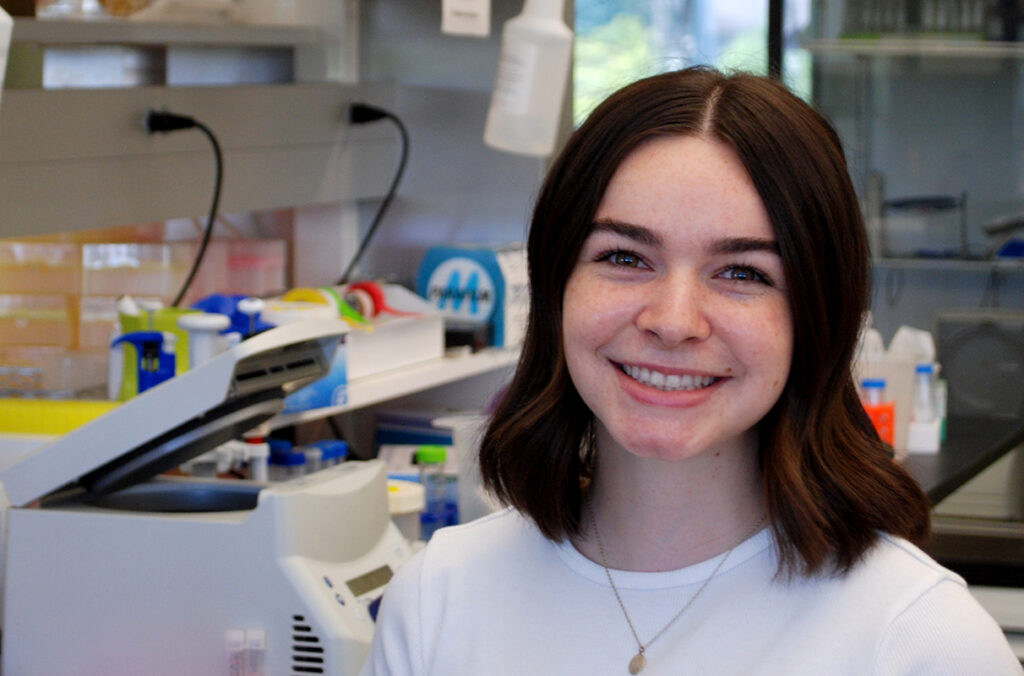
Taylor Page, a third-year biochemistry major at Washington State University, grew up surrounded by women affected by reproductive diseases. “Seeing them struggle with that their whole lives without an effective treatment just sucks,” she said. She wanted to help others like them and decided to study biochemistry at WSU to someday conduct reproductive health research. She wasn’t expecting that day to come so soon.
Her first semester, Page began helping with graduate students’ research projects in the Hayashi Lab. Now, she is also working on a project of her own investigating how a specific gene affects fertility and pregnancy in mice. This research may provide insights into the gene’s role in human infertility and inform the development of targeted treatments.
Page had been planning to do research this summer through the NIH Summer Internship Program. Federal funding for the program was cut, and that door closed. Another soon opened in the form of Honors College funding to work on her project full-time without classes, extracurriculars, or other work. As a result of being able to focus completely on her project, her research advisor Kanako Hayashi said, “She progressed so much.”
Page began her project by testing whether female mice without the gene in their reproductive tract were able to have pups. They weren’t. So, she’s now working backwards to find when things start to go wrong in the process. That includes performing surgery on live mice, removing their ovaries, and observing whether their uteruses can prepare for implantation normally.
Page said having her own project has especially helped her grow as a scientist. “It’s been really cool to take on more responsibility. I’ve learned a lot — lab techniques and how to manage my time and how to manage a project,” she said.
When students join a lab, senior researchers spend a lot of time mentoring them. After a while, however, they become more independent and contribute more to the lab. Page is now at that stage. “She can perform,” said Hayashi.
Page is well prepared for a career in research. But she doesn’t plan to stop there, hoping to begin an MD PhD soon after graduating. She explained, “So I’m able to see patients and then do something about it.”