PULLMAN, Wash. — Research led by scientists at Washington State University has revealed insights on how plants form a microscopic landscape of proteins crucial to photosynthesis, the basis of Earth’s food and energy chain.
The discovery provides a new view of the molecular engine that converts sunlight into bioenergy and could enable future fine-tuning of crops for higher yields and other useful traits.
Colleagues at WSU, the University of Texas at Austin, and the Weizmann Institute of Science in Israel used a novel, technology-powered approach to peer inside plant leaf cells and visualize the landscape of the photosynthetic membrane — the ribbon-like structure where plants harvest sunlight. The findings were recently published in the journal Science Advances.
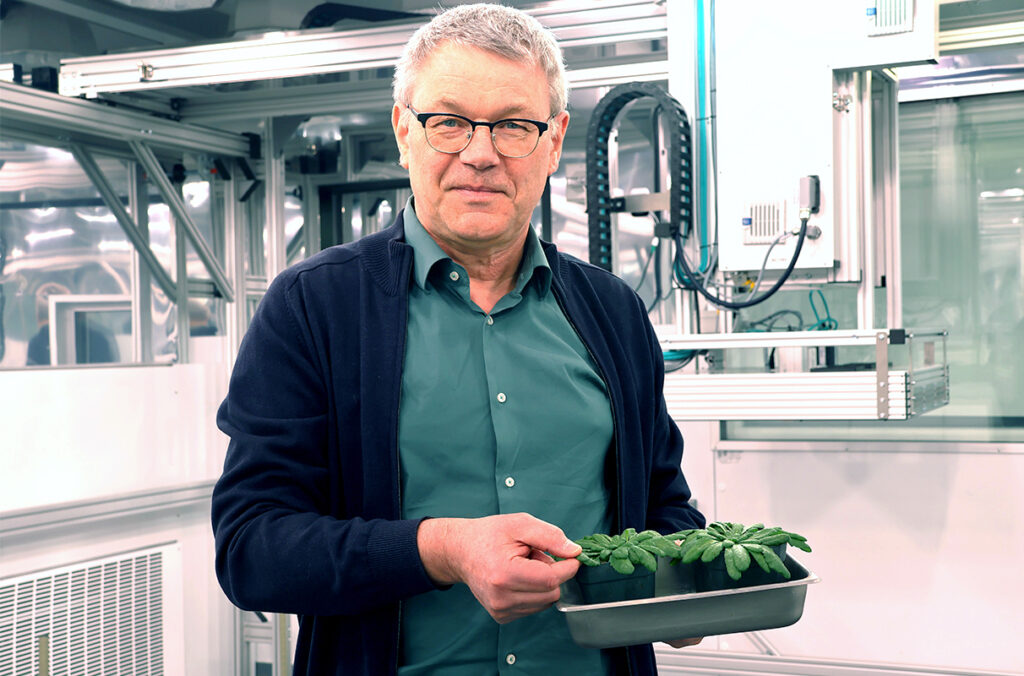
“These membranes are highly efficient biological solar cells,” said the study’s principal investigator and corresponding author, Helmut Kirchhoff. “They convert sunlight energy into chemical energy that fuels not only the plant’s metabolism but that of most life on Earth.”
The photosynthetic membrane derives its structure and function from a handful of crucial protein complexes — linked groups of proteins that do the work of energy conversion.
Using model plants in the mustard family, Kirchhoff’s team used advanced electron microscopy to create virtual representations of how those proteins organize as part of the membrane. They found that the precise size and mix of proteins are crucial to determining their arrangement, a key factor in energy conversion.
“At the molecular scale, structure determines function,” Kirchhoff said. Structural organization of proteins in the membrane controls how well electron-carrying molecules can flow through it or how easily damaged proteins can be repaired. Such factors affect the efficiency, creating downstream impacts on seed yield and plant performance.
Kirchhoff compares these intracellular landscapes to forests: some are wild and chaotic, seemingly growing at random, while others are more precisely arranged like a tree plantation. Each configuration has functional trade-offs.
There is potential here for advances in agriculture. By influencing these protein landscapes, we could fine-tune the yield of crops for a certain environment.
Helmut Kirchhoff, professor
Washington State University
“There is potential here for advances in agriculture,” Kirchhoff said. “By influencing these protein landscapes, we could fine-tune the yield of crops for a certain environment.”
The scientists drew on a wide range of disciplines, from quantitative biology to computer science, and technologies like cryo-electron microscopy, which provides a nanoscale view of structures inside cells, to picture the molecular landscapes. Kirchhoff describes their approach as an analytical pipeline that other scientists can use to further study the cellular protein landscape.
The team’s use of intact leaves, rather than processed cellular material, was also novel.
“We preserved the natural structure,” Kirchhoff said. “We wanted to understand it in its native, living context.”
The project was funded by the U.S. National Science Foundation, the United States-Israel Binational Science Foundation, and the U.S. Department of Energy.
The researchers are now developing virtual protein landscape models and launching experiments to determine how different light conditions influence the landscapes’ structural development. Kirchhoff plans to use the new pipeline to visualize and analyze protein landscapes from plants grown under stress or with genetic mutations.
“We want to better understand the molecular players that control them,” he said. “This is a starting point.”
Media Contacts
- Helmut Kirchoff, WSU Institute of Biological Chemistry, 509-335-3304, kirchhh@wsu.edu
- Seth Truscott, College of Agricultural, Human and Natural Resource Sciences, 509-335-8164, struscott@wsu.edu