For two years, Terran Gilbreath’s job was to trace disease outbreaks back to their source.
Working as an applied epidemiology fellow with the Oregon Health Authority, he investigated cases of Salmonella, E. coli, and other infectious diseases, interviewing people who had become sick, and piecing together clues that could reveal just how an outbreak began and spread.
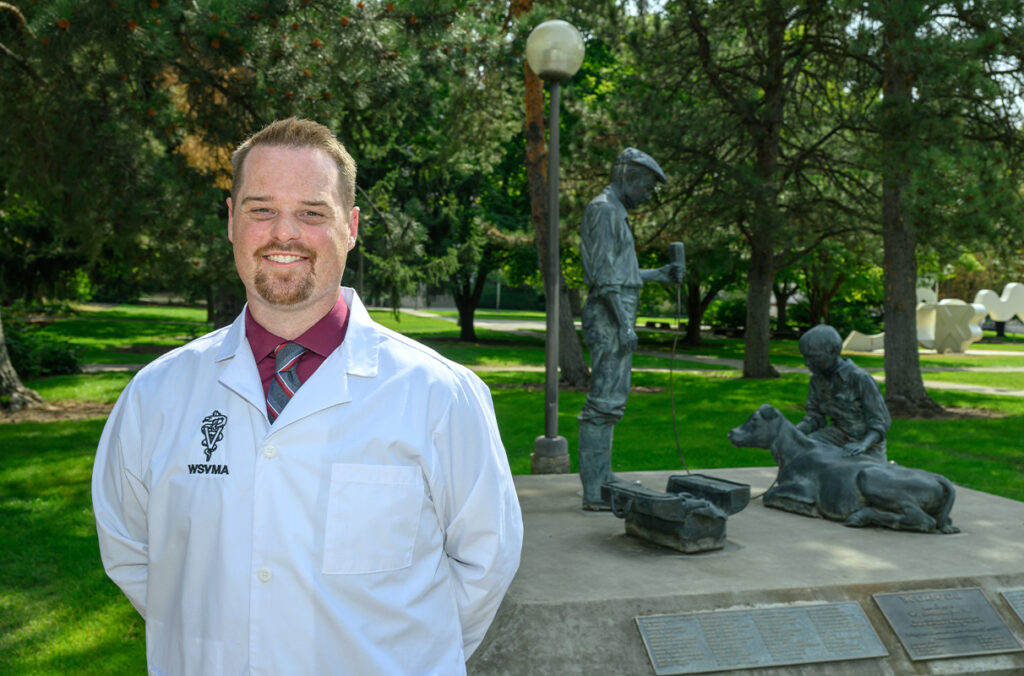
Now back at Washington State University where his interest in infectious disease was first sparked, Gilbreath is pursuing the Doctor of Veterinary Medicine degree that had always been part of his plan.
“Since I was notified I was accepted into the veterinary program at WSU, I’ve been incredibly nervous about being back, and I think those nerves kind of persisted right up until I stepped onto campus,” Gilbreath said. “I knew this was exactly where I was supposed to be.”
An unconventional path
Gilbreath first arrived at WSU in 2015, initially planning to study plant science. But an early biology course introduced him to genetics and cell biology, which ultimately led him to switch to biochemistry.
“I started as a plant science major, actually, and I think about the time I got to my first biology class, and we started talking about things like genetics and cell biology, and I kind of started to fall in love with that,” he said.
As an undergraduate, Gilbreath also spent about a year and a half working in a research laboratory studying Chlamydia trachomatis. The experience further fueled his interest in genetics and infectious disease and gave him his first opportunity to present research at a conference.
After earning his biochemistry degree in 2019, he pursued a Master of Public Health in epidemiology and infectious disease epidemiology at Oregon State University, followed by a two-year Applied Epidemiology Fellowship through the Council of State and Territorial Epidemiologists.
Gilbreath matched with the Oregon Health Authority, where his work ranged from disease surveillance and data analysis to foodborne outbreak investigations and infection prevention. He investigated outbreaks involving Salmonella, E. coli, and Campylobacter, while also working with Oregon’s state public health veterinarian, Dr. Emilio DeBess, on One Health investigations involving animal and human health. Gilbreath even spent weekends working with DeBess at his veterinary clinic.
“It’s one thing to learn about it in class; it’s a totally different thing to kind of see it in practice in real time,” Gilbreath said.
As a veterinarian, Gilbreath hopes to combine his clinical work with the perspective he gained through epidemiology and public health.
“I think the work I’ve done in epidemiology and public health is what’s kind of pushed me toward wanting to practice large animal clinical medicine, but also thinking about how these are animal health outcomes and how they relate to human health outcomes,” he said.
Coming home to WSU
Although Gilbreath’s path took him away from Pullman for several years, his connection to WSU never wavered.
As an undergraduate, he found mentors among professors, advisers, and research faculty. Those relationships, he said, played an important role in his decision to return.
“I always felt like when I needed a mentor, somebody was there,” Gilbreath said. “Somebody was there that was willing to lend a hand and kind of guide me to where I need to be.”
Now, as he begins veterinary school, Gilbreath is bringing all of those experiences with him – from the family farm where his passion for animal health began to the WSU laboratory where he first explored infectious disease to Oregon, where he saw firsthand how veterinarians can play a critical role in protecting both animal and human health.
“It’s a wholly untraditional path to veterinary medicine,” he said. “I’ve enjoyed every one of the experiences that have gotten me here.”