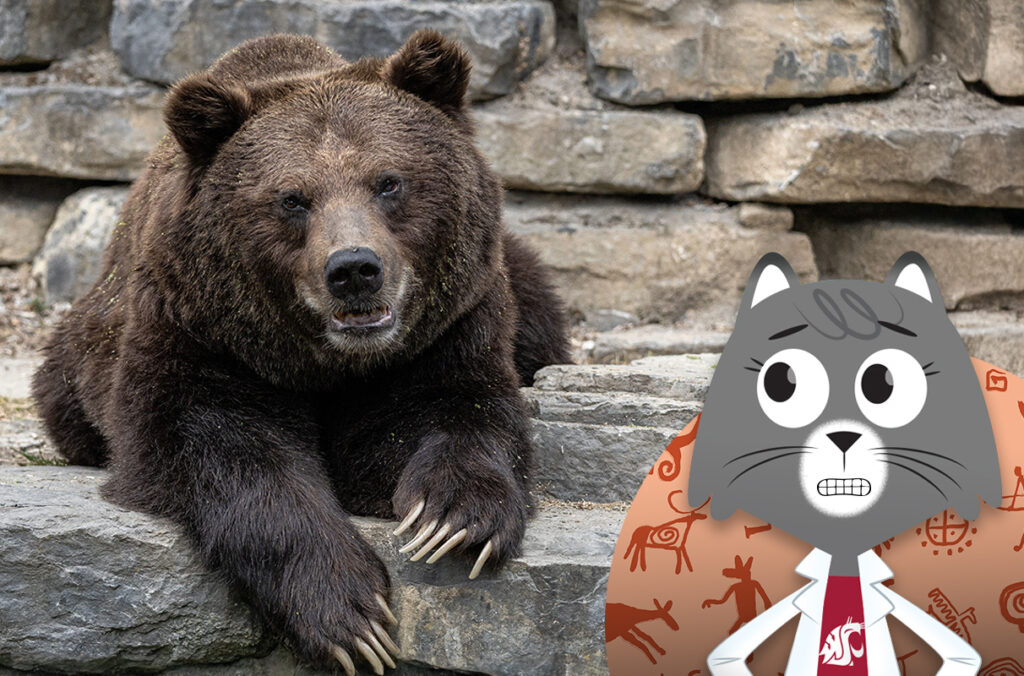
Washington State University’s resident feline scientist, Dr. Universe, answers a wild question from Florian of Austria: Could humans have domesticated bears instead of wolves?
With help from wildlife biologist Sean Farley, who studied at the WSU Bear Center, Dr. Universe explains how wolves’ social behavior made them better suited for life alongside early humans. Wolves live and hunt cooperatively in packs, while bears are generally solitary animals whose hierarchies are based more on size and dominance than teamwork.
Readers also learn how some ancient wolves may have gradually domesticated themselves by becoming less fearful of humans and feeding on scraps near their camps. Bears, by comparison, required far more food, spent months hibernating and gave birth to helpless cubs that remained in their dens for long periods.
Along the way, Dr. Universe explores ancient cave bears, the evolutionary relationship between dogs and gray wolves and how the mobile lifestyle of hunter-gatherers would have made raising bears especially difficult.
Ask Dr. Universe is a science education project from WSU that answers real questions from curious kids around the world. Readers and listeners can submit their own questions and explore more columns, videos and the Ask Dr. Universe podcast online.