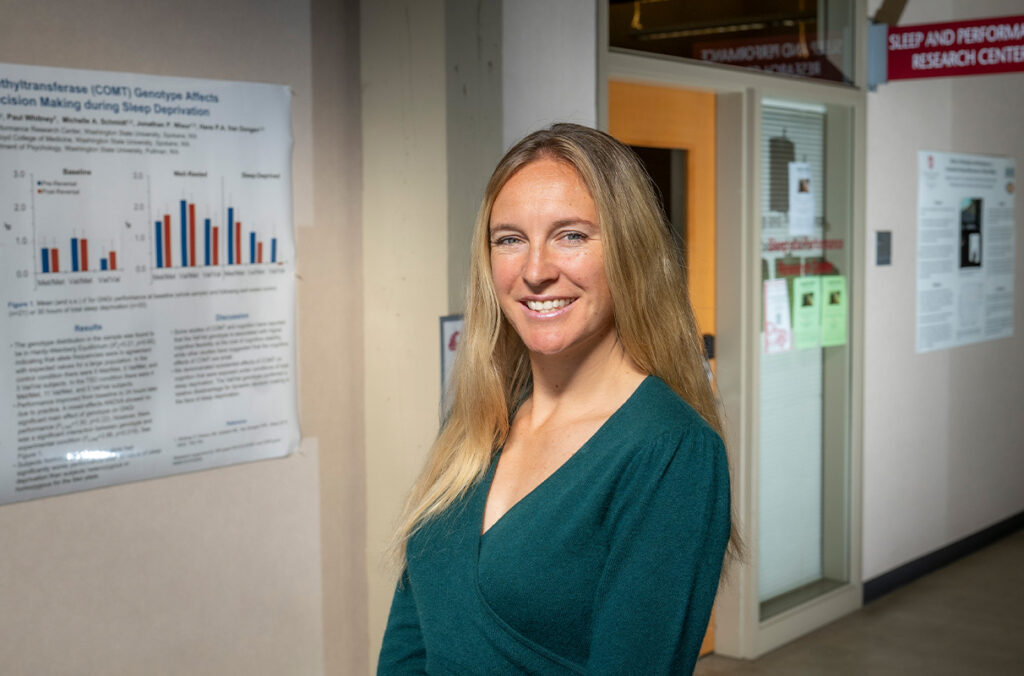
Lois James grew up with a stellar role model for setting her own course.
Her mother, Naomi James, became the first woman to sail alone around the globe via the treacherous Cape Horn route, single-handedly guiding a 53-foot sloop that ordinarily required a crew of 10. She completed the journey in 272 days in 1977–78, breaking the previous record by two days.
The example stuck.
“I always, always believed that anything I wanted to do, I could do,” said James, an associate professor of nursing and the director of WSU’s Sleep and Research Performance Center. “It didn’t really matter what doors were closed. It didn’t really matter who said no. If I wanted something, I could just plow forward and do it.”
That helped James plow through challenging straits, as she entered the sciences in college, earned a PhD at WSU in 2011 and moved on to a prominent career on the faculty in the College of Nursing, where she focuses her research on bias, stress, sleep and performance in “high-stress” populations such as police officers, military personnel, nurses and elite athletes. Her work has brought in millions of outside funding for research, and been featured in National Geographic, The New York Times and other national media outlets.
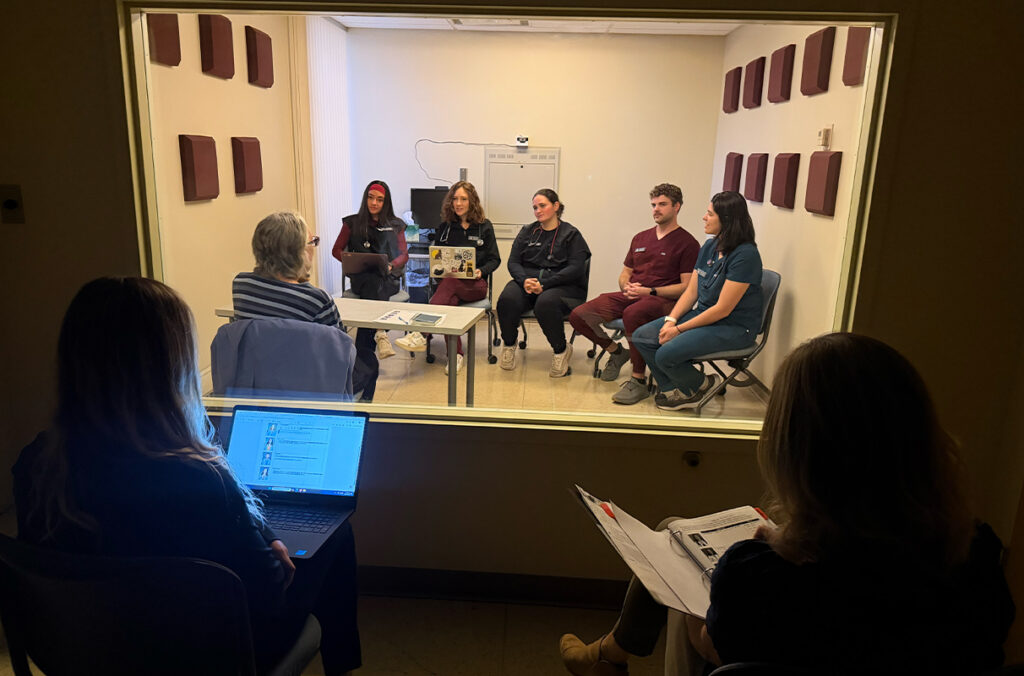
James created a novel training program to combat inherent bias in decision-making by police officers, which hundreds of officers have taken at departments around the country. That program began in the research lab as James was working on her PhD; she had developed simulations to study officer responses, and potential biases, when making decisions in encounters involving the use of force and other situations.
James created a novel training program to combat inherent bias in decision-making by police officers, which hundreds of officers have taken across the country.
Early on she recognized that the simulations could be turned from a research purpose toward a training one.
“We were researching what influences police officers as they make decisions, whether that’s use-of-force decisions or even how they interact with community members more generally, whether they escalate, whether they de-escalate, how they connect with people,” she said.
“I started to see that this was not just a process of discovery, but there’s the potential for creating a training program that takes all the lessons from the data that we were collecting and translating it into a product that we could give back to communities and the police officers that serve them.
She began by applying for a WSU Commercialization Gap Fund grant that she received after a “’Shark Tank’-like” competitive process. The grant is administered by the Office of Research yearly to help provide up to $50,000 to bridge the gap between their research and industry. James’ proposal was successful and it helped begin the process for the design and licensing of CBTSim — a process through which she said she received clear, consistent guidance from the Office of Research’s program for Innovation and entrepreneurship.
CBTSim has so far been used by hundreds of officers in departments around the country. A version of CBTSim has been developed for 911 dispatchers, and James is designing a similar bias training for people working in health care, which is being funded by the National Institutes of Health.
She has become an ambassador for the Office of Innovation and Entrepreneurship, working as an Innovation Liaison to encourage faculty members to explore the possibilities of commercialization.
Like others, James discussed the importance of role models and mentors — but she also noted that not all positive mentorship comes solely from women. She cited a critical mentor in Bryan Vila, a sleep and performance scientist who is now retired from WSU.
“He broke every mold or stereotype of what you would think of as a boys’ club for mentorship, right?” she said. “He promoted me from day one, so I always felt like I was front and center of any conversation. I was always at the table, and I was always being advocated for and being promoted.”