Many students had just gone to bed when a fire sprinkler broke on the eighth floor of Washington State University Pullman’s Stephenson East in 2022, flooding multiple floors and displacing dozens of residents.
Among the first to arrive on the scene were student troubleshooters from WSU’s Auxiliary Facility Services (AFS) in Student Affairs. Their work often goes unnoticed as they operate during the night when most people are sleeping. Two troubleshooters are on call every night, responding to issues across 3.3 million square feet of building space, including residence halls, university apartments, the Student Recreation Center, the Chinook Student Center, the Compton Union Building, and Elson S. Floyd Cultural Center.
“We can usually have a troubleshooter on the scene within 5 to 10 minutes,” Ely said. “Our goal is no longer than 20 minutes.”
Brian Baier, AFS associate director, added that rapid responses often prevent further issues, such as extensive water damage or a fridge full of spoiled food during power outages.
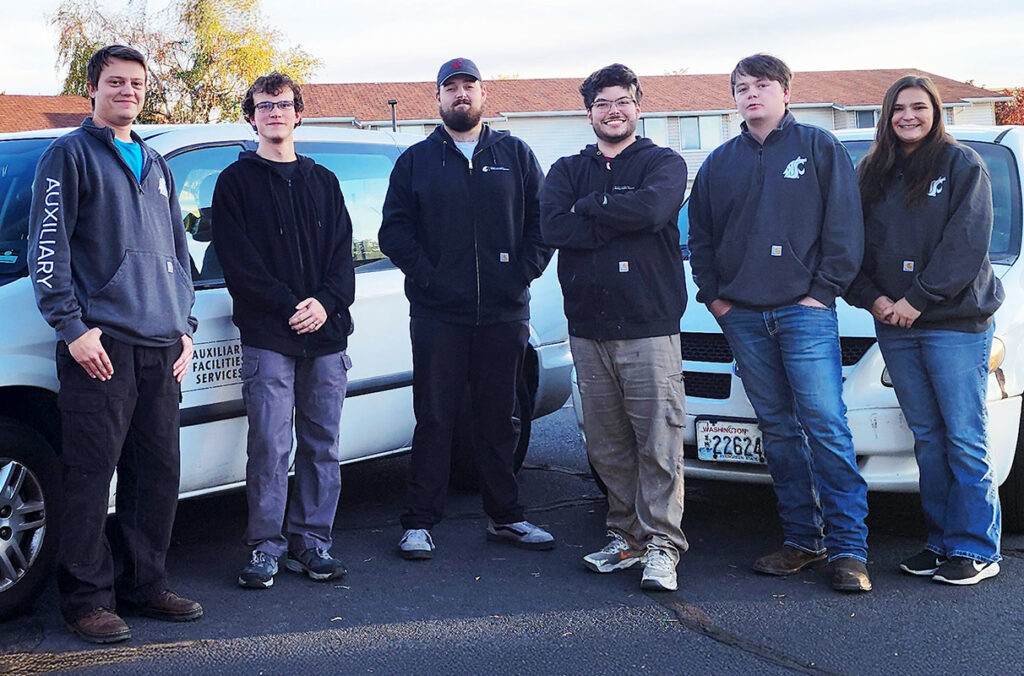
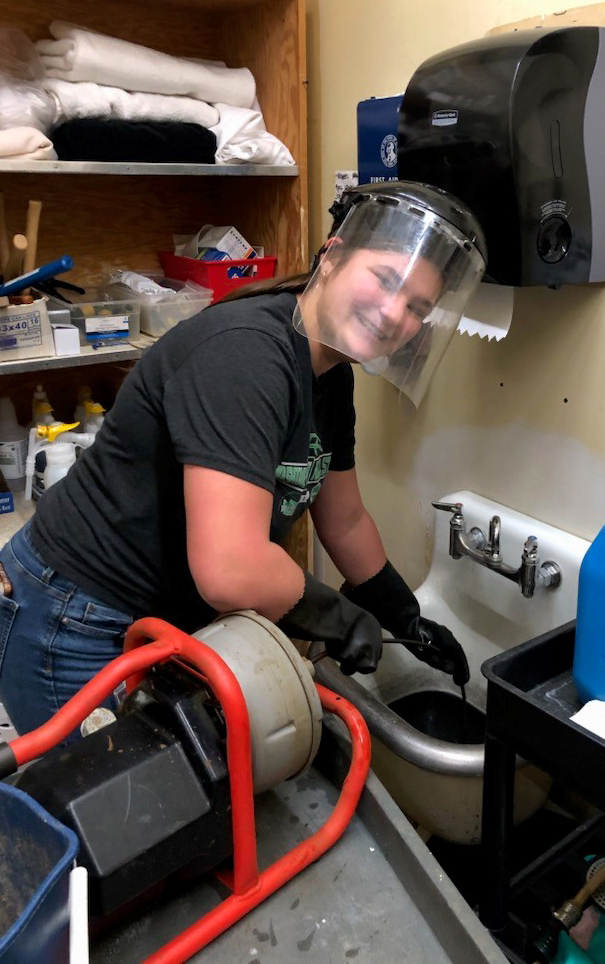
Who are these superheroes hopping from crisis to crisis throughout the night? They are students like Maci Brantner, a senior majoring in psychology, and one of six members of the current troubleshooting team.
“When I first got this job, I was super nervous because there are a million different situations I might encounter,” Brantner said. “But if I have questions or need help, there’s always another team member I can talk to.”
Baier confirmed that sometimes his phone rings at two in the morning, but he never hesitates to answer knowing it is a troubleshooter needing help.
The ultimate problem solvers
Fortunately for Baier, troubleshooters usually know how to handle the situations they encounter due to their extensive training. They learn about safety and health procedures, electrical work, plumbing and sewers, furnaces and water heaters, mechanical room equipment, and kitchen appliance repairs. They are trained by full-time professionals to identify and fix most problems.
“We do so many different things in our jobs, so we never get bored,” said Garrett Newell, a senior majoring in neuroscience. “We are basically problem solvers, and I find that very enjoyable.”
Newell’s problem-solving skills were put to the test in a different way last year when a police officer called to ask if he could remove a chair that had seemingly been thrown into a tree at Scott-Coman Hall. The unpredictability of each night is something he enjoys about the job.
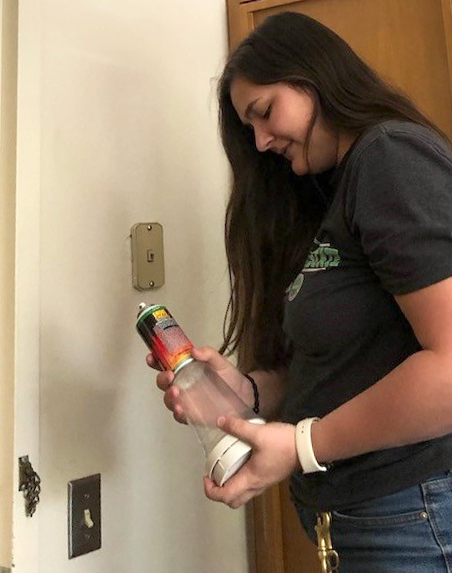
Whatever the problem may be, the troubleshooters usually have what it takes to get the job done. When on a call, they drive a van stocked with plumbing and electrical parts, tools, augers, and personal protective equipment.
Newell and Brantner said it is not the most glamorous job a student can have, but it suits them well. Their work does not interfere with their classes, they get to be part of a supportive team, and they can work during summers, too. They even get to live in a university apartment rent free, in addition to the hourly wage they earn.
“And when our troubleshooters graduate, they leave with more than an academic degree,” Ely said. “They have skills they will use for the rest of their lives.”
AFS is always looking for students interested in becoming troubleshooters and they can apply using WSU’s student employment portal, Handshake. Branter strongly encourages students to apply, even though the job does have its moments.
“Sometimes when I’m unclogging a toilet or wading through nasty water and I’m wet head to toe, I ask myself if this job is worth it,” Brantner said. “And the answer is always the same, it is absolutely worth it.”