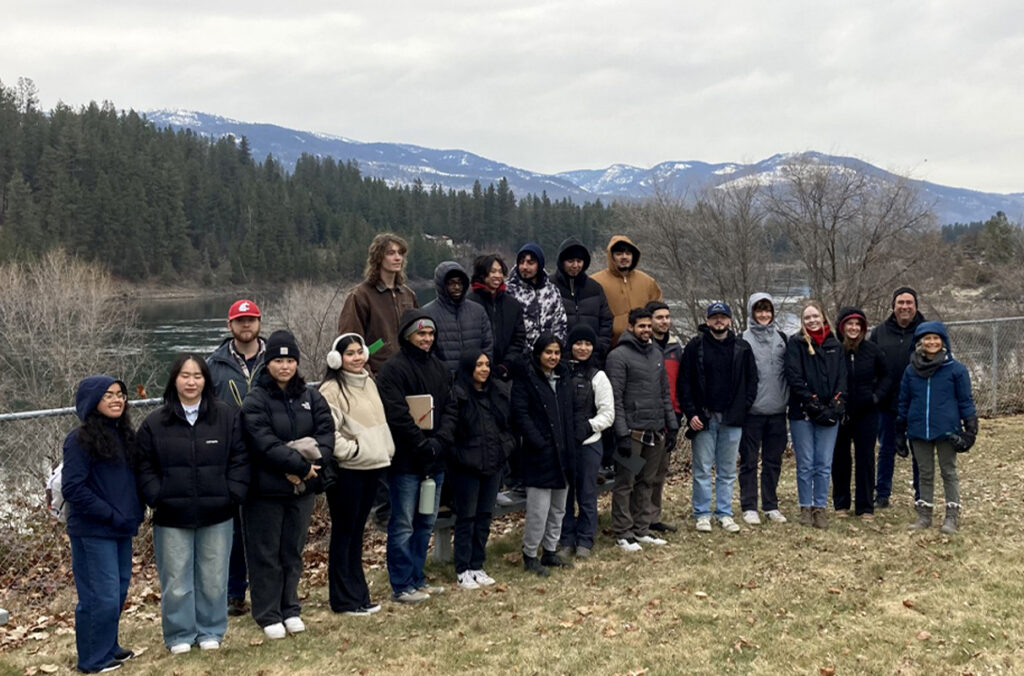
For a group of Washington State University landscape architecture students, their senior capstone project offers a chance to show how they can address complicated real-world issues in the Upper Columbia River Basin.
The students are working with Citizens for a Clean Columbia (CCC), a volunteer organization focused on advocating for the Upper Columbia River, Lake Roosevelt, and associated communities, to explore designs that can contribute to environmental justice and health
“There is an overarching sense of disconnect between the people and the landscape in the region,” said senior Megan Forbes. “Many of us want to focus our designs on reconnection, strengthening the critical bond between humans and nature through ecological restoration, outdoor recreation, and historic Indigenous practices inherently tied to the land.”
The CCC has worked to highlight public health concerns, including hosting riverbank clean-up events and collaborating with Indigenous groups on matters related to the Columbia River Treaty.
The students recently traveled to the region to conduct research for their design projects. There, they spoke with locals, including representatives from Colville Confederated Tribes and volunteers from the CCC and another advocacy group, the Northport Project. They also toured the Grand Coulee Dam and visited important sites along the Columbia River, such as the Sherman Fish Hatchery.
“The Upper Columbia River region is beautiful with breathtaking scenes of mountains, forests, and water,” said Forbes. “The land and its inhabitants are full of life and spirit despite the heartache, pollution, and injustice they have endured over the years.”
For the remainder of the semester, students will define and develop individual design projects informed by their interactions with the community and subsequent research. Broadly, their work will explore remediation, resilience, and adaptation to support the Columbia Basin communities.
Complementing their work in the capstone, the students are developing a framework for a comprehensive plan that embraces a seven-generation mindset. They will present all of their work to community members on April 22.
“The projects in both courses provide an intensified way for students to contemplate how designers can do good in the world,” said Jolie Kaytes, professor in the School of Design and Construction who teaches the capstone course. “They show how design and planning work can be a kind of advocacy and a catalyst for citizen and community engagement.”