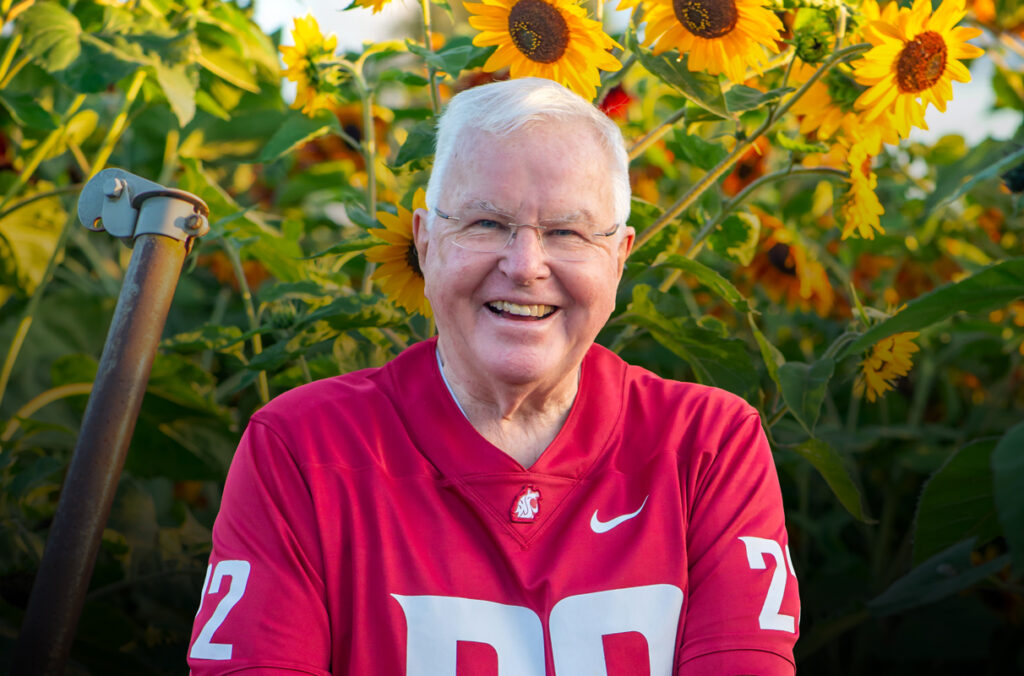
The Department of Physics and Astronomy invites you to a colloquium featuring Dr. Peter Engels, Department of Physics & Astronomy at Washington State University. Dr. Engels will present his talk, “Quantum gas research at WSU: From artificial gauge fields to negative-mass hydrodynamics” Tuesday, February 7 at 4:10 p.m. in Webster 17.
Meet for refreshments before the lecture at 3:45 – 4:10pm in the foyer on floor G above the lecture hall.
Please see abstract below.
“Quantum gas research at WSU: From artificial gauge fields to negative-mass hydrodynamics”
Abstract:
Dilute-gas Bose Einstein condensates (BECs) have emerged as an extremely versatile tool for the investigation of quantum dynamics. BEC experiments provide a unique access to the quantum world and often lead to new insights into a broad range of areas including atomic physics, quantum optics, condensed matter physics, and quantum computation, to name a few. They may also lay the foundation for future generations of sensors and interferometers. In this talk, I present results of our recent work focusing on the quantum analog simulation of condensed matter phenomena using BECs. In this context, one apparent difficulty is that the atoms in a BEC are charge neutral, while for condensed matter phenomena the interaction of charged particles with electric or magnetic fields often plays a key role. This difficulty can be overcome by engineering artificial gauge fields in BECs. I present techniques that we have implemented for the generation of these artificial gauge fields and highlight key results obtained by applying these techniques to problems from condensed matter physics and nonlinear dynamics. Specifically, by exploiting artificial gauge fields we have generated dispersion relations featuring a roton-like minimum and a region of negative effective mass, leading to peculiar quantum hydrodynamic behavior.