The W-S-U Emeritus Society wishes to announce the winners of the 2019 Emeritus Society Excellence in Undergraduate Research and Scholarship Awards. The awards were first presented in two-thousand-nine (2009) to encourage students to strive for scholarly excellence. Each awardee will receive five-hundred-dollars ($500) from the members of the Emeritus Society.
In the category of Biosciences, the recipient is Courtney Klappenback, a junior genetics and cell biology, and microbiology, double major from Clarkston. Her research with mentor Michael Konkel and co-author and alumnus researcher Nick Negretti is titled, “The bacteria that tricks your intestinal cells in order to make you sick.”
Courtney explained that many bacteria that attack your intestine and make you sick must bind to the cells that line your gastrointestinal tract. This leads to symptoms like diarrhea, nausea, fever, vomiting and cramping. Bacteria often manipulate host cells to alter their normal cell behavior and cause disease. Identifying the ways thatpathogens cause disease is the first step in developing treatments to lessen the severity and duration of illness.
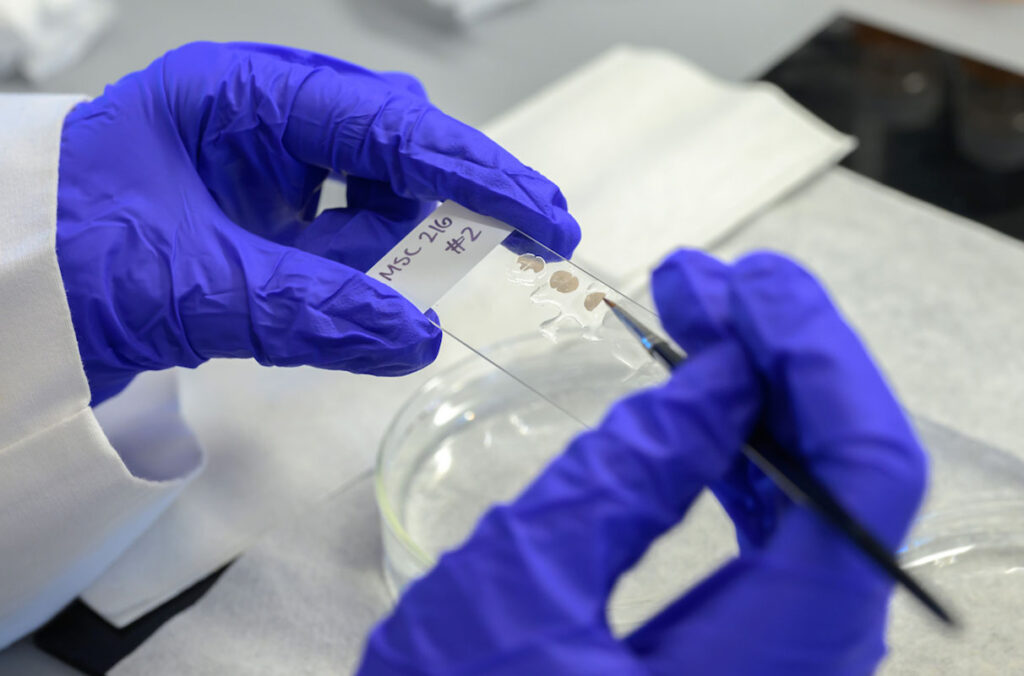
Courtney experimented with Campylobacter jejuni that causes gastroenteritis, or intestinal inflammation. She used low magnification time-lapse microscopy and had results that support the hypothesis that C. jejuni interacts with, and manipulates, focal adhesions during host-cell invasion. C. jejuni attaches to the cells that line your intestinal tract and prevents the cells from being washed away during infection.
In the Physical Sciences and Mathematics category, the recipient is Trevor Foote, a senior physics and astronomy major from Spanaway. With mentor Guy Worthey, he researched “Maximum Luminosity of type 1-A supernova as a function of distance from host galaxy.”
One of the most important parameters in cosmology (that is, the scientific study of the origin, evolution, and eventual fate of the universe) is what is called the “Hubble constant”. It provides the rate at which the universe is expanding, so accuracy is highly important. To calculate the Hubble constant, astronomers have used two different methods—one the benchmark that uses light-curve data from Type I-A supernovae, the other using measurements of the Cosmic Microwave Background (CMB). But the two values don’t agree with one another, having a difference of about nine (9) percent.
Trevor took a closer look at the Type I-A supernovae and host-galaxy survey data to compare maximum luminosity of Type I-A supernovae as a function of its distance from its host galaxy and therefore, by proxy, its metallicity. His results show no direct correlation between metallicity and peak brightness, but did show that across twenty-two (22) different Type I-A supernova, the variation in maximum luminositywas one-hundred-twenty-two-point-zero (122.0) percent. Trevor’s findings remove one potential source of systematic error in the local Hubble constant calculation, but show evidence of a potential issue with the community’s assumption about Type I-A supernovae having uniform maximum luminosities.
In the Arts and Humanities and Creative Activities category, the recipient is Ryan Moore, a political science/pre-law major from North Bend. With his mentor Lydia Gerber, Ryan explored “Notions of Uyghur Identity in Xinjiang and their development in the late twentieth (20 th) century.”
Creating a recent international outcry, “Re-education camps” in Xinjiang are being used (to control a population) by the Chinese government. The supposed aim is to quell dissent in this Uyghur-plurality region of the People’s Republic of China. During the last two decades of the twentieth (20 th) century, the notions of self-identity among Uyghurs in Xinjiang changed, thanks to influence from various geopolitical events in Central Asia [such as the Soviet invasion of Afghanistan in nineteen-seventy-nine (1979)]. The Uyghur’s went from identifying as part of the multicultural and multi-ethnicity policies of a united China, to identifying as a primarily Islamic and Turkic people. The political response of the People’s Republic of China to these developmentshas been to maintain control in Xinjiang and of the Uyghur people and their culture. The current crisis in Xinjiang, Ryan says, can been seen clearly through the historical lens of a changing Uyghur identity.
In the Engineering and Applied Sciences category, the recipient is Jordan Raymond. Jordan is a senior from Issaquah, majoring in mechanical engineering. Her work with mentor Jacob Leachman and co-author Carl Bunge is titled, “Oxygen separation in a vortex tube with applied magnetic field.”
The “large scale and efficiency of air separation units” remain key barriers to modular, distributed liquid oxygen systems. Identifying new physical separation mechanisms, or novel combinations of established methods, could enable the development of smaller, more modular air separation systems.
Jordan investigated the combination of centrifugal separation with paramagnetism of liquid oxygen in a vortex tube. The magnetic field is applied via externally mounted one-point-five(1.5) T-bar magnets along the length of the hot end of the vortex tube. Various calibrated air and Argon-Oxygen mixtures were tested. Gas chromatography analysis on the calibrated air samples shows the magnetic field gradient on the vortex tube produced a sixty-eight (68) percent increase in oxygen separation compared to the non-magnetic trials. Comparisons were made to competing oxygen separation methods. Success! Jordan’s results indicate a potential to increase oxygen purity and yield in a more compact form.
In the Social, Economic, and Behavioral Sciences category, the recipient is Jacquelyn Deichman, WSU Spokane nursing student. The title of her research with mentor Janessa Graves is “Return-to-play legislation and concussions: Are more youth leaving the emergency department without being seen?”
She says that to address the growing incidence of sport-related concussions, all U.S. states implemented return-to-play (RTP) legislation requiring athletes with suspected concussions to be evaluated by a healthcare provider before they could play again. With her co-authors, Jacquie found that between 2006 and 2017, about 1.2 million youth concussions (associated with football, basketball, soccer, baseball, softball, cheerleading, ice hockey, lacrosse, and volleyball) were treated at emergency rooms. The number of emergency-room treated concussions where the patient “left-without-being-seen” has increased over time. Future research, she suggests, should examine impacts of return-to-play legislation on emergency-room utilization and costs.
Congratulations to the 2019 award winners!