Bound for a youth basketball tournament in Carson City, Nevada in 2012, WSU cross country runner Ku Stevens and his family drove through the former campus of the Stewart Indian Boarding School.
“Your great-grandfather ran from here,” Stevens’ father told his then eight-year-old son. “It was a bad place.”
In the years that followed, Stevens learned why his grandfather, Frank Quinn, ran 50 miles from the school to Yerington, the home of the Yerington Paiute Tribe across thousands of feet of elevation change.
Not just once, but three times.
The facility was one of hundreds of government-funded, church-run boarding schools that sought to erase the cultural identity of Native Americans. This was done by taking Native children from their families and tribes and violently punishing them for acknowledging their culture.
In 2021, the unmarked graves of more than 200 children were found on the grounds of the former Kamloops Indian Residential School in British Columbia, Canda. Stevens remembers seeing the outrage of some Americans, presumably unaware that similar atrocities were inflicted upon Native American children here as well.
For more than a century, hundreds of thousands of Native American children were made to live in boarding schools far from their families and tribal communities, according to the National Native American Boarding School Healing Coalition. Unfathomable abuses were carried out under the stated purpose of U.S. government policy at the time: “Kill the Indian, save the man,”
“What I’ve learned opened my eyes to the fact that I’m really lucky to be here,” Stevens said. “I have a strong sense of belonging, knowing that tens of millions of Native Americans were wiped off this continent, and that my blood line has whittled down to men like my great grandfather who are strong enough to remain Native.”
Remembrance Run and ‘Remaining Native’
To honor the legacy of those who endured these schools and bring awareness to history often omitted in textbooks, Stevens and his parents organized a 50-mile Remembrance Run. He was still in high school when the first run took place, and the buzz generated from the event caught the attention of Paige Bethmann, a documentary filmmaker and Haudenosaunee woman.
Bethmann moved from New York to Nevada, documenting the Remembrance Run and Ku’s quest to go from his high school’s only cross-country runner to being a member of the renowned University of Oregon Cross Country Team.
Production moves at the speed of trust, Bethmann said. She spent hours with Stevens and his family, including going on fishing and berry-picking trips. She also opened her home to the 17-year-old, who’d frequently stop by to play video games and eat everything in her fridge.
“I needed to be there, I needed to show up and be just as vulnerable as I was asking Ku and his family to be,” Bethmann said. “It was so important because all too often these stories are taken and the community is left with nothing.”
After more than two years of editing, 290 hours of footage became an 85-minute-long documentary called “Remaining Native,” which premiered at SXSW in 2025. Since then, the film has been selected for showings at film festivals across the country and has been screened for groups across the country.
Journey to WSU
Around fifth or sixth grade, Stevens heard two older guys at a local track meet talking about Oregon being the best program in the country. Stevens wanted to be the best, and so he felt he needed to be with the elite runners.
While Oregon was his top pick, Stevens attracted attention from other schools, including WSU. Cross Country Head Coach Wayne Phipps recalled that a former member of the team from Nevada spoke highly of Stevens.
“You don’t have to talk to Ku for long before you get a sense for who he is,” Phipps said. “Because he was doing so much on his own, you could see he had the work ethic and motivation to be successful as a long-distance runner as well as a student.”
While Stevens was impressed with WSU, he initially chose University of Oregon, red-shirting his first year in Eugene.
Challenges arose right away, from an unexpected transition in coaching staff to struggles with performance targets despite logging 110 miles a week and showing steady improvement. After an injury just ahead of the sport’s outdoor season, he was cut from the team at the end of his sophomore year.
Stevens didn’t take the setback well. During his third year in Eugene, Stevens leaned into the lifestyle of regular college student. But it wasn’t how he wanted to live his life.
“I was tired, fed up, and lacked purpose,” Stevens recalls. “My name, Kutoven, is a title meaning to bring light from the darkness, and I didn’t have that. I knew I needed to make a change.”
Stevens entered the transfer portal, and just a few weeks later, Phipps reached out. After visiting the Pullman campus, Stevens committed to transferring to WSU.

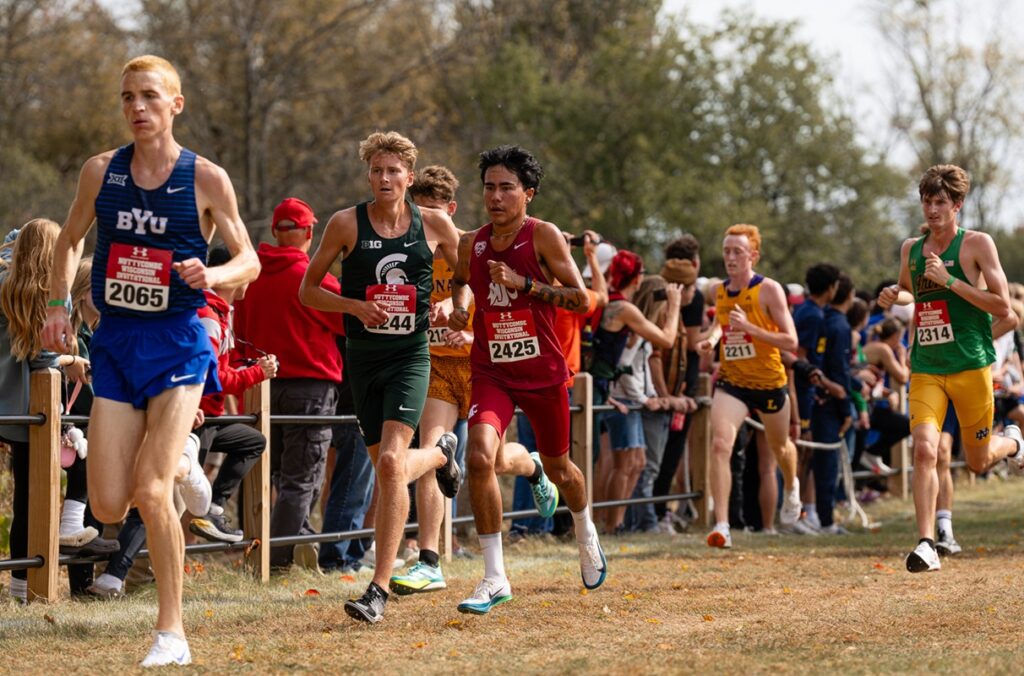
His first season on the team exceeded all of Phipps’ expectations. He became the fifth Native American runner and fourth Nevadan to run a sub-4-minute mile and broke into the top 60 runners in the NCAA.
“Ku was a rockstar for us,” Phipps said. “He provided us with much-needed depth and showed continual improvement that really contributed to us being conference champions and qualifying for the NCAA championships.”
The road ahead
Both Phipps and Stevens have high expectations heading into the latter’s final collegiate season.
“He’s gained so much confidence and found a renewed passion for running,” Phipps said. “With these long runs, you might not enjoy every step and so having this love for what you’re doing makes things so much better.”

But before the season gets underway, Stevens and his family are hosting the sixth-annual Remembrance Run back in Nevada. The 50-mile run will take place over two days. Anyone interested in the event but unable to make it to Nevada can sign up to participate virtually.
At the end of the first day, runners will camp out overnight and share with others why they are taking part in the event.
“A lot of people have ancestors that have been to boarding schools, and so this is an outlet to communicate feelings and share the history of their ancestry,” Stevens said. “It’s something many Native Americans have not had the outlet for, and so it ends up being this beautiful moment.”
Runners will set out bright and early the next morning from the 6500’ basecamp, running in 5-mile segments until they arrive on the Stewart boarding school grounds. At the end of the event, participants will take the tobacco ties they’ve been carrying and leave them on the graves of the children who perished at the school. Tobacco is widely used in spiritual practices by Tribes and Native Nations.
“When you’re tying these tobacco ties, you’re thinking of good energy as well as the ancestors that came before you and the generations that come after,” Stevens said. “It’s a beautiful way of bringing your thoughts and prayers across this journey.”
More information about this year’s Remembrance Run, which take place Aug. 14-16, is available on the “Remaining Native” website.