Editor’s note: The featured image originally published with this story did not meet WSU’s AI guidelines for visual content and has been replaced.
After helping build a journalism program at the American University of Armenia, Washington State University recently brought 11 of its master’s students to the Evergreen State to put their training to work in local newsrooms.
The experience is part of a master’s program developed by WSU’s Edward R. Murrow College of Communication and the American University of Armenia through a $2.3 million U.S. Department of State grant. The visiting students belong to the program’s first class, expected to graduate this spring.
The students were placed at The Seattle Times and The Spokesman-Review, as well as Spokane television stations KHQ, KREM, and KXLY. Others joined The Wenatchee World and the Lewiston Tribune.
Their assignments helped them get to know the region. A KREM television piece explored how the owner of Spokane’s Skewers restaurant brings people together over Armenian food. A Spokesman Review story took readers through a first visit to the Spokane County Interstate Fair, where a reporter encountered llamas and discovered fried cheese curds with ranch dressing for the first time. Other work included a Lewiston Tribune story on young rodeo riders keeping traditions alive in Pomeroy.
The partnership continues the Murrow College’s international journalism education work. Lawrence Pintak, a WSU communication professor and former Murrow dean, spearheaded the Armenian program and previously led a Murrow partnership with a journalism program in Serbia. He also helped develop Pakistan’s first professionally focused journalism master’s at the Institute of Business Administration in Karachi.
A former CBS News Middle East correspondent, Pintak was also previously director of the Kamal Adham Center for Journalism Training and Research at the American University in Cairo. His efforts there emphasized practical instruction, an approach carried into Pakistan, Serbia, and Armenia.
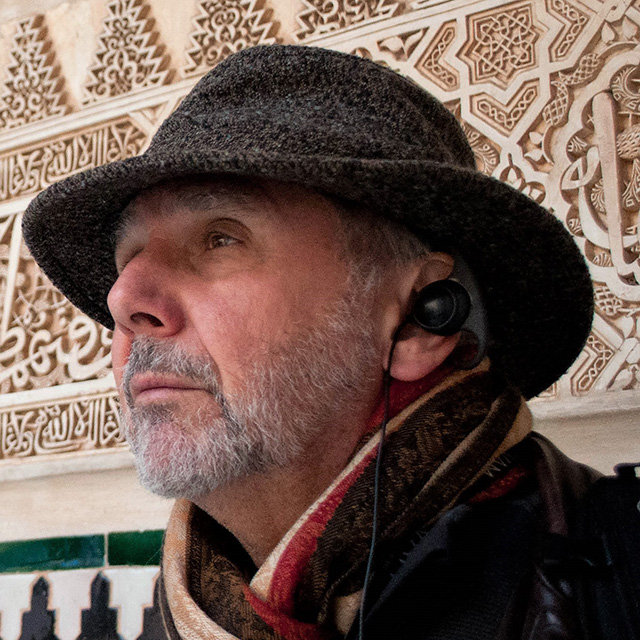
“We are a land-grant university, first and foremost serving the state,” Pintak said. “But we can use our knowledge to serve others abroad, help other universities grow their programs.”
For Roza Chibukhchyan, who spent her three weeks at KXLY, the visit reinforced an interest in journalism she once thought unlikely.
After earning a bachelor’s degree in English and communication at the American University of Armenia, she was looking for a master’s program that could help her work toward a doctorate. She had enjoyed an undergraduate journalism course but viewed the profession in Armenia as too politicized.
The new program’s curriculum persuaded her to reconsider. Its multimedia courses suited her interest in creating digital content, while its approach to reporting showed her that journalism could help people make sense of events without serving a political agenda.
“I had such a deep sense of frustration with the industry overall. I stayed away from it,” she said. “But when I was introduced to how it actually was supposed to be … I was like, ‘OK, I could get behind this.’”
Chibukhchyan pitched and reported a television story for KXLY about Washington’s debate over natural gas access for homeowners, including wildfire survivors rebuilding in Spokane. The Sept. 30 broadcast also highlighted WSU’s role in bringing the Armenian students to Washington newsrooms.
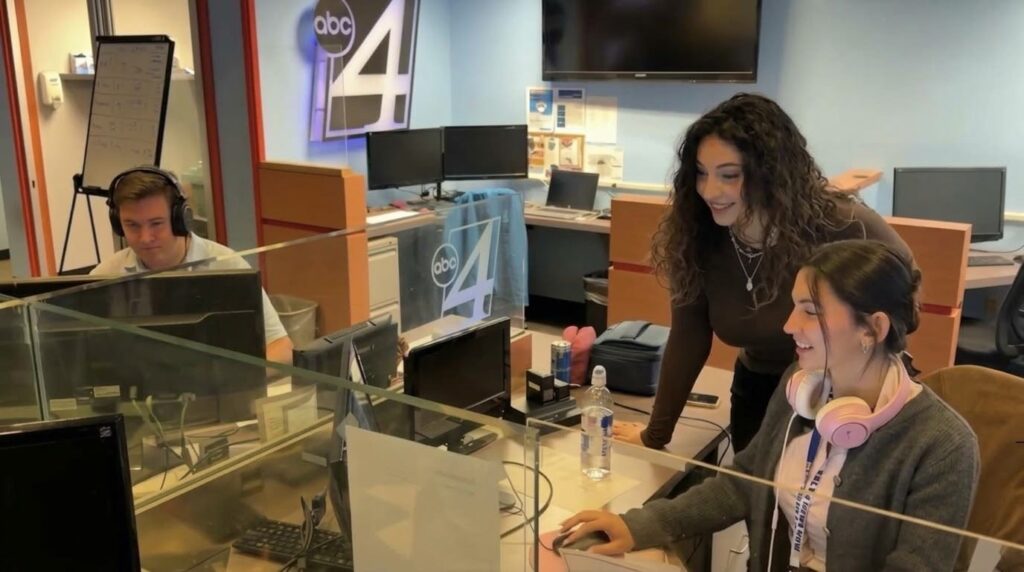
Other highlights of Chibukhchyan’s experience included a 3:30 a.m. start to cover a Greek festival’s 90th anniversary for social media while shadowing a reporter delivering eight live reports in four hours. Drawing on a classroom exercise, Chibukhchyan also built an AI persona designed to emulate KXLY’s target viewer to help her gauge which story ideas might resonate with an unfamiliar audience.
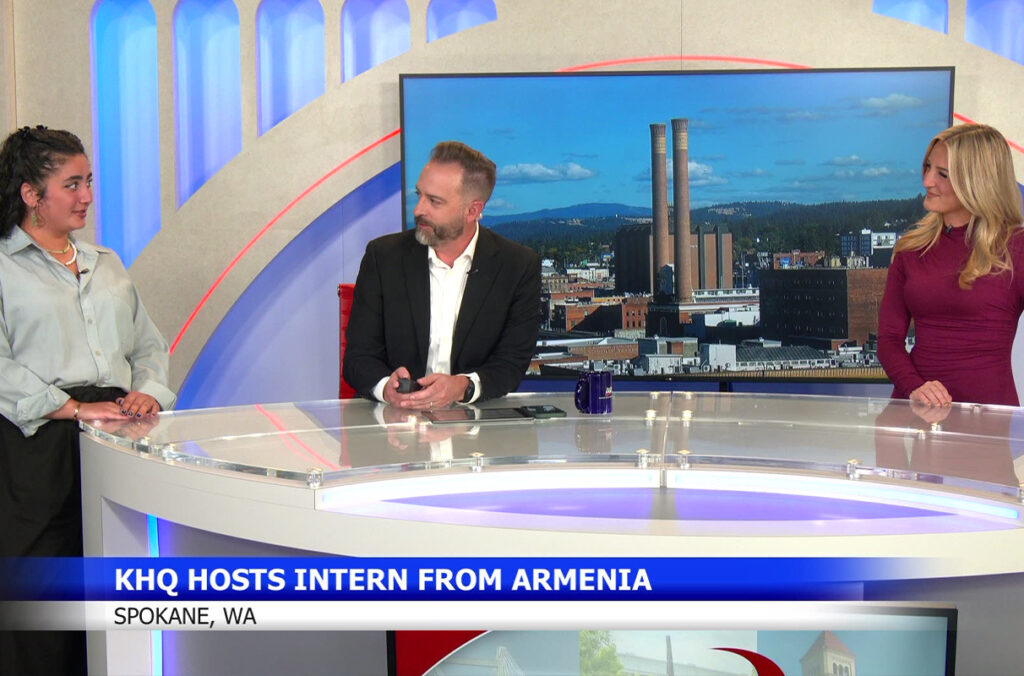
At neighboring Spokane television station KHQ, Lori Ishilian arrived with experience in marketing and public relations at the American University of Armenia. She had helped promote the master’s program before deciding to enroll herself.
“I was already in storytelling, and I just wanted to look at it from a different angle,” she said.
At KHQ, Ishilian practiced presenting “The Pulse,” a five-minute news update, while getting a close look at the teamwork behind a television broadcast. Her coursework in Armenia had moved her between the anchor desk and production jobs behind the camera, helping her understand how each person’s work contributed to what viewers saw.
“There are so many people involved in getting one story out, even a two-minute package,” she said. “It’s really interesting to see how everything is so fast-paced.”
Her biggest highlight was going on air during KHQ’s 4 p.m. newscast on Sept. 30.
“I had spent the three weeks moving around the newsroom, watching producers build shows, working in ENPS, going out with reporters, filming, editing and practicing The Pulse, so actually being on air felt like everything coming together,” Ishilian said.
Ishilian also created a video about her experience in Spokane, which KHQ later shared on its Instagram and featured on its newscast.
Beyond the newsroom, students remarked on the welcome they received. Chibukhchyan arrived expecting Americans to be more distant. Instead, she found a welcome that challenged what she thought she knew from years of watching American media. “I’m really pleasantly surprised by how the average person is so nice and friendly,” she said.
For Ishilian, the welcome extended beyond the newsroom to small encounters with strangers. “You can just walk on the street and someone can compliment you,” she said. “It can make your whole day.”