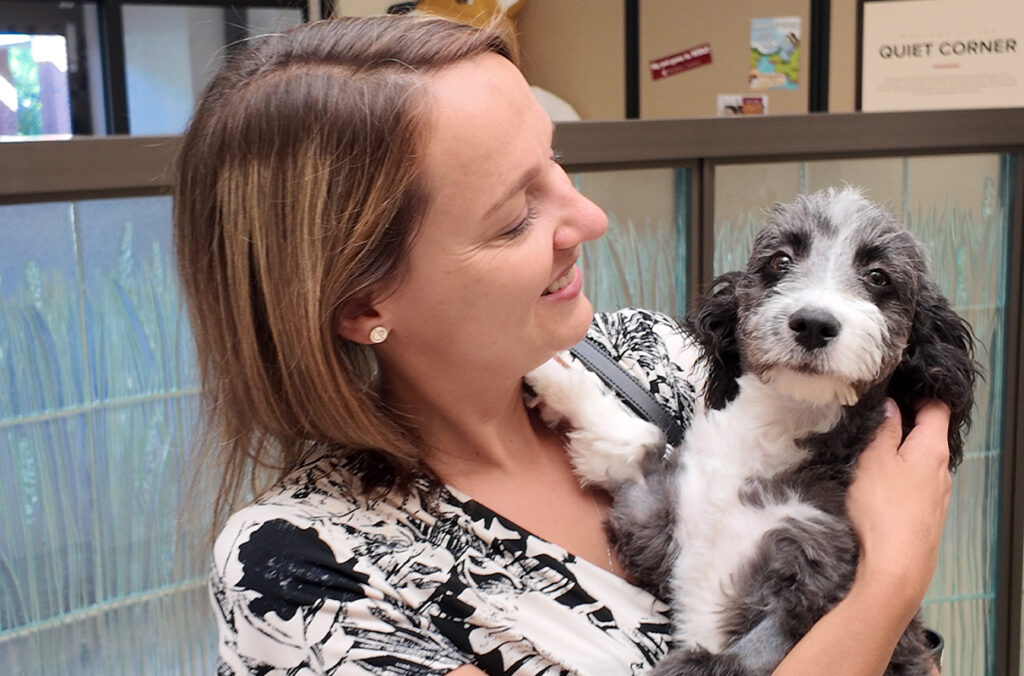
A puppy saved from a hoarding situation has overcome a life-threatening heart defect and found a forever home with the Washington State University veterinarian who first stepped in as his medical foster.
The young poodle mix, initially named Pepe but now known as Teedee, was among 38 dogs and puppies rescued this summer from a hoarding case in Benewah County, Idaho, by the Idaho Animal Rescue Network. During an initial examination by WSU veterinarians assisting with the case, clinicians detected a significant heart murmur that led to the diagnosis of patent ductus arteriosus, or PDA, a congenital heart defect that can be fatal if left untreated.
After community fundraising efforts helped cover the cost of care, Teedee underwent a minimally invasive procedure at WSU’s Veterinary Teaching Hospital to correct the defect. He is now expected to live a normal, healthy life.
“He’s such a sweetheart,” said Laura Williams (’13 DVM), a WSU veterinary pathologist who volunteered to serve as Teedee’s medical foster after his diagnosis and has since adopted him. “He loves people. He loves my other dog. He loves the cat. Everybody in the household has fallen in love with him.”
Teedee’s rescue began when dozens of dogs were removed from a home where animals were living in severely neglected conditions. The Idaho Animal Rescue Network took custody of the dogs and worked with WSU veterinarians to assess their medical needs.
Although Teedee appeared and acted healthy, WSU veterinarian Dr. Cassidy Cordon detected a heart murmur, which during a follow-up examination was confirmed as PDA, a condition in which a blood vessel needed before birth fails to close, forcing the heart to work harder and eventually leading to heart failure if untreated.
“We initially stuck him in medical foster, aka my house. You never would have known anything was wrong with him. He played and ran as hard as all his littermates,” Idaho Animal Rescue Network Director Jenna Redheart said. “But we knew we needed a very specific medical foster because after the surgery he had to stay very still and quiet for 30 days. So, we got the word out and received a lot of responses.”
One of those responses was from Williams. After having recently lost her 12-year-old dog, Duke, she had come across a social media post about Teedee and his need for a medical foster. She couldn’t shake his resemblance to Duke.
“He looked so much like Duke,” Williams said. “I felt like it was my calling to do it, a way to honor Duke. It felt right.”
Williams also was a strong candidate since she was not only a veterinarian, but she also was employed at WSU’s Washington Animal Disease Diagnostic Laboratory, just a short walk away from WSU’s Veterinary Teaching Hospital where Teedee would have his surgery.
Teedee moved into Williams’ home a few weeks before surgery and quickly bonded with her 5-year-old dalmatian, Lelu.
His surgery was eventually performed by cardiology resident Dr. Sarah Bayles under the supervision of Dr. Ryan Baumwart. The procedure and recovery went smoothly, and follow-up evaluations showed excellent results.
Keeping the energetic puppy calm proved to be the biggest challenge during the recovery period.
“The hardest part was keeping him quiet,” Williams said. “The next day, if I had let him, he would have been doing zoomies and circles all over.”
Teedee is now fully recovered from his surgery and has found a home with Williams and her family.
“I’m really thankful to the rescue for saving Teedee and his littermates,” Williams said. “I’m also so glad the PDA was caught by our veterinarians and that we could get that fixed. He’s been thriving ever since.”
Redheart said WSU plays an important role in the rescue’s work, from assessing newly rescued animals to treating some of its most medically challenging cases, like Teedee.
“Having a facility like WSU nearby makes an enormous difference,” Redheart said. “We’ve had all kinds of cases there, and they’ve made life-changing differences for so many animals.”