Robert Shields liked to chronicle what he read, often describing exactly what newspapers, books, or magazines he read each day. His prodigious diary — all 37.5 million words worth — contains many quotations from literature, the Bible, and other notable works.
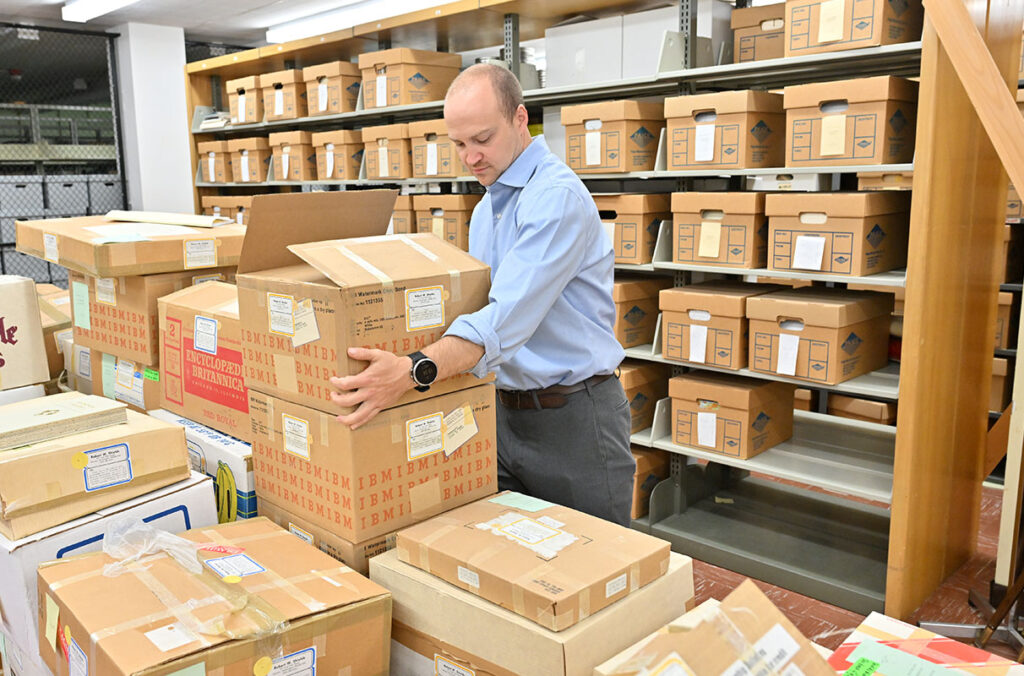
Washington State University Manuscripts Librarian Will Gregg is just starting to catalog the typewritten life’s work of the Dayton, Washington resident, businessman, minister, and teacher.
The Shields collection is remarkable as not just the longest diary of its kind but as a detailed record of an ordinary family, Gregg said. Much of the documentation preserved in archives is associated with an event or person of lasting political or cultural importance. Records of everyday life are not as common.
“For that reason, Robert Shields’ minute-by-minute diary provides a unique account of everyday life in our region for nearly 30 years and gives us a way of seeing historical events through different eyes,” Gregg said. “We hope that the collection will appeal to people in several disciplines at WSU and elsewhere.”
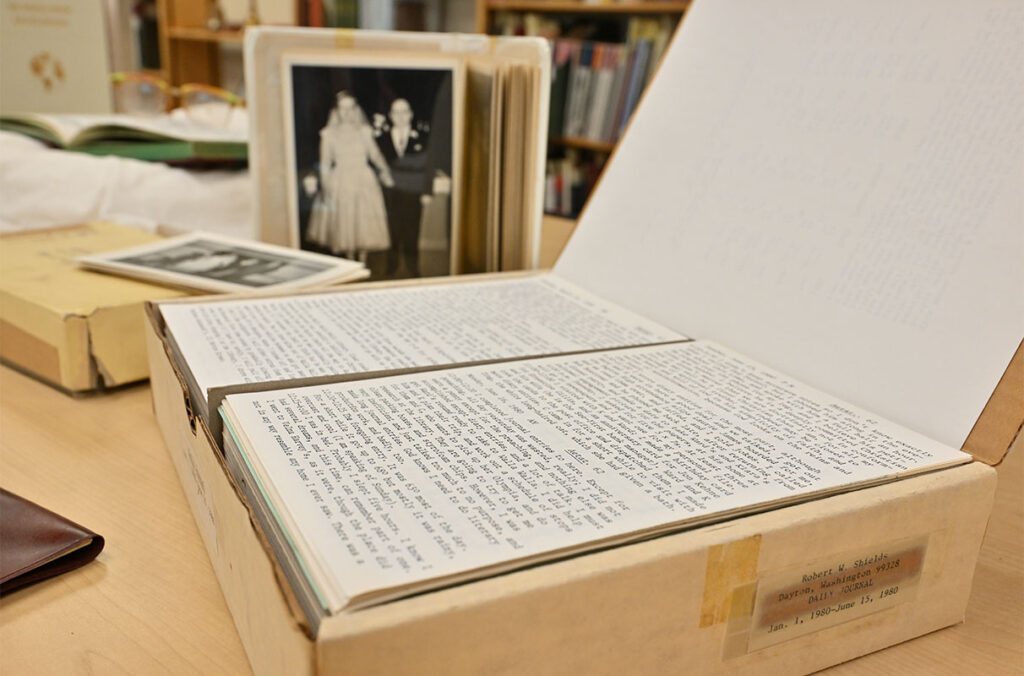
The cataloging work was made possible with the Robert and Grace Shields Library Endowment, which the husband and wife established when Shields donated his diary in 1999. The diary is collected in 96 boxes in WSU Libraries’ Manuscripts, Archives, and Special Collections. Shields asked that his work be closed until both he and his wife died. Shields passed away in 2007 and his wife, in April 2024.
The $245,253 endowment will primarily be used to process, index, and house Shields’ diary as well as other related costs. When that process is complete, the remainder of the endowment will support other MASC needs, including the enrichment of collections, specialized library equipment, and support for visiting speakers.
Gregg said the Shields collection is not only large but also complex: In addition to the diary for which he is known, Shields included photographs, letters, books, pamphlets, receipts, and even a pair of eyeglasses. Preparing the collection will entail sorting content into several major groups or “series,” moving the material into archival-quality boxes and preparing a well-researched guide to the collection that will inform readers about its contents as well as its overall scope and historical background. (A preliminary guide to the Shields papers is located on the Archives West-Orbis Cascade Alliance website.)
Anyone interested in working with the collection is asked to make an appointment with MASC.
Well remembered in his town
Shields and Grace had three daughters, all of whom attended and graduated from WSU: eldest Cornelia Shields (1984, English, history minor) and identical twins Klara Shields Hicks (1985, psychology, speech communications minor) and Heidi Shields (1985, zoology, French minor). Cornelia owns a publishing company. Hicks is an attorney with the U.S. Postal Service, and Heidi practices family medicine at Saint Alphonsus Nampa Hospital in Idaho.
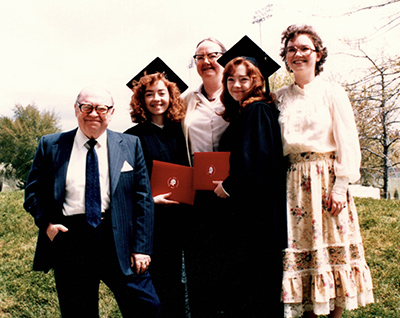
The family moved to Dayton in 1969; Cornelia remembers her father’s writing becoming more detailed around 1972.
“[His diary] does capture certain aspects of people’s lives, but not always fairly,” she recalled. “It gives a good picture of life in southeastern Washington during the time it was kept, what people did, and to some extent their opinions.”
Hicks remembers Shields’ IBM Wheelwriter running 24/7, “a comforting sound…the sound of my childhood.”
“What value can you place on effectively having a window into your father’s thoughts and feelings and hearing his voice years after he passed?” she said. “With the advancements in technology, perhaps this will be something that is taken for granted by Millennials, but as for me, my dad was way ahead of his time.”
Shields was forced to stop writing his diary after he suffered a stroke in 1997. In a StoryCorps segment recorded by National Public Radio and aired in 1994, interviewer David Isay asked Shields what it would do to him if he just stopped. The diarist responded, “It would be like …turning off my life.”
That year, several national media outlets covered the story of the small-town retiree and his very unusual diary. Some of the coverage did not represent the man Heidi remembers. She hopes future WSU Libraries’ patrons reading her father’s words will see him differently.
“I think if they look at parts of his diary, they will think of him as some sort of strange, obsessive, eccentric creature who recorded his life minute by minute, having no time left to live it. That couldn’t be further from the truth,” Heidi said. “He is well remembered in our town by his students, neighbors, and friends. He really cared about people, and that came across in the way he interacted with them. He was funny and always full of energy, and people loved him. I hope that comes across in his diary.”