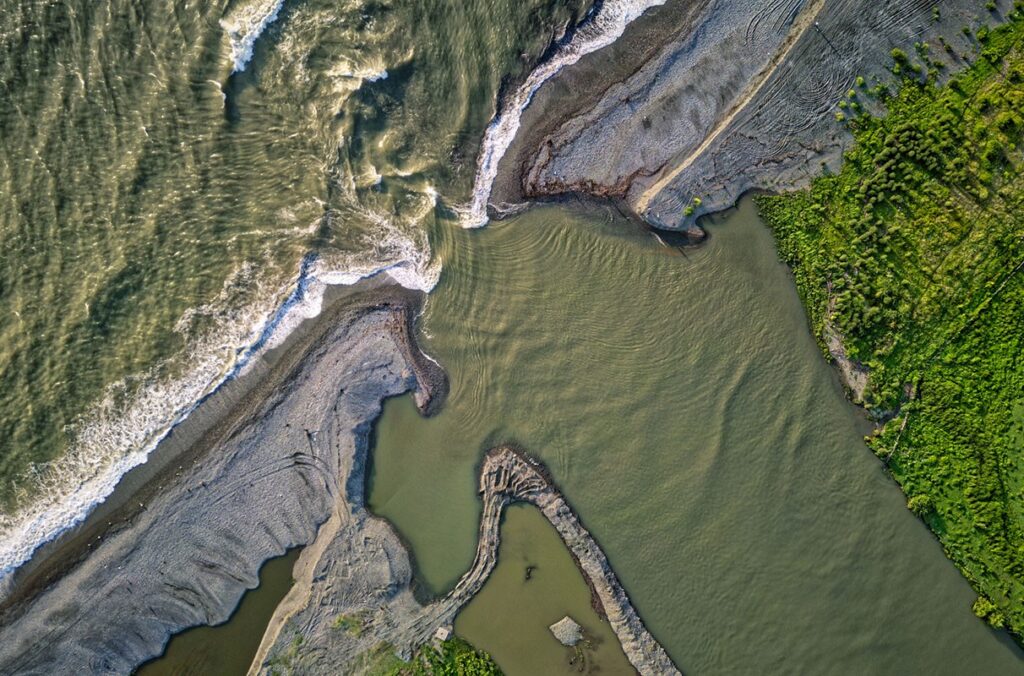
VANCOUVER, Wash. — Along a quarter of the planet’s coastal waterways, humans contribute more harmful nitrogen – via agricultural runoff, wastewater discharges and other activities – than all natural sources combined.
That is a key finding from a new study, led by Washington State University, that measured and mapped the human impact on nitrogen, phosphorus and silicon inputs to the planet’s coastal waters, which can have a destructive impact on marine life, as well as health risks for people.
“Coastal ecosystems provide food, jobs, and recreation for billions of people worldwide, but these coastal waters are threatened by nutrient pollution that can fuel harmful algae blooms, oxygen-depleted dead zones, and biodiversity shifts,” said John Harrison, the corresponding author of the new publication and Edward R. Meyer Distinguished Professor in WSU’s School of the Environment, where he directs the Global Change and Watershed Biogeochemistry Laboratory.
The study, published in the journal Global Biogeochemical Cycles, found that human activities outpace all natural nutrient sources in many coastal waterways, and that land-based sources of the nutrients — both natural and human-caused — contributed more than marine sources in roughly half the planet’s coastal waters.
The good news: Reducing nutrient discharge can make a big difference, and the research pinpoints where such steps may be most effective.
“Getting a handle on nutrient inputs to the coastal zone and mitigating them is important, but we need to be sure that we invest our resources where it’s going to make a difference,” Harrison said. “This work provides a first cut at a framework to use resources to manage coastal zones efficiently.”
Harrison’s co-authors included scientists from Utrecht University in the Netherlands, and Zhejiang University in China.
Levels of nitrogen, phosphorus and silicon, as well as their ratios to each other, are key for healthy marine life. The nutrients occur naturally, in both the ocean and on land, but human activities contribute substantially as well. Among some oceanographers, Harrison said, the idea that land-based sources are a dominant factor was considered unlikely, given the vast size of the ocean.
“I really wanted to understand whether that worldview was correct or whether the community of scientists that studies coastal impacts of land-based nutrients was correct in thinking that these nutrient inputs were really important,” Harrison said. “So, this is a first attempt to put together what we know about what’s coming from land with what we know about what comes from offshore sources.”
Humans add nitrogen and phosphorus to rivers in several ways, including fertilizer and manure runoff from farms, wastewater emissions from sewage systems, urban runoff from city lawns and streets, and emissions from cars and power plants.
Past studies have evaluated the overall global effects of human activity on nutrient levels; the new study is the most comprehensive to date, in that it includes both land-based and marine sources of multiple nutrients.
Researchers developed a novel database of global sources of nitrogen, phosphorus and silicon levels across pre-industrial and contemporary time spans and evaluated the contribution of land-based human activities, as well as the impact on nutrient ratios and the potential for eutrophication, a condition promoting algae growth.
While natural marine sources were still the largest overall contributor of nutrients, land-based sources made up the majority of nutrients for more than half the world’s coastlines, the researchers found.
The effects were more pronounced in concentrated areas of human impact. Human activities added more nitrogen than all natural sources in a quarter of coastal waterways and a fifth of large ocean areas extending outward from the coasts known as Large Marine Ecosystems. In terms of phosphorus, human activities contributed more than natural sources in 11% of coastal waterways.
The influence of human activity on silicon tends to move in the other direction, lowering silicon levels. One way that occurs is with river dams blocking the flow of silicon to the coasts.
The study pinpoints areas of greatest concern, including the Gulf of Mexico and coastlines around Europe and Asia.
Several strategies could be adopted to reduce the nutrient load going into rivers, ranging from advanced technology in wastewater plants to improved fertilizer management and no-till farming. The study identifies areas where the health of coastal waters could be directly improved by changes in human contributions.
“There are a number of stretches of coastline globally where a significant increase in nutrient inputs to land would put it in the danger zone, and a significant decrease would take it out of the danger zone,” Harrison said. “So, this work identifies where the situation can be reasonably addressed versus where high natural background nutrient loads are likely to complicate nutrient management efforts.”
Media Contacts
- John Harrison, WSU School of the Environment, john_harrison@wsu.edu
- Shawn Vestal, WSU News & Media Relations, shawn.vestal@wsu.edu