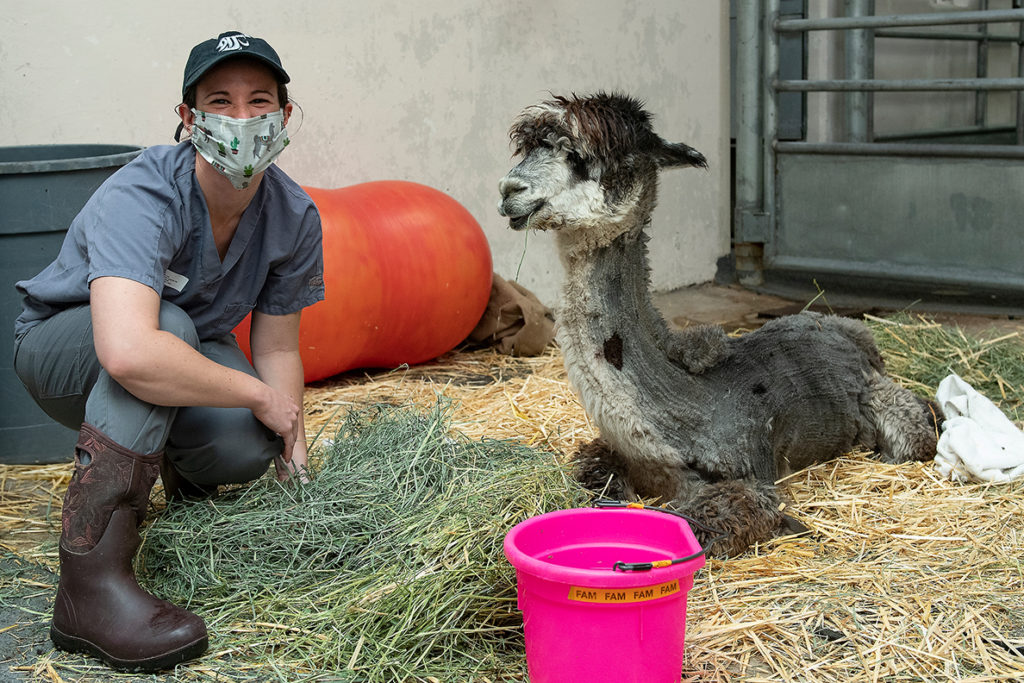
PULLMAN, Wash. – Warming weather in the Pacific Northwest has brought the first case of tick paralysis to Washington State University’s Veterinary Teaching Hospital.
The patient was a 3-year-old alpaca named “Rose,” admitted on April 8. It took more than a hundred sets of hands searching the animal’s thick wool and a subsequent shearing before the tick on her neck that was causing the problem was located.
Tick paralysis is a somewhat uncommon but potentially fatal disease that can affect virtually all warm-blooded land animals and people. The illness occurs when certain species of ticks inject potent toxins from their salivary glands into the host animal.
Each spring and summer, WSU’s veterinary teaching hospital sees or provides consultation on several cases of tick paralysis in llamas and alpacas. Cases occur throughout the Northwest. Occurrence however is sporadic and difficult to predict because the toxin does not occur in all tick populations all of the time or in the same local regions.
“Llamas and alpacas seem to be particularly susceptible to the effects of the toxin and we still don’t know why,” Catherine Krus said. Krus is a veterinarian and the current large animal intern in WSU’s Agricultural Animal Service.
“This was the first case I’ve ever seen, and I was amazed at how quickly the animal deteriorated and then again how quickly she returned to normal after the tick was removed,” Dr. Krus said. Rose was discharged on April 12.
The disease was first identified in Australia in 1824. Since then, more than 60 species of ticks worldwide have been identified as toxin producers.
At least two prominent species of ticks among the known toxin producers are native to North America, including the Pacific Northwest. In North America, ticks actually transmit more disease than mosquitoes.
“Symptoms of tick paralysis include a rapidly progressing total paralysis over 24 to 72 hours after the ticks attach themselves to the animal,” Dr. Krus said. “Left untreated, an animal may be unable to chew, swallow, drink or breathe as the paralysis progresses to the respiratory system. When the breathing mechanism is paralyzed, the animal can die.”
Death rates for tick paralysis have been reported as high as 10 percent or more in humans and around 7 percent in domestic animals. Medical literature shows that in most human cases of the disease, only a single tick was found on the patient.
Tick removal
Ticks are best removed with curved tweezers, forceps, or gloved fingers. The tick should be grasped close to the skin and pulled with steady but gentle traction to ensure all the mouth parts come off with the entire tick.
Other methods of tick removal famous as folklore, such as applying a lighted match or petroleum jelly to the tick, are not effective.
After removing a tick, people should always wash their hands thoroughly with soap and water.
That was also the case with Rose.
“As concerning as tick paralysis sounds, treatment is effective and reversal of the paralysis can be rapid with an excellent prognosis,” Dr. Krus explained. “The key is to remove the ticks and provide supportive care working with your veterinarian. In Rose’s case, she received supportive care and physical therapy to help prevent deterioration and restore function to her body and legs.”
Recovery occurs very quickly in most animals and people within 48 hours, but llamas and alpacas seem to be hit a bit harder than other animals for reasons not well understood.
“Complete recovery could take up to several weeks in those species, but Rose bounced right back.”
Media contact:
- Charlie Powell, WSU College of Veterinary Medicine, 509-335-7073 or charlie_powell@wsu.edu