PULLMAN, Wash. – Washington State University researchers have developed a new approach for studying Cryptosporidium, a waterborne gastrointestinal parasite now recognized as one of the leading causes of potentially life-threatening diarrheal disease in young children worldwide.
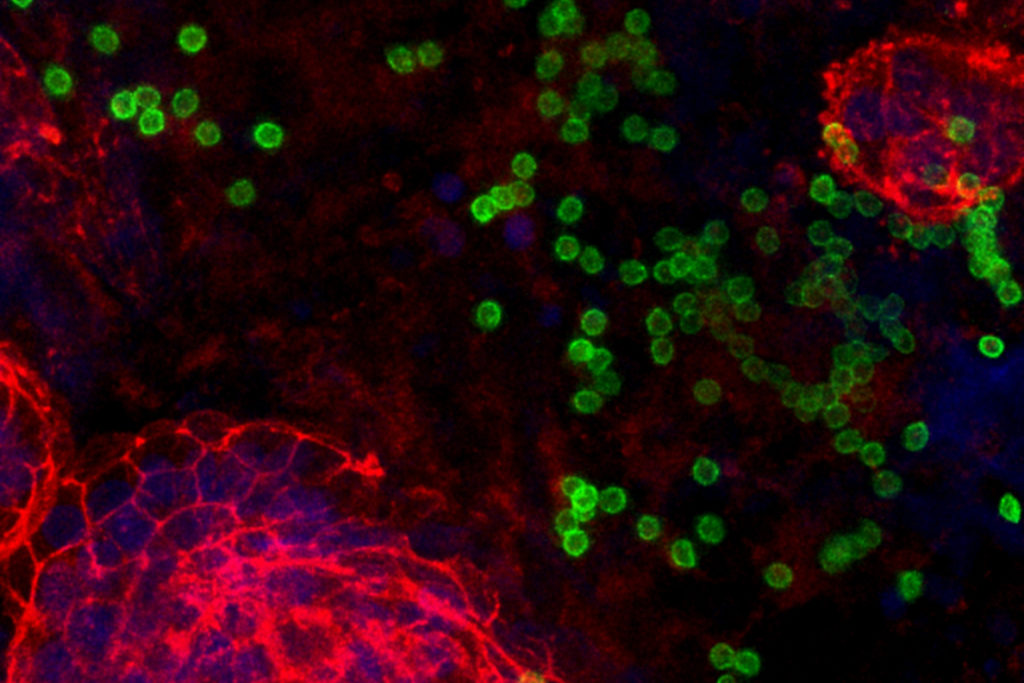
Published today in Nature Microbiology, Roberta O’Connor and Greg Bowden of the Department of Veterinary Microbiology and Pathology in WSU’s College of Veterinary Medicine, in collaboration with Hans Clevers’ group at the Hubrecht Institute in the Netherlands, announced their success in propagating Cryptosporidium in lung and intestinal organoids, mini-organs derived from human tissue biopsies and grown in 3-Dimensional structures in the lab. Organoids are, by far, the closest researchers can get to replicating the in-vivo architecture of human tissues.
In this study, researchers demonstrate for the first time that both lung and intestinal organoids will support the complete life cycle of Cryptosporidium, providing a near perfect mimic of actual human infection. The organoid system can now be used to dissect the parasite’s interactions with normal host cells and ultimately microbiota and immune cells can be incorporated into the system. Most importantly, the organoid culture system provides a rigorous platform for the testing of drugs and identification of vaccine candidates.

“Cryptosporidium infections can result in life-threatening severe diarrhea, particularly in those with compromised immune systems such as AIDS patients, malnourished children, and the elderly; severely immunocompromised people can even develop respiratory cryptosporidiosis” stated O’Connor, Ph.D., an associate professor with the Veterinary Medicine Program. “With this tool we can now study this complex parasite without the former barriers and understand its lifecycle in healthy human tissues that will lead to new treatments or interventions.”
Currently, there are no vaccines to prevent this disease and the only approved drug is ineffective and does not work in immunocompromised patients. Because advances in therapeutics and vaccines have been greatly hampered by the intractability of the parasite, especially the inability to culture the complete life cycle in the lab, the WSU researchers have prioritized developing new tools to study this parasite.
Contact:
- Laura Lockard, communications director, WSU College of Veterinary Medicine, (206)861-6884, laura.lockard@wsu.edu