Schweitzer Engineering Hall is more than just a new building. It’s a first-of-its-kind student-focused hub of learning and innovation, featuring an array of spaces specifically designed to encourage collaboration and project-based learning.
Unveiled last month to fanfare and donor appreciation, the importance of SEH to the Voiland College of Engineering and Architecture, its students, faculty, and researchers is obvious. Less evident is the novel method being employed to heat the building. It’s an approach that might one day transform how building temperatures are controlled across the Pullman campus.
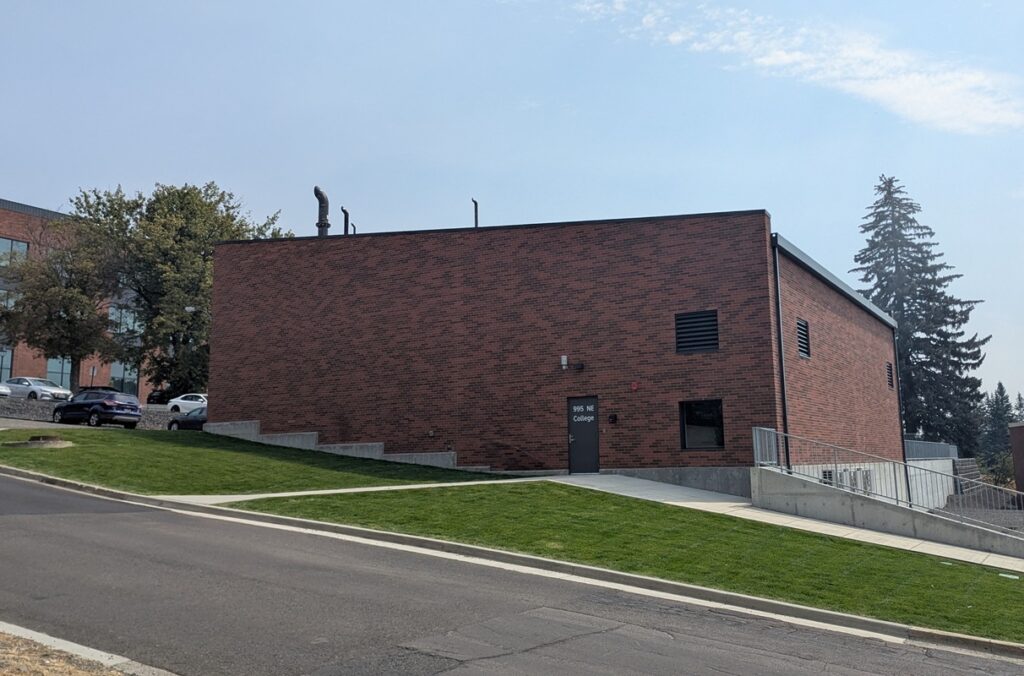
Washington State University recently completed the initial phase of its first Nodal Utility Plant using approximately $14 million in state support. A portion of the funding was connected to the construction of SEH, with the rest coming from a separate funding request related to the university’s decarbonization efforts.
The full operationalization of the university’s first Nodal Utility Plant would offer a window into how the campus’ energy needs could be met in a more environmentally friendly manner.
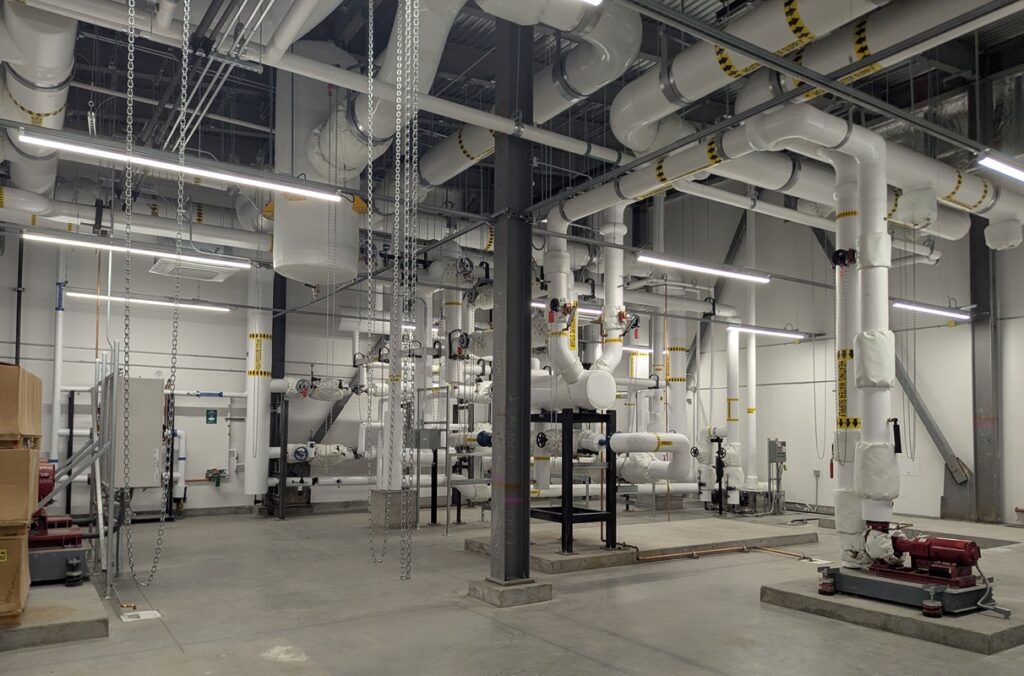
As part of its decarbonization planning, the university is examining how it might provide heating and cooling to buildings by dividing the Pullman campus into several energy districts. These districts would have 10-12 buildings connected to each Nodal Utility Plant, which would provide heating to campus with much lower carbon emissions than the current steam system.
Under the State of Washington’s Climate Commitment Act, WSU must make substantial strides in reducing its carbon footprint. WSU is considered a covered entity under the CCA because its greenhouse gas emissions exceed the 25,000 metric tons of carbon limit. Currently, the Pullman campus contributes more than 65,000 metric tons, with its natural gas boiler system alone accounting for approximately 50,000 metric tons of carbon annually.
Throughout most of its existence, the Pullman campus was heated with coal, first with coal stoves and accompanying smokestacks in each building, and then coal-fired boilers. The boilers sent steam heat to buildings across campus and were converted to using natural gas instead of coal in 2003.
Once fully completed, Nodal Utility Plants would use a combination of air and ground-source heat pumps to heat and cool campus buildings more efficiently. In simplistic terms, air-source heat pumps provide heating by using outside air to warm a refrigerant. After being further heated using a compressor, the refrigerant transfers its energy into hot water, which is then distributed to buildings as a heating source. The process can also be reversed to provide cooling.
WSU’s Nodal Utility Plant is expected to install its first air-sourced heat pump next year, and the plant is currently only providing heat to SEH. To connect additional buildings to the first NUP, or to make use of potential ground-source heating, significant additional investment is needed, according to Jeff Lannigan, Associate Director of Utilities and Energy.
“Ground source heating is more efficient yet and can be scaled up more effectively than air source, but is also more expensive. And any heat pump solution requires significant work to convert building systems from steam and connect them to these new plants,” Lannigan said. “Fortunately, this work would also help to address longstanding deferred maintenance on many of our campus buildings.”
Adopting a nodal utility model would also require significantly more electrical power. Currently, the Pullman campus uses up to 30 megawatts of electricity from Avista at peak, roughly equal to the peak usage of the City of Pullman. That peak usage would likely need to double to fully carry out the university’s decarbonization ambitions, likely requiring utility infrastructure upgrades by Avista.
Efforts to decarbonize the Pullman campus will likely take two to four decades, depending on the rate of technological advancement and state support. And while Facilities Services and other campus units consider the future, it’s probable that emerging methods of energy generation could supplement existing methods in terms of efficiency. With that in mind, the energy district model WSU is considering – one that connects multiple buildings to a plant within a given area – is flexible enough that new energy generation technologies could be incorporated.