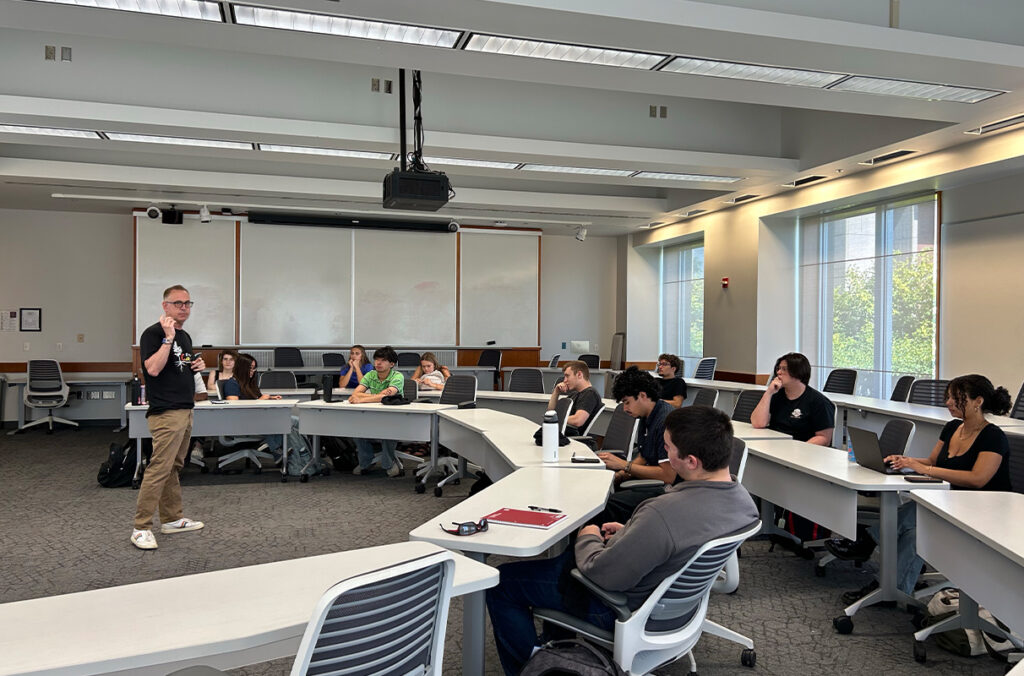
The opportunity to teach a small class, really get to know his students, and apply course material in new ways is what excited Todd Sabato about teaching Introduction to Public Health as part of Washington State University’s Community Service and Leadership Living Learning Community (LLC).
The program brings together students with shared interests who live in the same residence hall and take a related class.
“It has been neat, and as a big kid myself, I feed off my students’ energy,” said Sabato, an associate professor in Washington State University’s College of Veterinary Medicine. “With 14 students in my class, it is allowing me to be flexible in how I teach and give each student as much ownership of the course as I have.”
The Community Service and Leadership program is one of four Living Learning Communities on the Pullman campus. The others focus on environmental sustainability, gender studies, and wellness. Erik Sorensen, associate director for Housing & Residence Life, said the programs are designed to connect students with similar interests through both their living arrangements and coursework.
In addition to Sabato, Anna Whitehall, associate professor in the College of Agricultural, Human, and Natural Resource Sciences, is teaching Human Development (HD) 205 for the Wellness Living Learning Community. Josie Cohen-Rodriguez, LGBTQ+ Center student life and community coordinator, is teaching Women and Gender Studies 101 for the Gender Studies Living Learning community; and Jolie Kaytes, professor in the College of Engineering and Architecture, is teaching Land Architecture 150 for the Environmental Sustainability Living Learning Community.
“The LLCs are helping to build students’ belonging on campus by integrating their interests with both in-and-out of classroom experiences,” Sorensen said. “The ultimate goal is to increase student retention, while giving them a fun and unique experience on campus.”
Sabato said his students are strongly interested in environmental health, and he is developing projects that will get students out into the community to learn things such as farming and sustainability, urban and rural access to healthcare, and healthy food.
“I want my students to think about how we can apply the information we learn — how to communicate what we know so we can advance policy, scholarship, and research to better our lives and our communities,” Sabato said. “That’s what leadership is.”
Developing ‘world-ready’ citizens
Sabato’s learning goals align with what the team in the Center for Civic Engagement (CCE) envisioned when they and their partners began creating the Community Service and Leadership Living Learning Community in January.
Allison Rockwell, service-learning coordinator in CCE, said the Living Learning Community is the first one to extend its reach into the community with an overarching goal of developing leadership. It is designed so students will participate in one service-learning project every month, and in addition, community partners, like Whitman County Public Health, will regularly conduct workshops for students where they live in Perham Hall. She said it is part of making sure WSU graduates are well-rounded and world-ready citizens.
“We want students to see the world outside of campus, and at the same time, develop themselves as students and citizens,” Rockwell said. “It takes getting involved in the community and seeing how other people live and work, and what they need.”
Room for growth
Sorensen said unique experiences across all four Living Learning Communities are bringing students and faculty closer together and creating memories that students will remember for a lifetime. Nationally, data shows Living Learning Communities help students find a sense of belonging on campus, make better connections with faculty, and are often more successful in college.
It is why Sorensen and his partners would like to strengthen and expand the Living Learning Communities at WSU in the future. There have been discussions about developing Living Learning Communities around different academic majors and broadening participation to include returning students, where the older students could mentor the younger ones.
For now, they will continue to monitor and adjust the existing Living Learning Communities to ensure both students and faculty have great experiences. Sabato said he is excited to see where his class goes.
“My students are committed to making their communities better through understanding, leadership, and having the difficult conversations,” Sabato said. “For me, it’s thrilling that I can be a conduit to that process.”