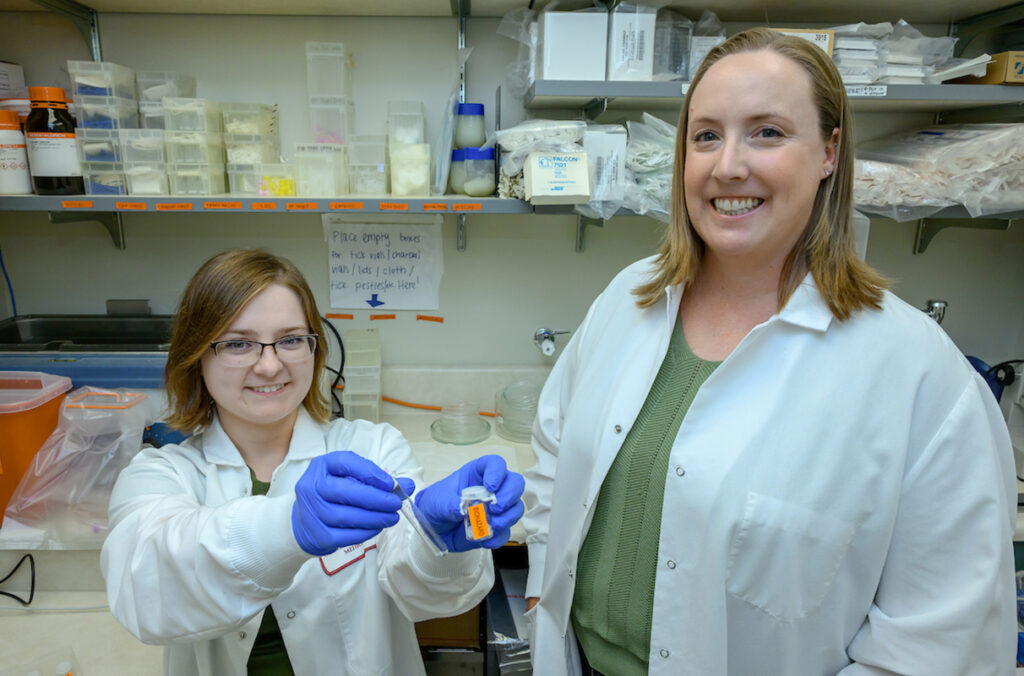
Washington State University postdoctoral researcher Chelsea Osbron has been awarded a highly competitive National Institutes of Health fellowship to support her research efforts aimed at understanding and ultimately reducing the spread of tick-borne diseases.
Osbron, a postdoctoral fellow in the laboratory of Dana Shaw in WSU’s College of Veterinary Medicine, received a three-year, $237,708 NIH National Institute of Allergy and Infectious Diseases F32 postdoctoral training grant for her project, “Dissecting the role of IKK-epsilon in tick immunity and vector competence.”
The NIH F32 fellowship is one of the nation’s most prestigious training awards for postdoctoral researchers in the biomedical sciences. Only 13 F32s are currently held by postdocs in all of Washington state, including one at WSU by Contessa Ricci in the College of Nursing.
“These are extremely competitive grant awards, which makes it a rather noteworthy accomplishment when a trainee is awarded one,” Shaw said. “This fellowship is a well-deserved recognition of both the quality of Chelsea’s science and her potential to become a leader in the field.”
Osbron completed her doctorate in molecular biosciences at WSU in 2024 under the guidance of Alan Goodman in the College of Veterinary Medicine.
Osbron’s research focuses on how a tick’s immune system affects its ability to acquire, carry, and transmit disease-causing pathogens, a concept known as vector competence. She is currently studying the blacklegged tick, which spreads several pathogens that cause diseases in humans, including Lyme disease and anaplasmosis.
“Ticks are the biggest vector of diseases in the U.S.,” Osbron said. “There’s a really big knowledge gap when it comes to the interactions happening inside the tick that contribute to ticks being able to spread pathogens to humans, livestock, and other animals.”
While most efforts to combat tick-borne diseases focus on preventing tick bites through repellents or treating patients after infection, Osbron’s research is exploring how pathogens survive and multiply inside ticks before being transmitted.
“We’re trying to prevent the disease before patients get sick, as opposed to trying to play catch-up,” she said.
The long-term goal of the research is to uncover biological mechanisms that could eventually be used to reduce pathogen levels inside ticks, making them less capable of transmitting disease.
Osbron credited Shaw and WSU’s collaborative tick-borne disease research community for helping create a strong training environment. College of Veterinary Medicine researchers work closely with colleagues across the U.S. Department of Agriculture on tick-borne disease research.
“It’s been really great working with Dr. Shaw,” Osbron said. “She’s been very supportive of my research interests and helping me become a more independent researcher so I can eventually start my own lab.”
The fellowship will be completed under the mentorship of Shaw and co-sponsor Dr. Erol Fikrig, chief of infectious disease at Yale School of Medicine. Following completion of the award, Osbron plans to pursue a faculty position and continue her research.