True or false: Cranberries grow in water.
Yes or no: Do fresh ripe cranberries bounce?
One more: How many air chambers do cranberries contain?
These are the kinds of questions food science doctoral candidate Ahhria Kirkendall (’13 Biol.) poses to people — and helps answer for them if they’re unsure — at the annual Cranberry Festival in Long Beach, which celebrates, as its name suggests, “all things cranberry.” The event, generally held in October, when cranberries are ripe, highlights the importance of cranberry heritage and harvest on the Long Beach Peninsula, or Washington’s “Cranberry Coast.”
Kirkendall uses trivia as a tool to engage festival attendees. Her aim: spread awareness about cranberries and their cultivation as well as health-related topics. The cranberry scientist researches the prebiotic effects of cranberry products, such as juices, seeds, and press cakes, on gut and vaginal microbiomes to learn how they might play into the prevention of urinary tract infections (UTIs) for women.
“Why does it work for some people and not others? We’re hoping to identify microbial mechanisms that may explain that,” said Kirkendall, who also emphasizes the importance of precision treatment that focuses on individuals and their specific microbiome and metabolome for health.

Preliminary findings from her study suggest potential for UTI prevention when consuming low-calorie cranberry juice. According to Kirkendall, there was an increase in Lactobacillus spp. in the vaginal microbiome — a good bacteria — indicating a healthy balance in which bacteria that cause UTIs cannot thrive. There was also a decrease in the undesirable bacteria Prevotella.
Kirkendall became interested in the gut microbiome in 2008, when she was diagnosed with ulcerative colitis, a type of inflammatory bowel disease, alongside Crohn’s disease. “I’ve been on so many medications,” she said. “So there’s this personal component for me. I’ve been able to learn more about holistic approaches and natural remedies through my work in food science in the Nutrition and Gut Microbiome Lab.”
Kirkendall consumes cranberries “as often as I can,” upping her intake as she’s learned more about the power-packed super-berry. Large American cranberries (Vaccinium macrocarpon) contain antioxidants and are rich in fiber, potassium, vitamin C, and more. Research has linked them to the prevention of certain cancers as well as decreased blood pressure, improved immune function, enhanced oral health, and reduced urinary tract infection.
Kirkendall drinks cranberry juice, adds dried cranberries to cookies and muffins, and even came up with her own recipe for cranberry salsa (below). When she’s not participating in outreach activities at the festival, including installing an exhibit on cranberry anatomy and nutrition, she enjoys trying other cranberry specialties, such as sorbet, jams, sauces, baked goods, and even wines.
She’s hoping to continue her cranberry research after graduation. Meantime, she’s got some answers for you.
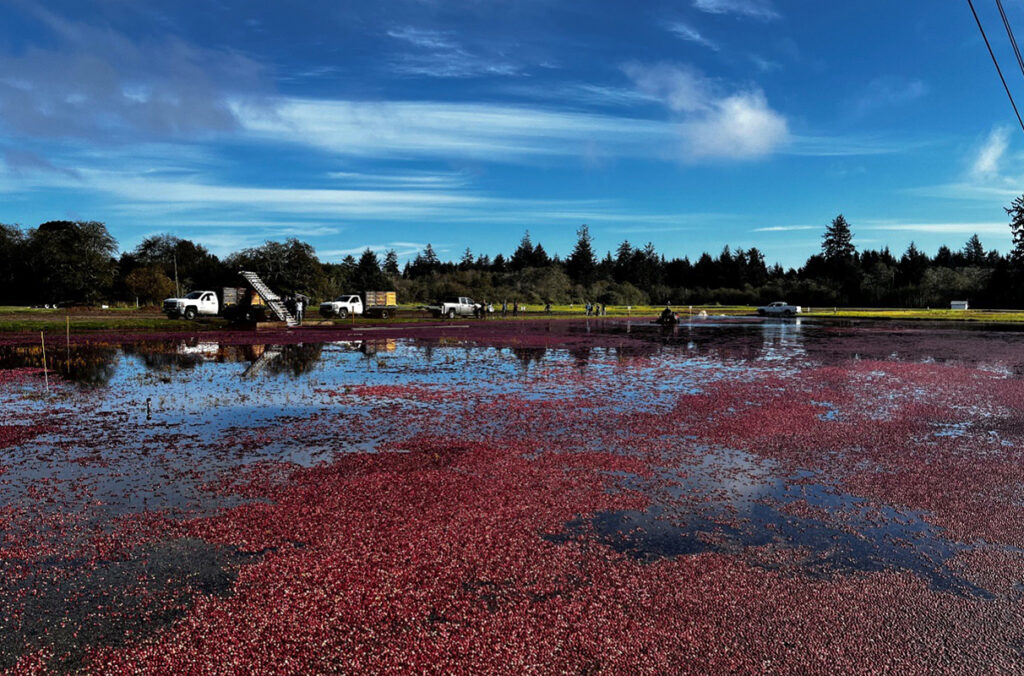
Cranberries typically contain four air chambers, allowing the ripe fresh fruit to both float and bounce. They do not, however, grow in water. They grow in dry beds, which are flooded with water in order to help collect cranberries for processing. Cranberries for the fresh market are picked by small combines or by hand.
Harvest season is six to eight weeks in September, October, and November. Or, just in time for the holidays.
Read more about cranberries in the Winter 2021 issue of Washington State Magazine.