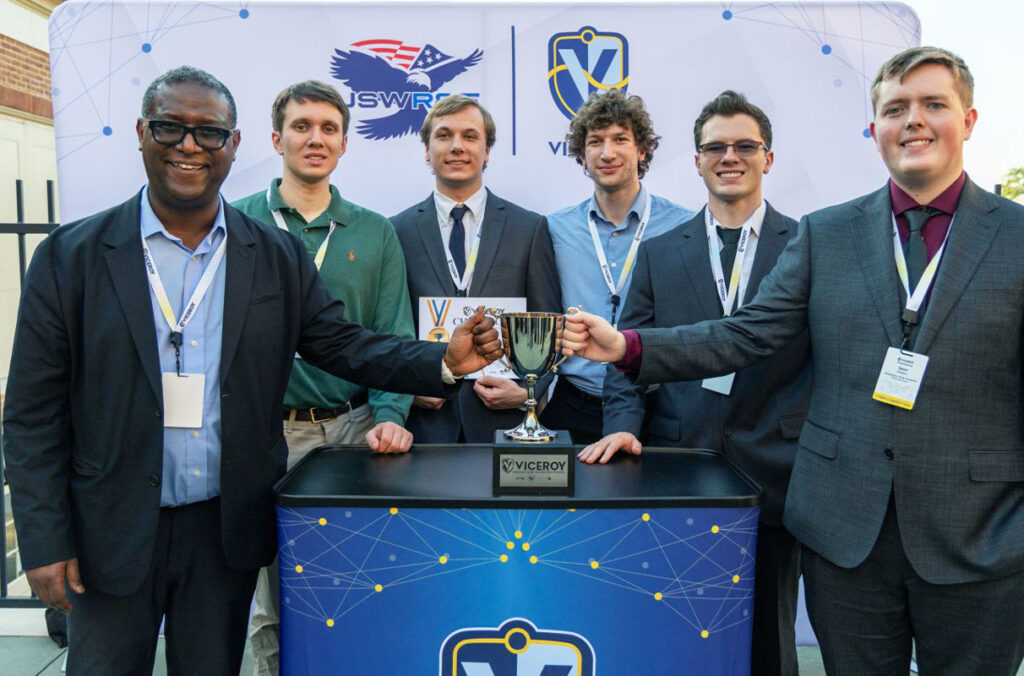
A team of Washington State University computer science students recently earned first place in the 2026 VICEROY National Cyber Competition called The Guardian Prevails.
The event was held during the annual VICEROY Symposium at the College of William & Mary on April 14.
Drawing students from across the U.S., the competition requires students to solve realistic cybersecurity challenges. VICEROY, which stands for Virtual Institutes for Cyber and Electromagnetic Spectrum Research and Employ, is a Department of Defense-funded initiative designed to train students in cyber-spectrum skills, operations, and research. The competitions aim to help develop a skilled cybersecurity workforce for national defense, according to the initiative’s website.
WSU team members who won the competition included Sean Hodgson, Adam Caudle, Cole Wilson, Justin Van Der Sluys, and Andy Sorge, undergraduates in the School of Electrical Engineering and Computer Science.
“This was an incredible opportunity to put our flexibility, ingenuity, and systems understanding to the test in high-stakes, realistic simulated environments,” said senior Adam Caudle. “It’s a testament to what can be achieved when a team brings their A-game.”
This was an incredible opportunity to put our flexibility, ingenuity, and systems understanding to the test in high-stakes, realistic simulated environments.
Adam Caudle, student
Washington State University
The students are part of WSU’s CySER (Cybersecurity Education and Research) Institute, which came about as a result of an initial $1.5 million award from the VICEROY Initiative in 2021. The program established a thriving cyberoperations research and teaching center at WSU, where training is provided to ROTC and DOD-skilled civilian workers in computer science and other majors in cyber basics, operations, or defense, offering bachelor’s degrees as well as specialized certificates. Participating students receive training that integrates cybersecurity research and education with professional skills in teamwork, communication, leadership, and lifelong learning. In recent years, WSU has also instituted a bachelor’s degree in cybersecurity, and last year, the university was named a National Center of Academic Excellence in Cyber Research (CAE-R) by the U.S. National Security Agency (NSA).
The Cybersecurity Group student club gives students the chance to meet and learn about cybersecurity topics. Students participate in competitions online and regionally.
“It was thrilling to watch the CyberCougs Crimson team compete in the finals at the VICEROY Symposium!” said Assefaw Gebremedhin, Berry Family Distinguished Associate Professor in the School of Electrical Engineering and Computer Science and the group’s advisor. “CyberCougs Crimson eventually came on top closely followed by the other four teams within the VICEROY network. Congratulations to all top 5 teams on their incredible achievements and performance!”
In addition to the competition, two WSU student groups also presented research posters at the symposium on safeguarding large language models from cyberattacks and on Assimilate: A Takedown Resistant Botnet Simulation. Students who presented included William Fralia, Emily West, and their mentor, Tashi Stirewalt and Justin Van Der Sluys, Sean Hodgson, and Fredy Fernandez.