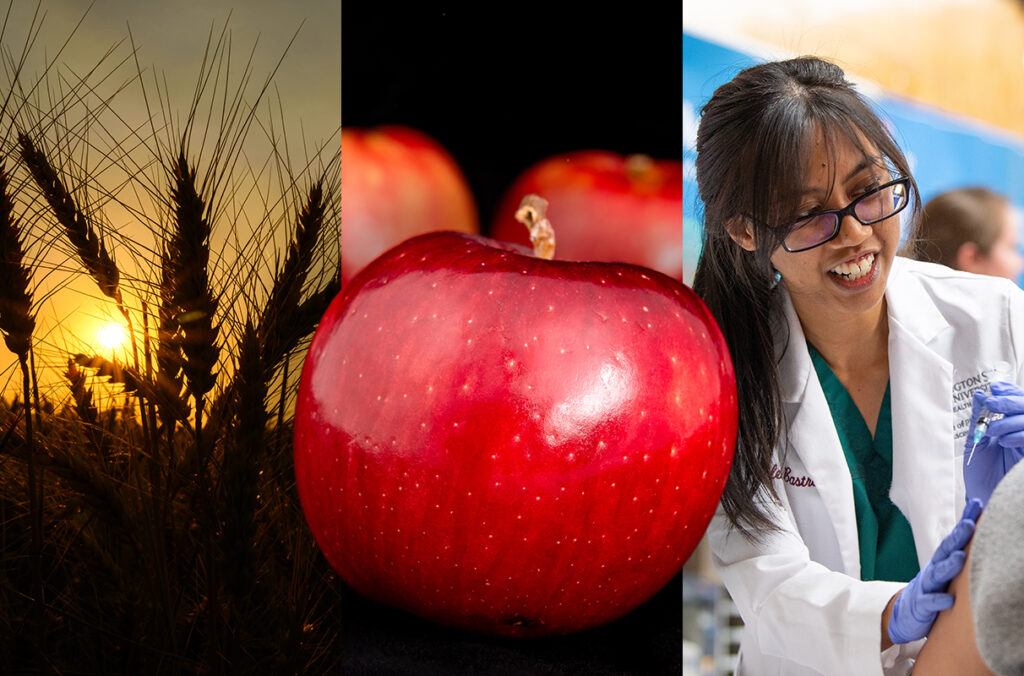
What do specialty apples, vaccine administration manuals, and a method of sterilizing food with microwaves have in common?
All are the product of the ingenuity and labor of Washington State University’s research enterprise, contributing to a record-setting year for licensed royalty generation.
During the 2025 fiscal year, WSU generated $19.4 million in royalty revenues, nearly doubling the amount generated in FY24. Over the last decade, commercialized innovations from the minds of Cougs have generated more than more than $82 million in royalties, including four consecutive years of eight-figure earnings.
“The bottom line is that WSU is absolutely killing it in terms of its commercialization efforts,” Jeremy Tamsen, senior director of Innovation and Entrepreneurship within the Office of Research, said.
The university isn’t just outdoing itself. In the most recent U.S. Licensing Activity Survey conducted by the Association of University Technology Manager, WSU outperformed institutions with similarly-sized research portfolios.
The bottom line is that WSU is absolutely killing it in terms of its commercialization efforts.
Jeremy Tamsen, senior director
Innovation and Entrepreneurship, Office of Research
Among institutions with between $250 million and $499 million in research expenditures, the university had more innovation disclosures, new patent applications and gross licensing income than the median. This in spite of the fact that WSU has fewer licensing staff than the median figure among peer institutions.
Current licensing revenue leaders
Apple cultivar WA 38, more commonly known as Cosmic Crisp®, is far-and-away the most profitable university innovation today, generating more than $8 million in the most recent fiscal year. There are now more than 22 million Cosmic Crisp® trees growing in the state of Washington, and the increasingly popular variety has yet to reach its peak production, according to Tamsen.
Five varieties of wheat made the top 10 list of royalty generators for WSU in FY25, with names ranging from the animal-inspired “Piranha CL+,” “Stingray CL+,” and “Sockeye CL+” to the simple elegance of “Ryan” and “Tekoa.”
A widely-used manual for pharmacy-based vaccine administration developed by WSU and further refined in partnership with the American Pharmacists Association, generated more than $1.7 million in royalties for the university in FY25.
Food and medical innovations rounded out the top royalty generators list:
- A test for identifying dogs sensitive to Ivermectin
- Guidance on screening neurodivergent disorders using pupillary light reflex tests
- A system for microwave-assisted sterilization or pasteurization of pre-packaged food
Next steps
Raising awareness among researchers about the processes of turning an idea into a revenue-generating product or service is critical to enhancing the university’s commercialization efforts.
“We want faculty to come to us to talk about licensing potential at the manuscript phase,” Tamsen said. “It doesn’t take long to file provisional patent application. The researcher can then publish and do conference presentations during the provisional period, as they are their own best advocates for their work. That process helps to capture interest and then we can look at ways to capitalize down the line.”
For patented inventions, the inventors are incentivized with 50% of the royalty income. The seed-propagated and vegetatively-propagated plants follow different distributions, based on the higher institutional investments that come with supporting plant-breeding programs.
For vegetatively-propagated plants like WA 38, aka Cosmic Crisp®, the royalty distribution is 30% to the plant breeders, 60% to the CAHNRS Office of Research, and 10% to the WSU system for Innovation & Entrepreneurship.
More information about how royalty income is divided at WSU can be found on the university policies website.
Innovation and Entrepreneurship is currently developing an outreach program that’ll ensure its staff connects with every department annually to provide education and support around entrepreneurship and innovation.
“We want to help researchers drive impact from their research outcomes, as well as support all those who would like to utilize our toolkit and experience in this field to maximize the impacts from their research,” Tamsen said. “These tools are not just focused on patenting widgets, and our scope is expanding to welcome more innovators across the WSU system.”

Recognizing potential
The Office of Research has several resources designed to help inventors explore commercialization potential.