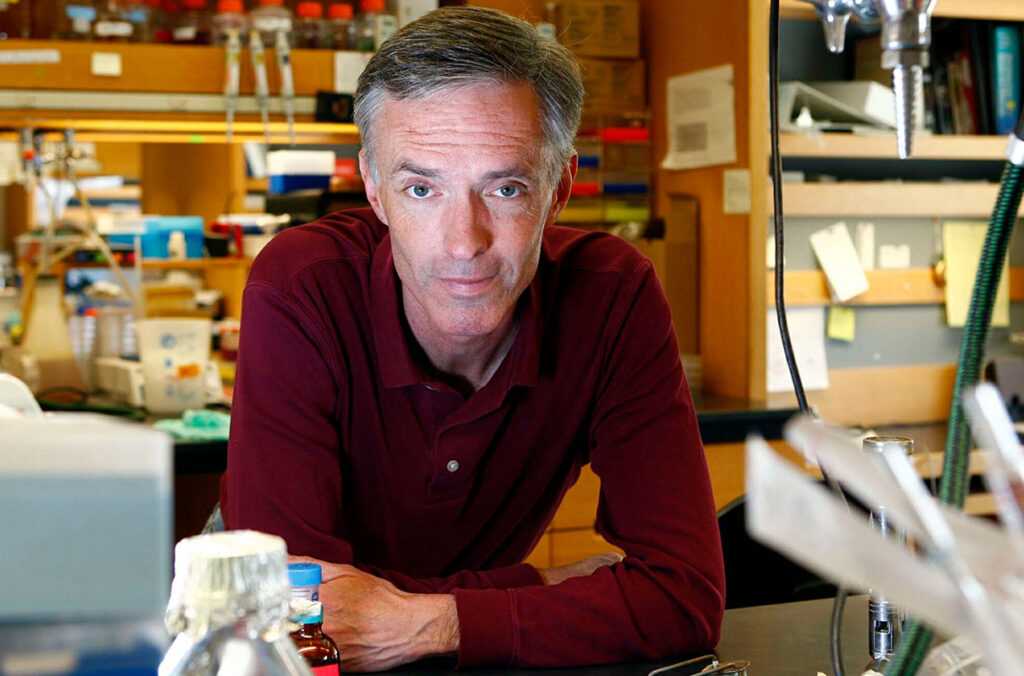
James Collins, Termeer Professor of Medical Engineering & Science at the Massachusetts Institute of Technology (MIT), will speak on synthetic biology and making biology programmable at the Ensor Lecture on Biotechnology on April 28.
The event will be held from noon to 1 p.m. in the Spark Atrium on the Pullman campus and livestreamed via Zoom. A reception will precede the lecture at 10:30 a.m.
Synthetic biology is bringing together engineers, computer scientists and biologists to model, design and construct biological circuits out of proteins, genes and other bits of DNA and to use these circuits to rewire and re-program organisms. These re-engineered organisms could change lives in the coming years, leading to cheaper drugs, rapid diagnostic tests, and synthetic probiotics to treat infections and a range of complex diseases.
In his lecture, Collins will highlight recent efforts to create synthetic gene circuits and programmable cells and discuss synthetic biology applications in biotechnology and biomedicine. He will also discuss recent studies that use generative AI in the context of synthetic biology to create novel classes of diagnostics, therapeutics, and programmable molecular tools for the life sciences.
Collins will highlight recent efforts to create synthetic gene circuits and programmable cells and discuss synthetic biology applications in biotechnology and biomedicine.
Collins is a professor of Biological Engineering at MIT as well as a member of the Harvard-MIT Health Sciences and Technology faculty. He is a core founding faculty member of the Wyss Institute for Biologically Inspired Engineering at Harvard University, and an institute member of the Broad Institute of MIT and Harvard. Collins is one of the founders of the field of synthetic biology, and his research group is focused on using synthetic biology to create next-generation diagnostics and therapeutics as well as programmable molecular tools for the life sciences.
He is also director of the Antibiotics-AI Project at MIT and co-founder of Phare Bio, a non-profit focused on AI-driven antibiotic discovery. Collins has received numerous awards and honors, including a MacArthur “Genius” Award, the Dickson Prize in Medicine, and the Feynman Prize in Nanotechnology. He is an elected member of all three national academies — the National Academy of Sciences, the National Academy of Engineering, and the National Academy of Medicine.
The Ensor Lectureship was established through the generosity of David Ensor and his wife, Sara, as a reflection of their deep interest in higher education and their belief in the empowerment that education provides for one’s life. After graduating with a bachelor’s in chemical engineering from WSU in 1963, David Ensor received his master’s and PhD at the University of Washington. He is an expert in aerosol and air pollution science, applying his aerosol expertise to nanotechnology research and international standards development as a U.S. delegate to the International Organization for Standardization. Ensor worked for Meteorology Research, Inc., and retired from a long career at RTI International. He is one of the founding editors of Aerosol Science and Technology and has received several awards, including the White House’s Hammer Award and the Meritorious Service Award from the American National Standards Institute.