At first, Itsuhiro Ko was not very enthused about his professor’s suggestion.
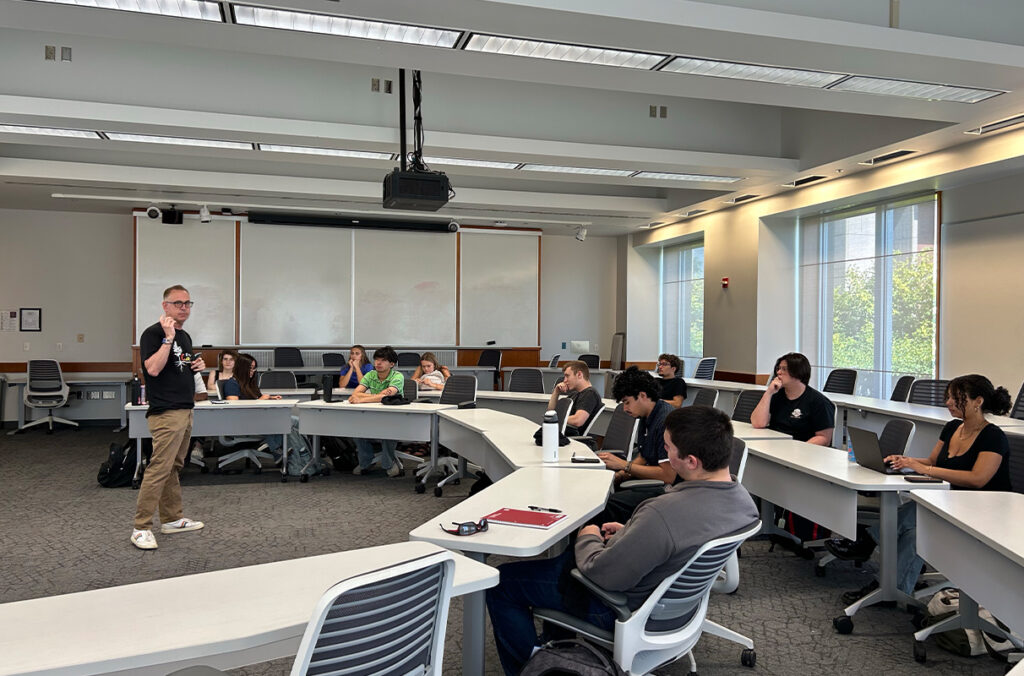
It was spring of 2022, and Ko was among a small group of graduate students in Andrei Smertenko’s Journal Club class, learning how to critically evaluate research papers. Smertenko had suggested that the students consider writing a review of the scientific literature on the effects of heat and drought on grain development, as a joint project outside of class.
“I was like, ‘No, I cannot do that,’” said Ko, a PhD candidate in molecular plant sciences, studying plant-nematode interaction. “This is too far from my topic.”
But he told himself to keep an open mind, and eventually he began to see what was interesting — and important — about the subject. Over recent decades, erratic climate conditions have harmed the yield and grain quality of staple crops, and the projected intensification of heat and drought lends urgency to the need to find ways to make grains such as wheat more climate-resilient.
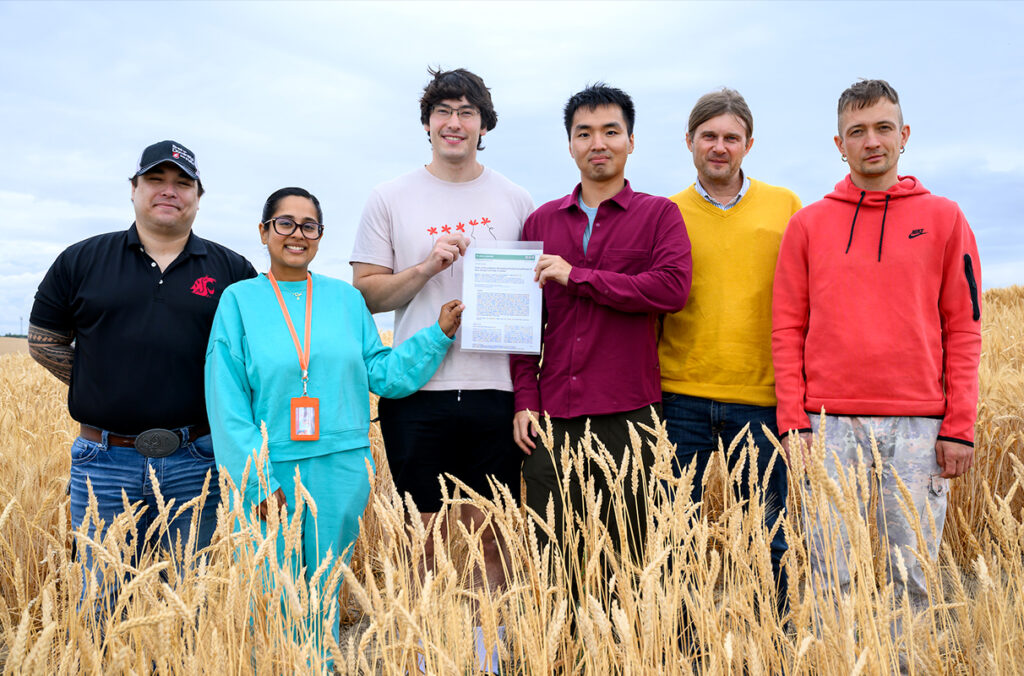
Over the next couple of years, Ko helped organize six fellow WSU doctoral students who researched, wrote, submitted, edited, and finally published a scientific review in The Plant Journal.
The paper evaluates the state of knowledge about the effects of heat and drought on grain development, and points to areas of that development that could be targeted to develop a “Climate Smart” wheat.
It was the third time that students from Smertenko’s class have published a review paper. In this case, however, the students played unusually prominent roles, he said, and the paper itself has received strong attention within scientific circles — nearly 750 people had viewed the full text within a month of its publication.
Ko and Tyler Chapman, a PhD candidate studying how plants protect the photosynthesis process under stress, were lead authors, and Niharika Nonavinakere Chandrakanth, a PhD candidate studying grass cell walls, was the corresponding author.
“Students were driving the project and I was more in the back seat, helping them, trying to make the process easier,” said Smertenko, an associate professor of molecular plant sciences. “It makes what they’ve done unique.”
Many of those questions will be asked and answered not by us, but by future generations.
Taras Nazarov, post-doctoral research associate
Washington State University
Their experience highlights the opportunities that students at WSU have to participate in the research and publication process, and to collaborate across scientific disciplines. The other authors on the paper are: Taras Nazarov, a post-doctoral research associate in biological chemistry; Dylan Oates, a PhD candidate studying molecular plant science; and Ruth Uwugiaren, a PhD candidate studying crop biofortification.
While there have been review papers published about the issue of climate change and grain yields generally, Smertenko and the students wanted to identify a narrow focus that would contribute to the field — landing eventually on the biochemical processes that regulate the production of starch and proteins in grains, which are key determinants of the nutritional value as well as price.
And yet the precise ways in which heat and drought activate these biochemical processes is not well-understood. The students’ paper examines the state of knowledge about three critical biochemical pathways under adverse environmental conditions during grain development, highlights critical factors contributing to the deterioration of grain quality and proposes strategies to enhance the resilience of starch development in wheat.
It’s an area of critical future importance, given the global challenges of climate change and feeding a growing population.
“It’s high time for the scientists now to do something and help the future generations to survive better and adapt some sustainable solutions,” Chandrakanth said.
The students said that they learned important lessons about perseverance through the long process.
“The key takeaway for me was hard work pays off,” Oates said.
The students said it was rewarding to contribute to a field of study that will be of critical importance for coming generations.
“Many of those questions will be asked and answered not by us, but by future generations,” Nazarov said.