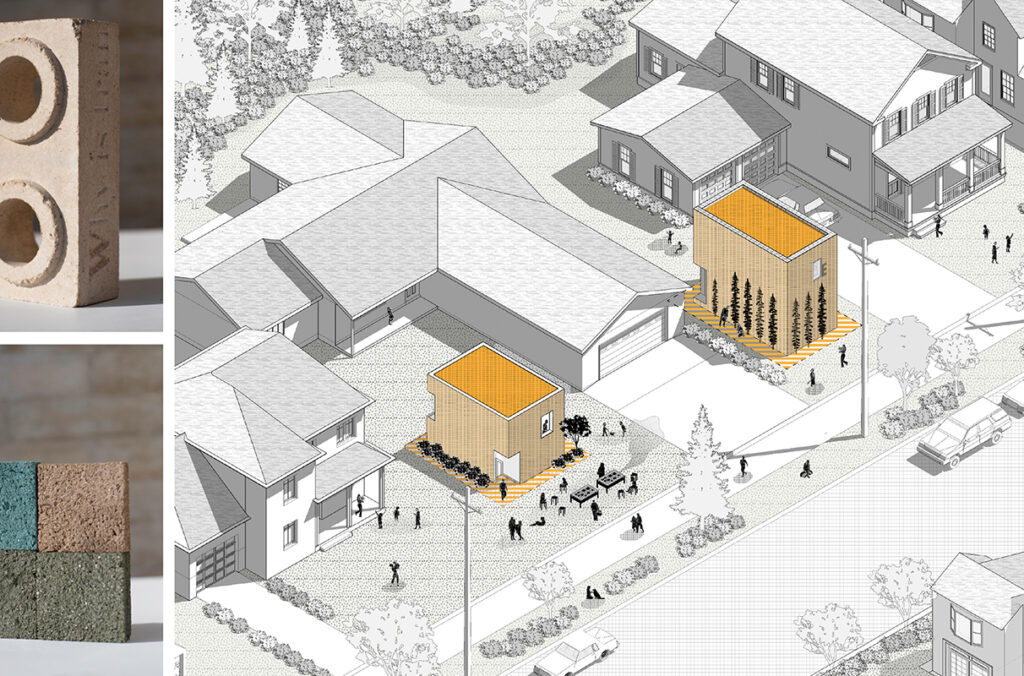
Researchers in Washington State University’s School of Design and Construction (SDC) won an international award for their study on using drywall waste technology for building affordable tiny homes in the Seattle area.
Led by Professor Taiji Miyasaka, and David Drake, scholarly assistant professor, the project received an AZ Award in environmental leadership. The award from Azure’s international architecture and design competition recognizes excellence and innovation, and showcases the world’s best projects, products and ideas, according to their website.
Drywall, also known as gypsum board or sheetrock, is a common, inexpensive building material prized for its fire-proofing qualities and ease of installation. The four-by-eight-foot sheets are cut to size on construction sites, resulting in between 10 and 12% of the material being discarded. Ten million tons of the material is dumped into U.S. landfills each year, making up about 9% of all construction waste. Soil bacteria decompose the gypsum when it’s put into landfills, which produces a noxious gas, and some cities have banned it from landfills.
Miyasaka and Drake began work in 2017 on a process that pulverizes the drywall scrap and turns it into a useable building material. The waste is mixed with water and carbon-neutral binders and pressed into building blocks using a low-energy compaction process.
Miyasaka and Drake estimate that waste from construction of 16 new homes could produce enough drywall waste to build a tiny house.
The researchers have developed drywall waste blocks, which are building blocks similar to bricks, as well as drywall waste panels, which is insulation material made from 95% drywall waste. The blocks can be made on-site using portable machines or off-site using existing machinery at conventional masonry plants and can use up to 90% of the drywall waste.
They estimated that waste from construction of 16 new homes could produce enough drywall waste to build a tiny house. In the Seattle area, that totals about 800 tiny homes per year that could be built from drywall waste.
Working with WSU’s Office of Commercialization, the researchers have received two patents for their technology. They have produced 100 blocks, and the Spokane Masonry Industry Promotion Group will soon conduct performance testing by constructing a full-scale wall mock-up.
In addition to Miyasaka and Drake, the project team included Jason Peschel and Omar Al-Hassawi from SDC, Juliette Dubroca of Dubroca Studio, and former student Pimchid Chariyacharoen. The team also received a People’s Choice Award and an Award of Merit in the Concepts category for the project.