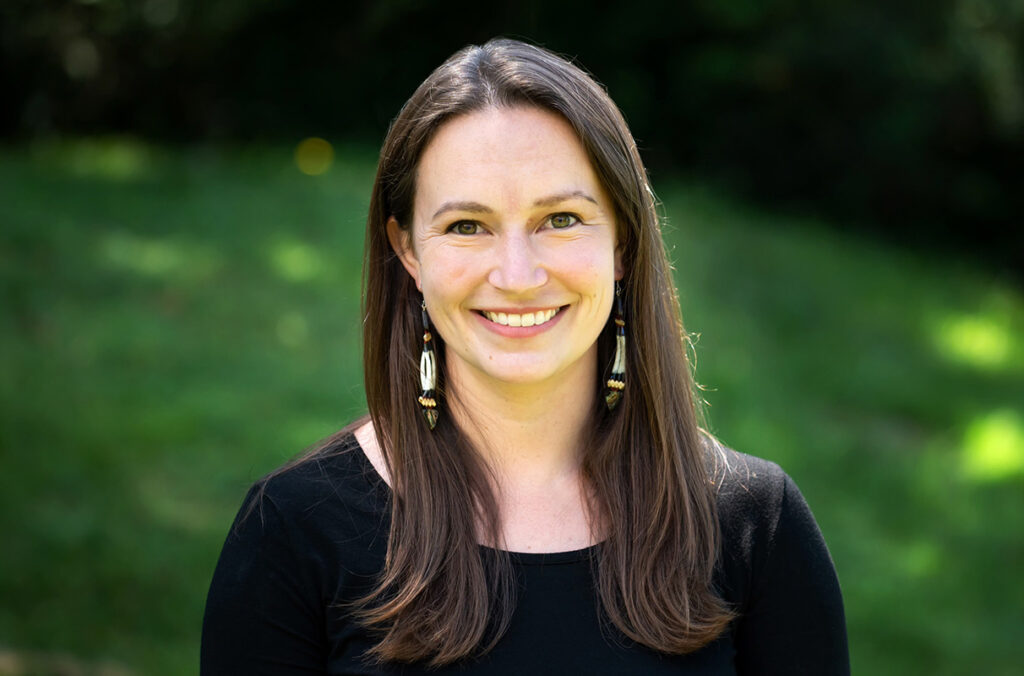
Washington State University Assistant Professor Rachel Wilbur, PhD, MPH, has been awarded a highly competitive National Science Foundation Faculty Early Career Development Program (CAREER) award, one of the NSF’s most prestigious honors for early-career faculty.
Totaling $577,000 in funding over five years, the award will support her research project, “Survivance for Indigenous Well-Being: Research and Education,” which seeks to reframe how Indigenous health is perceived and promoted.
“This is a passion project,” said Wilbur, who is a faculty member in the WSU Elson S. Floyd College of Medicine and affiliated with the Institute for Research and Education to Advance Community Health (IREACH). “It’s incredibly meaningful to see this work recognized and supported by the NSF, especially given how rare it is for Indigenous-centered, strengths-based research to receive this kind of funding.”
Reframing Indigenous health through ‘survivance’
At the heart of Wilbur’s project is the concept of “survivance” — a term coined by Anishinaabe literary scholar Gerald Vizenor that blends survival and resistance. Unlike the more commonly used term “resilience,” which often implies a reaction to adversity, survivance emphasizes the active presence, cultural continuity, and inherent strengths of Indigenous communities.
Wilbur’s CAREER-funded project on survivance emerged from her previous work on historical trauma and the long-term effects of American Indian boarding schools. Through this work, she recognized that many Indigenous communities demonstrated enduring strengths that weren’t simply responses to trauma but were rooted in deep cultural and familial traditions.
“People kept saying, ‘We’re tired of being resilient,’” she said. “They wanted a term that reflected who they are — not just what they’ve endured.”
The NSF-funded project will develop a Health Survivance Toolkit, including a formal definition, conceptual framework, and measurement tool. This toolkit will then be piloted in partnership with the United Indians of All Tribes Foundation in Seattle, applying it within their traditional medicine program to assess how cultural engagement promotes well-being for urban Indigenous communities.
Building generational connections: The INSPIRE grant
In addition to the CAREER award, Wilbur is also the recipient of WSU’s INSPIRE! Community Engaged Research Seed Grant program for the project “Connecting Generations for Indigenous Well-Being.” The initiative, a collaboration with the Coast Salish Youth Coalition and William Hartmann, an associate professor at the University of Washington, focuses on intergenerational knowledge sharing as a means of addressing mental health challenges for American Indian youth and elders.
The program pairs elders and youth from Coast Salish communities to engage in traditional practices such as storytelling, basket weaving, and subsistence activities. The goal is to foster positive cultural identity, self-esteem, and community connection — factors that research suggests can reduce substance misuse and suicidality among Native youth.
“Some of the most powerful moments have come from conversations with youth,” Wilbur said. “They’re eager to learn, to connect, and to reclaim traditions that have been disrupted by colonization.”
Wilbur emphasizes that both projects are deeply collaborative.
“These aren’t just my projects,” she said. “They’re the result of strong partnerships and shared visions. I’m just an academic who can help secure the funding.”