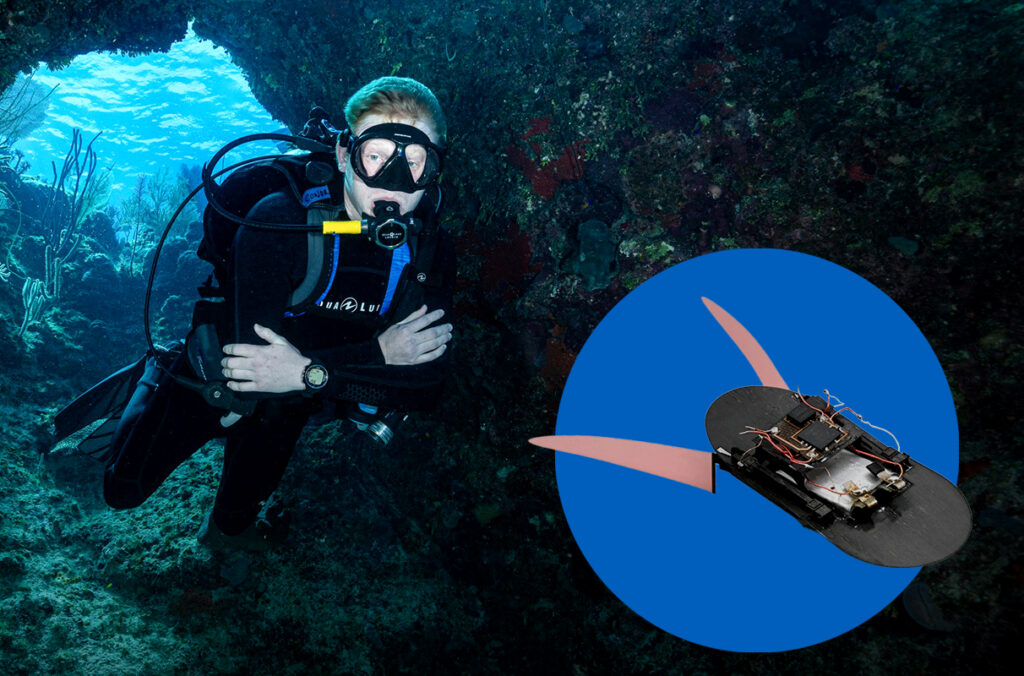
During his scuba diving experiences, Washington State University graduate student Conor Trygstad has looked into tiny caves within coral reefs and wondered about the wildlife that lurks there.
In recent years, he has worked to make his childhood dream of a tiny, insect-sized submarine that could explore those depths into reality.
Most recently, Trygstad is a recipient of a Koerner Family Foundation Fellowship for his graduate studies in micro-robotics. The fellowship supports American graduate students who are conducting research and working on PhDs in engineering. In addition to Trygstad, WSU students Caitlin Grover, a graduate student in materials science and engineering, and Philip Moffatt, in civil engineering, are recipients of the prestigious fellowship.
I was fascinated by robotics and the things that we could do with these small mechanisms. We had just gotten started when I graduated….I wanted to see this through.
Conor Trygstad, graduate student
Washington State University
Originally from Maple Valley, Washington, Trygstad enjoyed tinkering and so pursued mechanical engineering when he came to WSU. He became interested in micro-robotics during a class on dynamical systems during his senior year and eventually began working as an undergraduate researcher with Néstor Pérez-Arancibia, Flaherty Associate Professor in the School of Mechanical and Materials Engineering. Soon, he was fascinated by the tiny robots, especially an actuator that he built that moved by way of a special type of metal called a shape memory alloy.
“I saw it moving, and it was just super cool,” said Trygstad of the robot he built. “It didn’t have rotating parts or gears or any of what you would think of traditional robotics, but it ended up moving.”
When it came time for graduation, Trygstad wasn’t ready to leave his research and decided to stay on to work toward a PhD.
“I was fascinated by robotics and the things that we could do with these small mechanisms,” he said. “We had just gotten started when I graduated. It was going to be very hard for me to step away. I wanted to see this through.”
A scuba diver who has explored the waters from Canada to the tropics, Trygstad is particularly interested in swimming robots and wants to develop a tiny submarine robot that can explore the beautiful and different world under the sea. In coral reefs, up to 75% of the ecological mass is in so-called ‘cryptic regions,’ little cave systems within the reef that are hard for researchers to get to.
“When I scuba dive, I like going through these little swim throughs, and it’s cool to be within the coral structure,” he said. “But then you always see these small holes that you can’t go inside of, so you’re just curious about what lives there.”
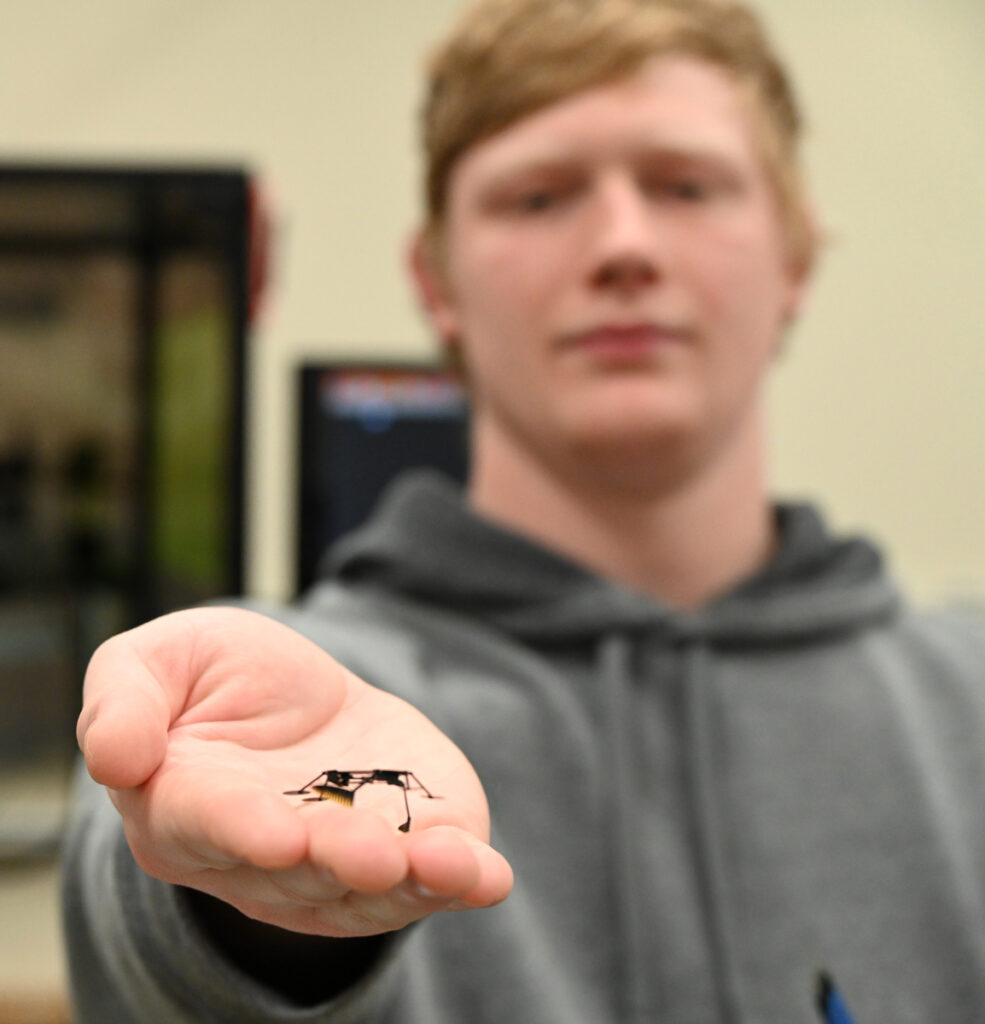
The tiny submarines that he envisions could have other uses, such as infrastructure inspection, environmental surveying, or search and rescue operations.
Trygstad has made numerous, high-impact research contributions in the field of micro-robotics, said Pérez-Arancibia, including the invention of the smallest and fastest shape memory alloy-based, in-air and underwater actuators for micro-robotics.
“He’s one of the most promising young researchers in the field of robotics,” he said.
Trygstad is grateful for the financial support from the Koerner Foundation as well as for the help that he’s received from his lab mates, from previous students who laid the foundation for his work, and from his advisor.
A long-time student of Jiu-Jitsu, he compares the support for his engineering studies to his training in the martial art. In Jiu-Jitsu, once students get to a certain rank, they have a responsibility to give back the knowledge to people who are just starting out.
“I draw some parallels to that with the Koerner Family Foundation,” he said. “They had successful careers, and now they’re able to give this to a newer generation of engineers to get people started on the right foot. I’m really inspired by their mission, and I’m very honored to be a part of this fellowship class.”