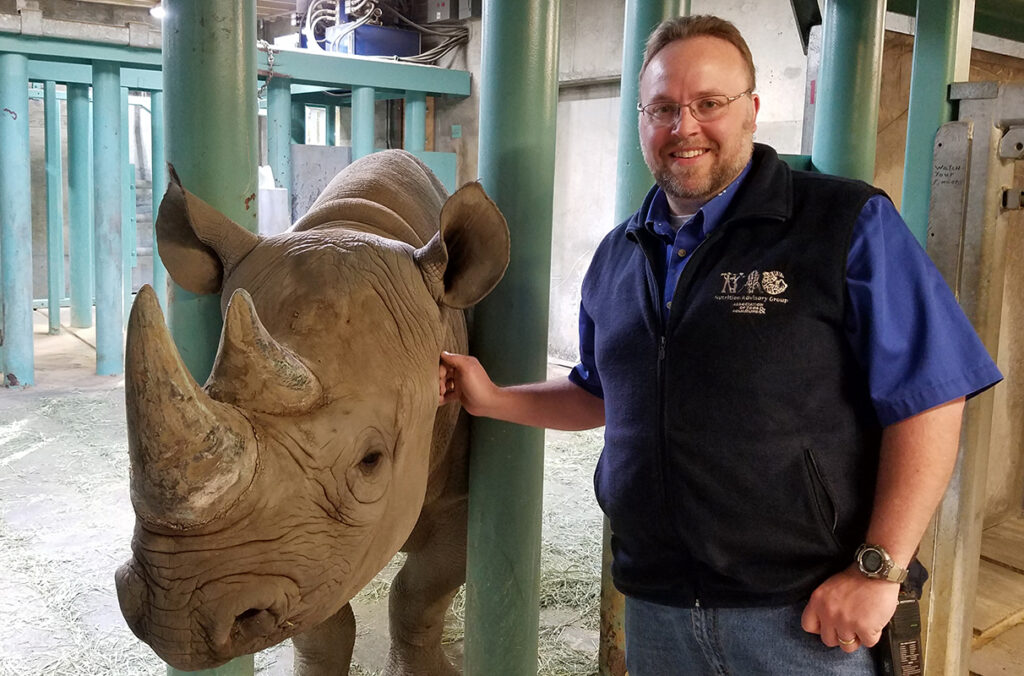
From elephants and penguins to horses and chickens, Matt Brooks has helped care for a world of wild and domestic animals. The creature most responsible for a career that’s taken him to zoos across the country is the rhino.
“It’s my ‘totem’ animal,” said Brooks, who will give the annual Halver Lecture in Comparative Animal Nutrition from 5–6 p.m. on Tuesday, Feb. 25, at Washington State University Pullman. Brooks’ talk is a way for WSU students to learn about the diverse career pathways in animal science. Hosted by the WSU Department of Animal Sciences through the support of the Halver family, the event is free and open to all.
“Twenty years ago, I would never have thought I’d be where I am today,” Brooks said. “It’s been an amazing journey.”
It all began with an overnight fifth-grade class trip to the Riverbanks Zoo and Garden in Columbia, South Carolina, not far from where Brooks grew up. Touring behind the scenes, he saw how animals are fed and cared for. Some classmates were grossed out by the carnivore diets of birds of prey, but Brooks was hooked.
Twenty years ago, I would never have thought I’d be where I am today. It’s been an amazing journey.
Matt Brooks
From then on, animals were his vocation. In high school, a teacher nicknamed him “Rhino Man” due to Brooks’ enthusiasm for the big, charismatic beasts. The nickname stuck; to this day, Brooks keeps rhino-themed artwork on his mantle and a custom rhino license plate number.
“They’re the sweetest animals,” he said. “They have really bad eyesight but a great sense of smell. They get a bad rap because they charge without looking. In some ways, that’s been my life, too.”
An aspiring pre-vet student in college, Brooks introduced himself to classmates: “My name is Matthew Brooks, and I love rhinos.” His professor immediately responded: “We can get you an internship!”
That intern role at Texas’ Fort Worth Zoo, working with his beloved rhinos, led to a job as the zoo’s lab technician and later nutrition department keeper. Eager to grow professionally, Brooks went back to school, earning his master’s degree in nutrition while studying fat metabolism in cattle.
A spur-of-the-moment road trip with friends to a Colorado meeting of the Comparative Nutrition Society expanded his contacts and led to doctoral studies in ruminant nutrition. Brooks went on to launch the nutrition program at the Oregon Zoo and directed animal nutrition at the Indianapolis Zoo. Most recently, he launched his own comparative nutrition consulting company and is the small animal nutritionist for Nom Nom, a U.S. pet food company. At every step, Brooks encountered new aspects of science and animal health.
“It’s my job as a nutritionist to keep animals healthy and make sure they have a good life,” he said.
One of the biggest lessons from Brooks’ 22-year career is that ‘Plan A’ rarely works out.
“You’d better have plans B, C, and D ready to go,” said Brooks, who is now president-elect of the Comparative Nutrition Society that helped nurture his career connections. “Do not pass up opportunities just because it might not be exactly what you want to do.”