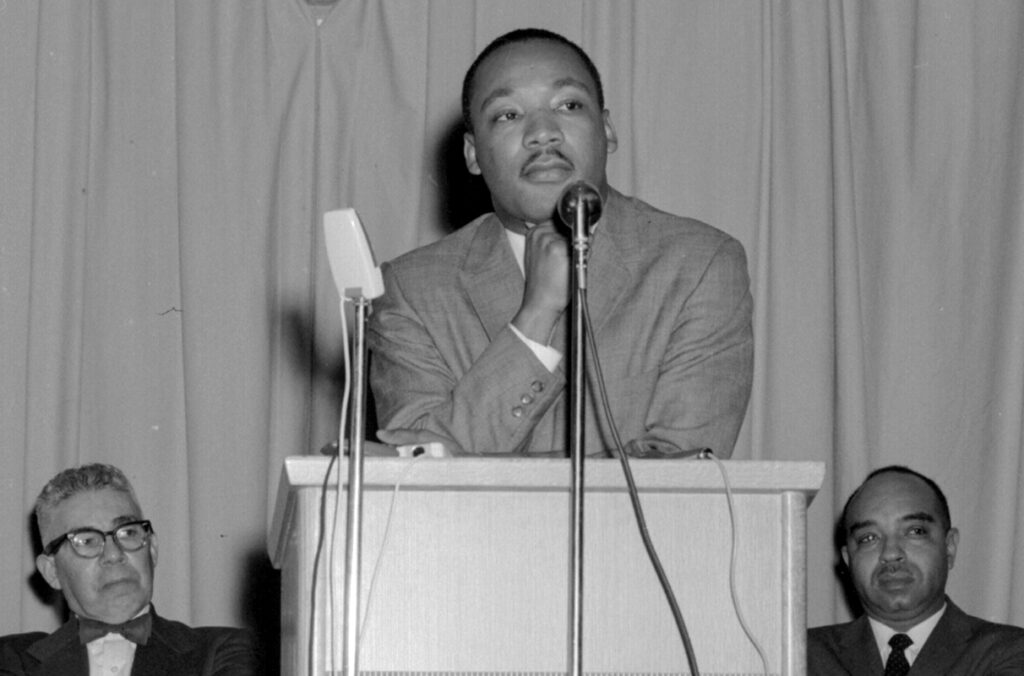
Jason Miller thought his future held a teaching job at a small liberal arts college after he earned his doctorate in English literature from Washington State University.
Instead, he’s become an authority on the speeches of Martin Luther King, Jr., and even discovered a previously unknown address by the Civil Rights leader.
“It absolutely surprises me the direction things have gone,” Miller said, “but streams find their way to the sea.”
Like a stream’s channel, though, his path wasn’t direct.
It started with the poetry of Langston Hughes, an important figure in the cultural and artistic movement of the Harlem Renaissance. Miller’s dissertation at WSU and much of his academic career have centered on Hughes’ prolific work.
Miller and others knew that King and Hughes were contemporaries and friends. But Miller wanted to explore whether there were connections between Hughes’ poems and King’s oratory.
For instance, “a few people had speculated that Langston Hughes wrote a lot about dreams,” said Miller, a Distinguished Professor of English at North Carolina State University. Could King have been inspired by his friend to declare, “I have a dream” in his famous speech at the March on Washington in 1963?
It’s likely he was, Miller said, adding he documented many more connections between the two men’s work. He wrote a book, “Origins of the Dream: Hughes’ Poetry and King’s Rhetoric,” based on his findings.
Other academics hadn’t seen the parallels because the study of literature, poetry, and history are often siloed in academia, Miller said. He credited the “radical interdisciplinarity modeled at WSU” with helping him see the intersection of Hughes and King in a new way.
Miller’s research led to a startling discovery in 2015. He had come across a transcript of a speech King gave in a high school gym in Rocky Mount, N.C. Eventually Miller tracked down the only known recording of that November 1962 speech.
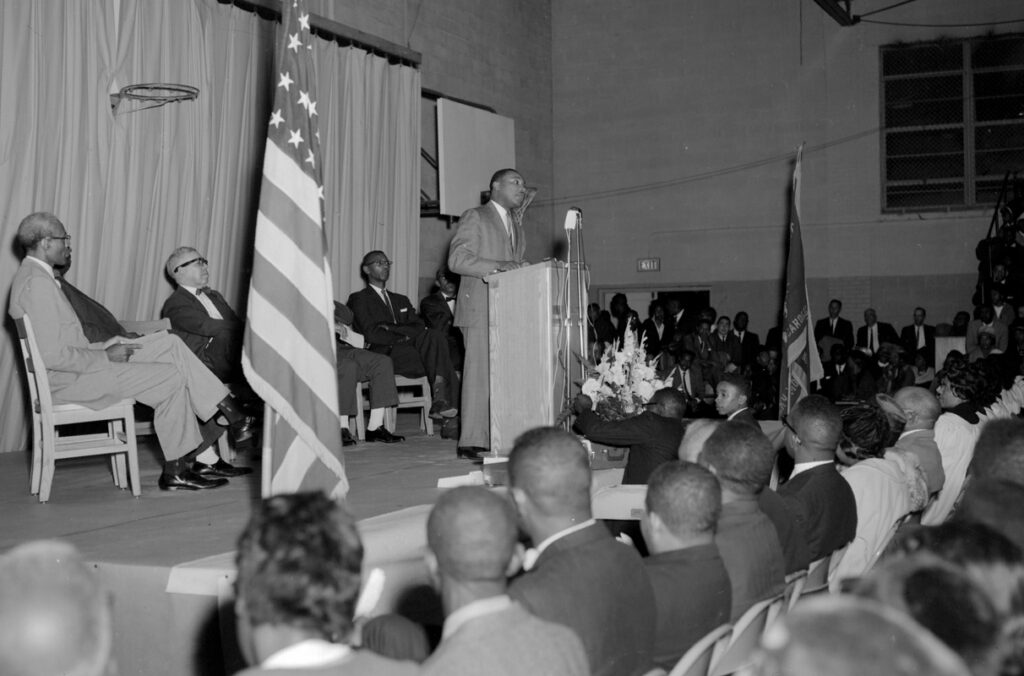
The reel-to-reel tape “was raveled at the end and curled,” Miller said. “The case had a crack in it and the box had rust all over it. I distinctly remember having it in my vehicle and I couldn’t find my way home, I was so excited.”
Miller hand-delivered the tape to George Blood, an audio preservation expert, who was able to restore it. (Listen to a clip from the Rocky Mount speech.)
Part Civil Rights rally and part sermon, the Rocky Mount speech included other phrasing that King would reprise later, including “Let freedom ring” and “How long? Not long.”
“I have listened to about 190 speeches in full audio and read over 800 transcripts” of King’s speeches, Miller said, “and I never heard or studied a speech that’s like the Rocky Mount speech. It’s literally three of his greatest hits all in the same place.”
Miller said King was a legendary orator, but it wasn’t by accident. He reworked his speeches repeatedly, honing his rhythm, cadence, and word choices.
“He would rewrite in his own hand speeches he’d delivered 12, 13 times before,” Miller said. “And he knew how to perform. Reading an audience, making eye contact, knowing what they’re listening for. It made him somebody that could meet the energy of a mass meeting.”
Miller had the chance to meet some of the people who were in the audience at King’s Rocky Mount speech. Some said it changed the trajectory of their lives.
In some ways, King changed the trajectory of Miller’s life, too. Miller has been interviewed by CNN and NPR, he produced a documentary on the Rocky Mount speech, and his research and books have been featured in national media. He followed up that project with another, “When MLK and the KKK Met in Raleigh,” displaying for the first time photos of a large Ku Klux Klan march that coincided with a King speech in the North Carolina capital. Said Miller of his renown as a King scholar, “I anticipated educating students in being better readers and better citizens. This has been completely unexpected.”