Big changes are coming to healthcare.
That was the message behind three days of speakers and workshops at the TIPed Institute on the Washington State University Health Sciences campus.
The institute is sponsored by the WSU College of Pharmacy and Pharmaceutical Sciences; TIPed means Transformation and Innovation in Pharmacy Education. But many of the technologies and teaching methods discussed will affect all aspects of healthcare.
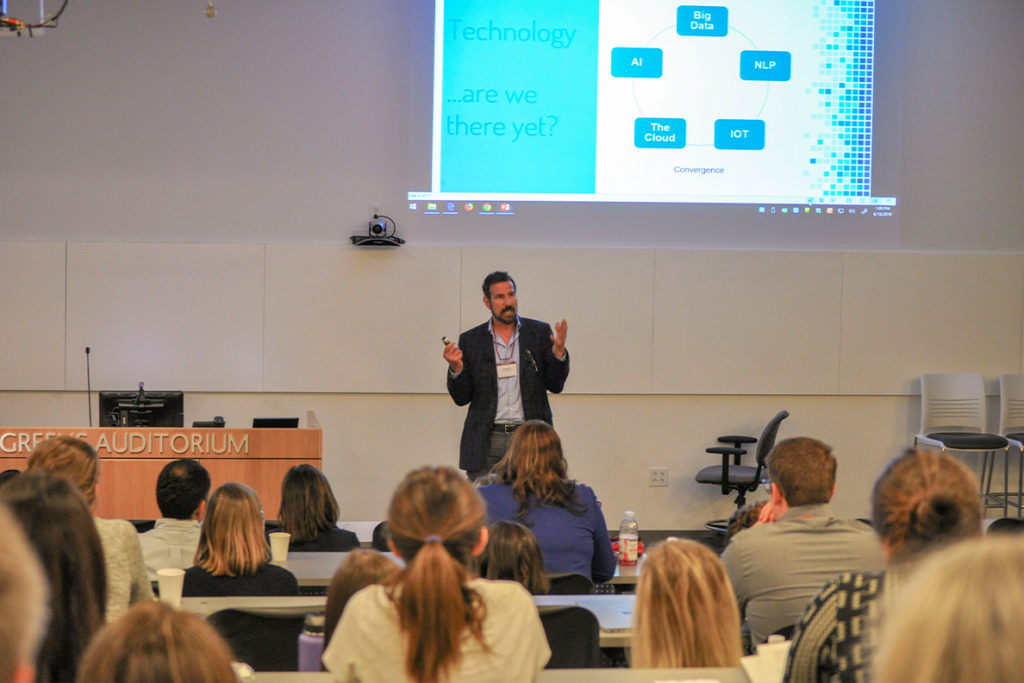
For example, Steve Riddle, director of clinical development for Pharmacy OneSource/Wolters Kluwer, said the complexity and cost of the current healthcare system, as well as its failure to transform the patient experience in any meaningful way, makes it ripe for disruption.
It takes a shift in attitude among consumers, he said, using the example of ride-sharing services. There was a time when many people wouldn’t consider getting into a stranger’s car, but now it’s often a less expensive and more convenient mode of transportation than a taxi.
In terms of healthcare, consumers are being trained by other industries to expect higher levels of transparency, ease of use and better communications, Riddle said.
And just as their expectations are changing, advances in the use of data, wearable devices, and artificial intelligence are changing the practice of pharmacy, medicine and nursing.
“We have incredible insights we’ve never had before into our patients and populations,” Riddle said. “Technology is impacting all areas of care.”
Amazon and its subsidiary PillPack, for instance, could upend the distribution of medications in the United States. Artificial intelligence can create risk alerts for patients based on a host of factors, dictating the outreach or engagement required by the pharmacist or clinician. A patient might make his or her next doctor’s appointment using their smart speaker.
“Change is coming and it’s going to be rapid and pervasive,” Riddle told the audience in his session.
The WSU College of Pharmacy and Pharmaceutical Sciences founded the TIPed Institute in 2016 to foster innovation and transformation in professional education.
“We developed the institute after we changed the way we assess student learning to be competency-based and moved into a ‘flipped classroom’ model of active and collaborative learning,” said Linda Garrelts MacLean, vice dean for external relations and the incoming interim dean of the college. “We wanted to invite others who’ve taken a similarly pioneering approach so we could highlight all of our successes and best practices.”
Among the topics covered at TIPed 2019 include change management; integrating technology, informatics and personalized medicine into pharmacy education; and what works in interprofessional education.
The common thread was change.
Said Garrelts MacLean, “One of our main objectives is to offer an environment of learning and collaboration for change agents in pharmacy education.”