By Brian Charles Clark, Washington State Magazine
It may be possible to use good bacteria to control bad bacteria and, in the process, reduce the use of chemicals currently employed for such control. Just look in a tick’s gut.
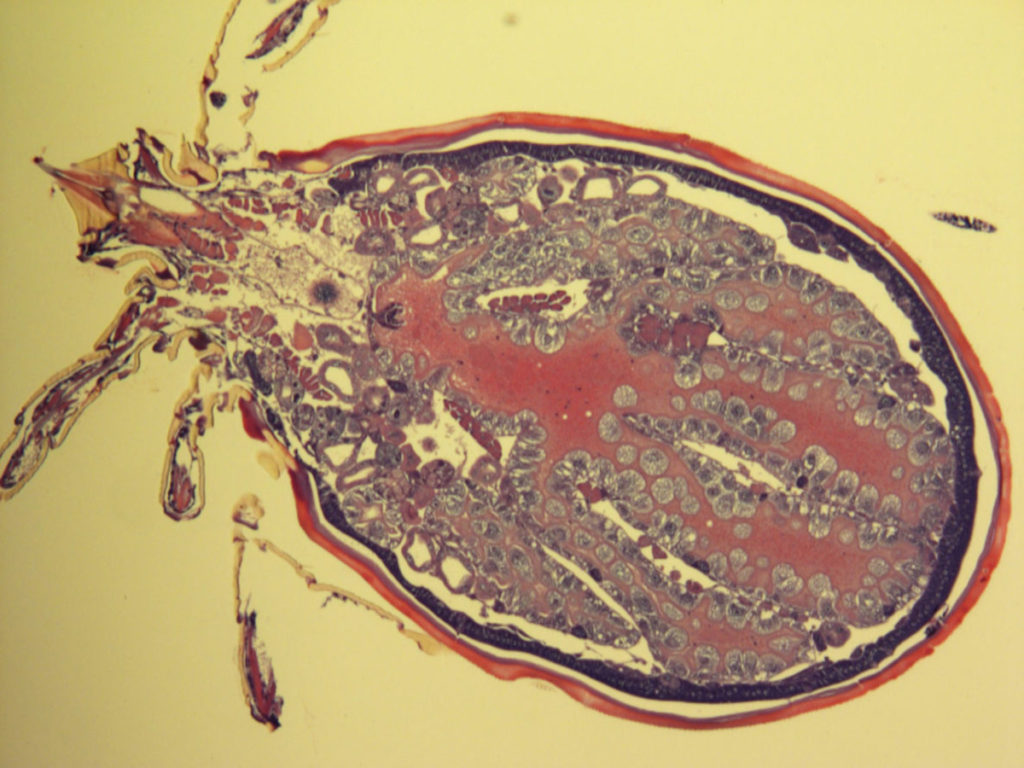
Kelly Brayton, a WSU veterinary microbiologist, and her colleagues study the pathogens in ticks that cause disease in livestock and humans. The pathogens infest ticks’ guts and salivary glands and, along with other non-pathogenic organisms, comprise the tiny arachnid’s microbiome.
They’ve recently been studying something fascinating: If a tick is infected by a non-disease causing strain of the bacteria Anaplasma marginale, its bite won’t transmit anaplasmosis to its human victim. This “exclusion process,” Brayton says, has been suspected since the 1930s but she and her colleagues figure this just might be a key to preventing disease transmission without inducing pesticide resistance.
For example, a specific cattle tick transmits Babesia, an organism that causes a nasty, malaria-like disease that parasitizes cattle blood. After decades of effort, the United States in the 1950s eradicated the cattle tick with a pesticide called acaricide. The trouble is, cattle ticks are becoming acaracide resistant—and outbreaks cost millions of dollars to contain.
One way around pesticide resistance might be to find a way to infect ticks with a non-virulent bacteria that outcompetes the bad guys. “This might be a more environmentally friendly way of preventing pathogen transmission,” Brayton says.
(This article originally appeared in the Winter 2017 issue of Washington State Magazine)