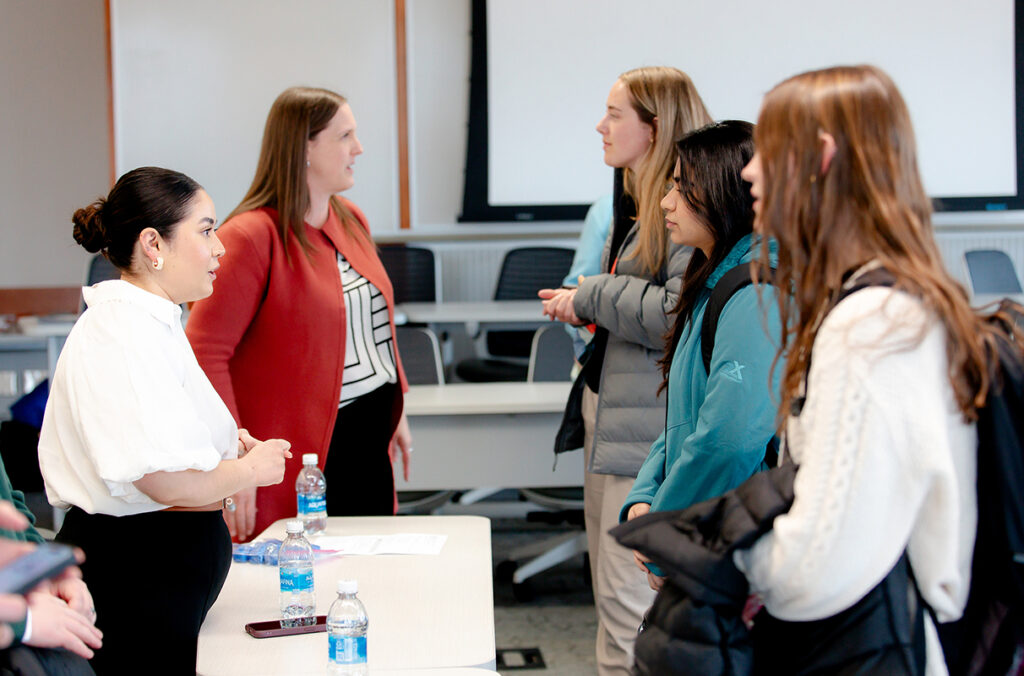
WSU student Amy Smith interacts with students at Pullman High
School. (Photos by Julie Titone, College of Education)
School. (Photos by Julie Titone, College of Education)
PULLMAN – Graduate student Amy Smith never thought playing games at recess with elementary school students would help her future career.
But after observing classrooms at the grade school, middle school and high school levels, Smith realized that understanding students and their day-to-day interactions would make her a better school counselor.
Smith and six other WSU first-year graduate students visited Pullman public school classrooms in the fall as part of a program developed by Clinical Assistant Professor Susan Jensen.
Jensen’s “pre-practicum” gives each of her WSU students the opportunity to observe interactions between students and teachers, the developmental characteristics of students, and classroom management styles. During their second year and final year in the master’s degree program, the students will spend 400 hours interning in school counseling offices.

WSU student Kyle Ross with students at Pullman High School.
A new perspective
“We’ve all spent time in classrooms observing from a student perspective, but this program gives us the ability to observe from a professional perspective and reflect on classrooms in a different way,” said counseling student Kyle Ross of Gig Harbor. “This is especially helpful for those of us who have little or no teaching experience.”
Observing classroom interactions helps future counselors to more thoroughly understand the reasons students may come to the counseling office, including such behavioral issues as unwillingness to participate or conflicts among students.
“It’s important for counselors to observe interactions between teachers and students because part of our job will be to advocate for students,” said Smith, who is from Almota. “By having a better understanding of ways in which students interact with each other and with teachers, we’ll be better prepared to assist students in maximizing their potential in and out of the classroom by being able to better relate to what they’re experiencing.”
Setting an example
WSU’s counseling program is the only one in Washington that requires students to spend time in classrooms, said Jensen, who taught for eight years before working 14 years as a school counselor.
The hands-on learning technique allows students to observe behaviors that are discussed theoretically on campus.
Said Smith: “The pre-practicum taught me, as a future professional school counselor, that it is of the uppermost importance to collaborate with students and teachers in order to do my job.”
More information about the counseling program is available at https://education.wsu.edu/graduate/specializations/counselingpsych/