Photos by Shelly Hanks, WSU Photo Services
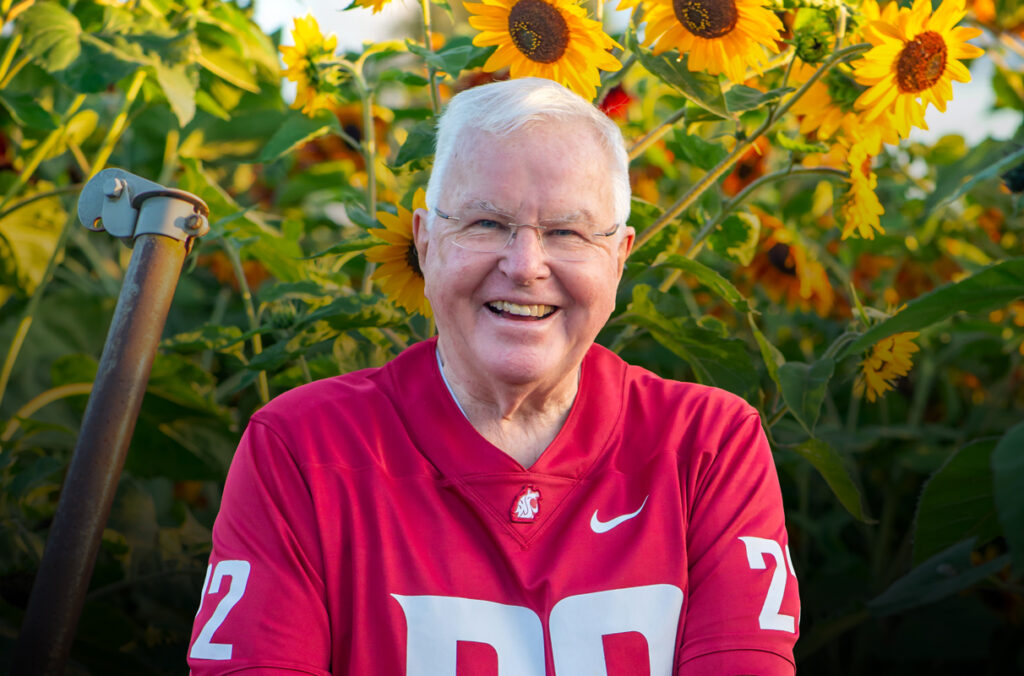
PULLMAN – On Monday morning professor emeritus James F. Short Jr. arrived at his office just like he always does, just like hundreds of faculty and staff members all over campus. But, unlike the rest of us, he now works in a building named for him.
It’s a fitting tribute, said friends and colleagues who gathered with Short’s family on Terrell Mall Friday afternoon to celebrate the rededication of Wilson Hall as Wilson-Short Hall. First recognized as a pioneer in the field of juvenile gang behavior in the 1950s, Short has remained a leading figure in social-science research.
Still, the rededication was as much about friendship as it was about scholarship.
“I wouldn’t miss this for anything,” said Cheryl Churchill, Short’s administrative assistant in 1979-81, who drove down from Spokane for the ceremony.
“He’s the best boss I ever had,” she said. If you heard him talking with someone out in the hallway, she said, you never knew if it was the building custodian or the president of the university.
“He treats everyone the same way,” she said, “which is wonderfully.”
“A class act,” said Regents professor Yogi Gupta after the ceremony.
R. James Cook, professor emeritus of plant sciences, said he had driven over from Bothell to help celebrate the event.
“I figured out early on that this Jim Short was a special guy and represented excellence,” Cook said. “He’s someone I really looked up to.”
Short and Cook both have received the WSU President’s Distinguished Lifetime Service Award, Cook in 2005 and Short in 2006. Short, 85, joined the WSU faculty in 1951. He retired from full-time teaching in 1997 but has continued conducting research, working with graduate students and publishing.
At the rededication ceremony, Short, accompanied by his wife, Kelma, was lauded by Douglas Epperson, dean of the College of Liberal Arts, WSU President Elson Floyd, Regents professor Donald Dillman, and Lorine Hughes, a former WSU doctoral student who is an assistant professor of criminal justice at the University of Nebraska, Omaha.
When colleagues find out she studied with Short, Hughes said, they’ve called him “a luminary, legendary, an icon and a gem,” and she agrees completely. Hughes said not a day goes by that she doesn’t give thanks for having had the opportunity to collaborate with him.
“It’s hard for people outside (criminology) to know how respected Jim is in the field,” she said after the ceremony. “I think he’s probably the greatest living criminologist.”
Hughes met Short in 2000 when she was searching for a graduate adviser (her previous one had left WSU) and he was already on emeritus status. Together they have revisited data from Short’s landmark study of gang violence in Chicago in the 1950s. Hughes earned her doctoral degree in 2003, and she and Short co-edited one book and co-authored another book on gang violence since then.
Dillman, internationally recognized as a major force in the development of modern telephone, mail and Internet survey methods, said his early association with Short led to the development of the country’s first university telephone survey research laboratory in the western United States and possibly the entire country.
In 1970, Dillman said, student protests about the Vietnam War, racism and other civil-rights issues had forced the administration to close campus and end spring semester a month early. It was a tense and difficult time on campus, Dillman said, and Short wanted to gauge public opinion quickly, rather than using the accepted – but time-consuming and labor-intensive – practice of face-to-face interviews.
“He asked me to set up a telephone survey laboratory to see if we could develop a new way of collecting survey information that would make it possible to quickly understand student and public concerns – and how they changed,” Dillman said.
That was the beginning of the Social Research Center, now the Social and Economic Sciences Research Center, which will celebrate its 40th anniversary in the spring. The center has 20 full-time staff and has generated grants and contracts totaling nearly $35 million.
“It’s people like Jim who turn ordinary departments and ordinary universities into great ones,” Dillman said.
He said he thought it particularly apt that Short’s name be added to a building originally dedicated to James Wilson, who served as secretary of agriculture in the early 1900s.
“It’s wonderful to have the Wilson-Short Hall as a permanent reminder of our land-grant heritage and the legacy of Jim Short’s more than half century of commitment to this university and the people who work here,” he said.
“It’s wonderful to have the Wilson-Short Hall as a permanent reminder of our land-grant heritage and the legacy of Jim Short’s more than half century of commitment to this university and the people who work here,” he said.
During the course of his career, Short has authored more than 20 books (and counting). He has been president of two prominent national professional associations, the American Sociological Association and the American Society of Criminology, as well as other professional organizations. He is a fellow of the American Association for the Advancement of Science.