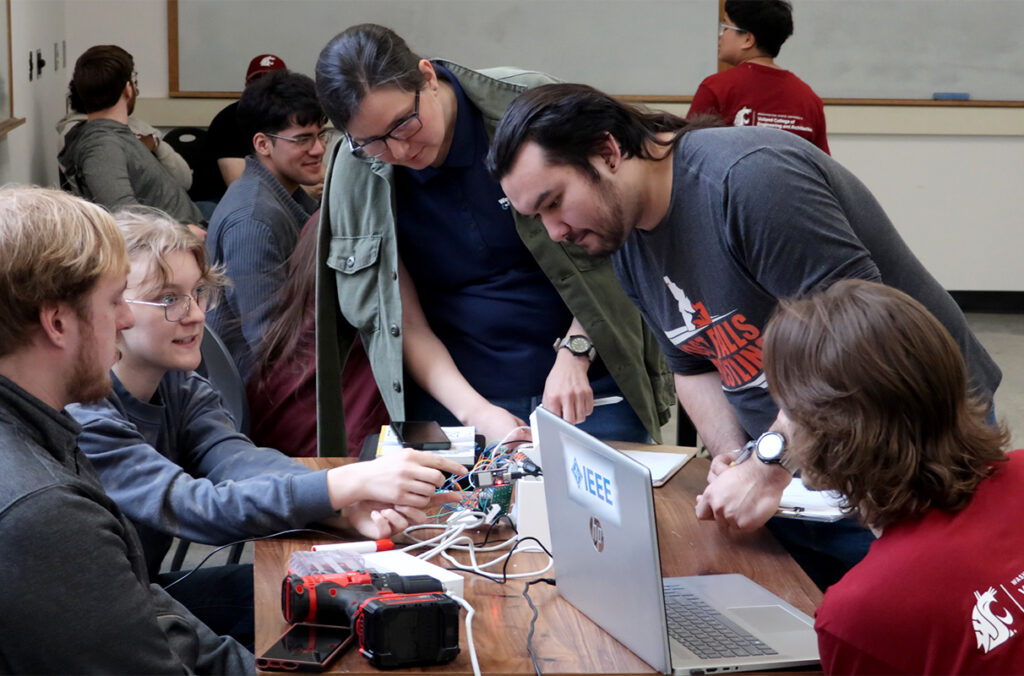
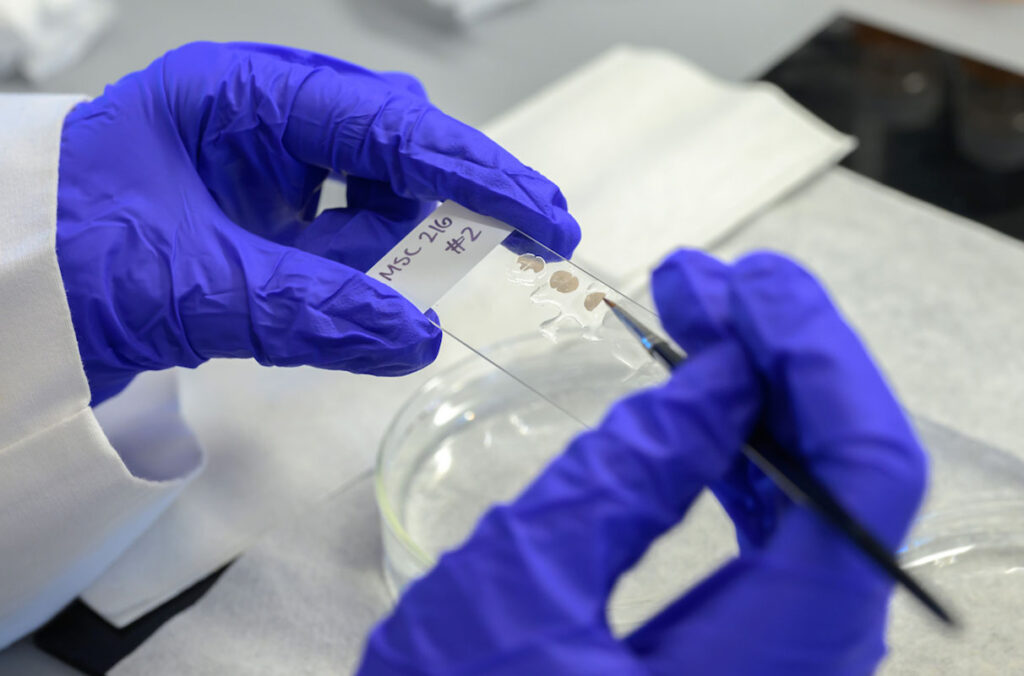
Christine Porfors, WSU Vancouver associate professor, and her student in the lab
VANCOUVER Christine Portfors, associate professor of biology at WSU Vancouver, has received a $700,000 grant from the National Science Foundation (NSF) for her research in “Neural Encoding of Behaviorally Relevant Sounds.”
This research is an important step toward indentifying the neural mechanisms of speech processing. The project began in June and will end in May 2013. It is funded under the American Recovery and Investment Act of 2009 and will provide a variety of training opportunities during this project for undergraduate and graduate students.
“It is not understood how complex sounds are processed and represented in the auditory system,” said Portfors. “My goal is to understand how sounds are processed in the brain … and how the brain has evolved to optimally encode behaviorally relevant sounds.”
Many animals communicate with members of their own species using specific sounds called vocalizations. These sounds are relevant to the animal because they facilitate important behaviors such as mating, maintaining a territory or finding offspring. When an animal hears one of these sounds, it must make an appropriate response based on the information in the sound. To do this, the auditory system must detect, discriminate and categorize each of the sounds. The goal of the current project is to understand the strategies and mechanisms that the auditory system uses to achieve these tasks. This research focuses on characterizing the neural mechanisms that underlie encoding these sounds.
Portfors and members of her research team, which includes undergraduates, will record naturally occurring vocalizations from mice then playback the sounds to individual neurons in the auditory system to study how the brain processes behaviorally relevant sounds. The vocalizations made by a mouse have similar structures to some human speech sounds, so research in mice is an important step toward identifying the neural mechanism of speech processing in humans.
For more information on Portfors research click here.
Related:
- November 2006, Washington State Magazine — Do you hear what I hear?