PULLMAN, Wash.- Washington State University student Leah Jordan attended the Society for American Archaeology Conference April 23-26 in Atlanta to present research she conducted under the supervision of Brian Kemp, molecular anthropologist and ancient DNA specialist at WSU.
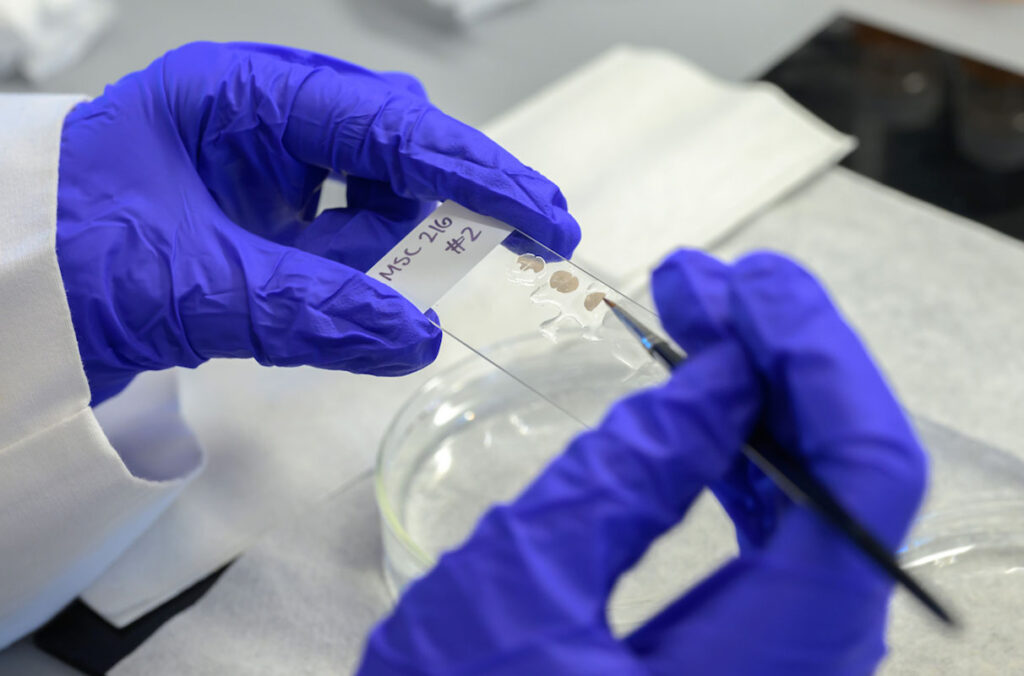
This conference is attended by hundreds of anthropologists from across the world, and it is a unique opportunity for an undergraduate student to present her own research. Jordan developed the tools necessary to identify different salmon species from old bones dug up from an archeological site in Canada.
The method that archaeologists currently use to identify salmon may not be the most accurate technique, Jordan said. “There are five different species of salmon. If it’s a big bone then you kind of know it’s a king salmon, but with the other four there is a lot of overlap between coho and chum, and pink and sockeye. Pink and sockeye, for example, run at different times of the year. There are definite implications when it comes to archeology, such as finding out the behavior of people living in villages or the timing of the fish runs.
“It is actually really difficult to get DNA out of old fish bones. They have been in the weather and under a foot of soil for hundreds of years,” she said.
Jordan developed an interest at North Central High School to study fish. “I had this awesome teacher, Mr. James, and he got me started on fish. We had an awesome lab at our high school. We had a sequencer, which is a way to read DNA, and only about five or 10 high schools in the United States have that equipment.”
Reading some of Gary Thorgaard’s research papers, one of the leading researchers in the area and a professor at WSU, added to Jordan’s interest in fish.
“I never thought I’d get the chance to meet him,” Jordan said. “I didn’t even know he was at WSU.” She took a genetics course her freshman year, and Thorgaard was her professor. This led to the opportunity to work with Thorgaard, and he introduced Jordan to Kemp who has background in anthropology and biological sciences.
“The cool thing about working in Gary’s lab is that this was truly my project. He made some suggestions, but unlike other labs where students may be doing other people’s research, I am doing my own,” she said. “It is a cool experience to actually make my own project and have to draw my own conclusions. It’s my thing.”
“Originally we were looking at identifying unknown fish samples and we wanted to use a genetic method to identify, for example, dead juvenile fish,” she said.
Jordan produced specific primers used to copy DNA in fish. She had to research how to do it and which sequence to use in order to target a specific area. “You have to make your primers very specific. The primer is what targets the specific region. DNA needs something to start the replication process. It can’t just start copying on its own.”
To take a step back Jordan explains that “DNA is what makes you ‘you’, and what makes us different from each other. Studying a specific region of DNA is kind of like a barcode in the grocery store, where every product has a different code. Every species has a different barcode.”
Through Jordan’s research, she successfully produced DNA primers to identify species of fish. “You identify an area of DNA to copy, and use one set of primers, which keeps costs down. I just lined up a bunch of sequences that had already been identified, and used a computer program to look at areas that would be good for primers.”
Jordan will graduate from WSU in 2010 with a double major in genetic cell biology and music. As if a biology degree wasn’t enough, Jordan chose to pursue her interest in music as well, which meant taking an increased number of credits each semester. Jordan not only conducts research for her biology classes, but is writing her honors thesis on how posture and different foot positions affect trumpet playing.
Following graduation, Jordan plans to attend medical school and aspires to become a family practitioner. “I enjoy talking to people and getting to know them,” she said. “Family practice allows you to see a wide range of things and gives you a variety of situations to deal with every day. I don’t like redundancy, so this is a good fit.”
Jordan is the daughter of Andrew and Jill Jordan of Spokane. She can be reached at leahgj@gmail.com.