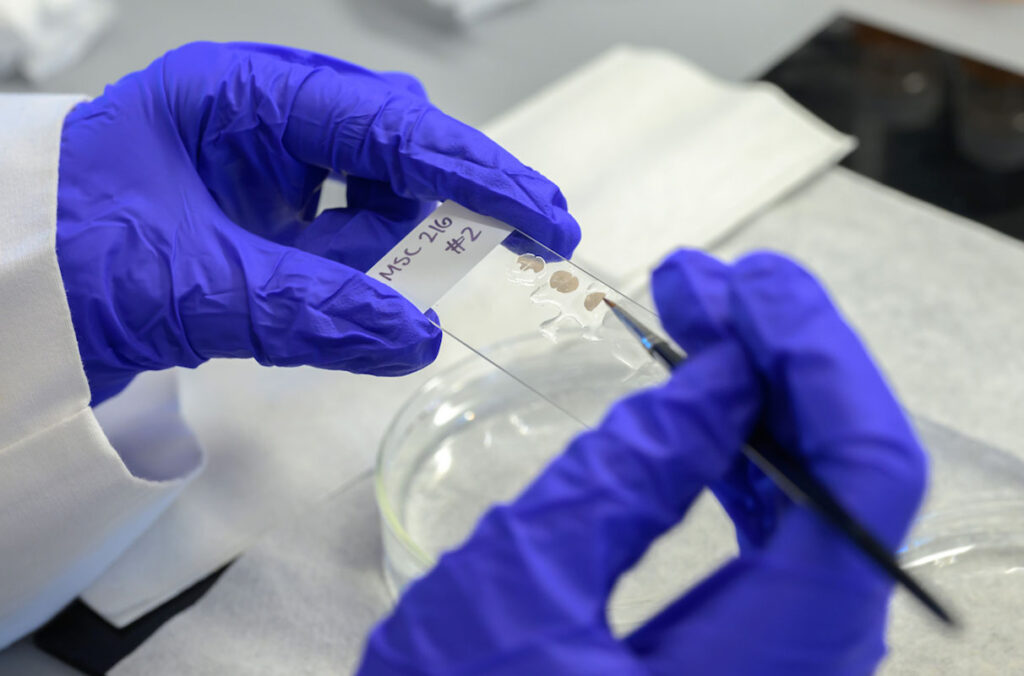
The new building on the WSU Pullman campus will provide approximately 20,000 assignable square feet of office, meeting and research space for 12-15 research scientists and their support staff and graduate students. It will include a state-of-the-art infectious disease research facility that has been designed and equipped to meet today’s standards for investigating emerging diseases. The building will not house animals.
“We are excited to undertake this remarkable effort in something as important and far-reaching as global animal and human health,” said Floyd.
“WSU’s work could lead to innovative new solutions for preventing serious diseases affecting animals and humans worldwide,” said Dr. Fil Randazzo, senior program officer in Global Health Discovery at the Gates Foundation. “It’s important to understand how infectious diseases affect animals, and how these diseases can jump from animals to humans.”
WSU is internationally recognized in infectious disease research focused uniquely on preventing transmission of animal pathogens. WSU researchers will transform these existing strengths into leadership in solving global health challenges in the School for Global Animal Health.
“You cannot identify a healthy human population in which the animals are not also healthy. Humans are inextricably linked to animals, whether for food, for work, or for companionship. Solving the challenge of global poverty is not possible without a focus on animals,” said Warwick Bayly, dean of WSU’s College of Veterinary Medicine. “Controlling infectious diseases at the animal-human interface is fundamental to eliminating the impact of these diseases on human health and well-being.”
The School will focus on three interrelated approaches to global animal and public health, including: vaccine development and deployment, emerging pathogen and disease detection, and control of disease transmission from animals to humans.
* Vaccine development and deployment: Human health and well being in the developing world is dependent on healthy livestock. Tropical infectious diseases of livestock have been a neglected issue due to their absence in the most developed countries. WSU is creating novel vaccines for control of the major vector-borne diseases of livestock that are a significant impediment to economic development in Africa, Asia and Central/South America.
* Emerging pathogen and disease detection: Major emerging infectious diseases in humans have originated in animal hosts, either through direct transmission (such as SARS, West Nile Virus) or by mutations that may result in a “species jump” (HIV, pandemic flu – avian influenza H5N1). WSU is currently identifying determinants of pathogen emergence that will allow early intervention by healthcare organizations. The approach involves both ongoing testing for emerging pathogens and elucidating common mechanisms that will increase the ability to predict and respond to disease emergence.
* Control of disease transmission from animals to humans: Zoonotic diseases — infections transmitted from animals to humans — account for more than 70 percent of human infectious diseases, with a disproportionate impact in the developing world. WSU is pursuing innovative solutions for the prevention of zoonotic diseases through vaccination and other strategic interventions in animal populations and the environment that reduces pathogen levels below thresholds required for transmission. These approaches are directed for cost-effective, efficacious control of globally important infectious diseases.
“The School for Global Animal Health will strengthen existing international partnerships into a sustainable network to develop innovative solutions to major infectious diseases of animals that directly affect human health and economic development,” said Dr. Guy Palmer, professor and director of WSU’s School for Global Animal Health. “It will complement infectious disease programs in the Puget Sound region and will enhance the leadership of the State of Washington in global health by providing innovative strategies for treatment or eradication of diseases at the animal and environmental level.”