PULLMAN Bernard Van Wie, professor in the School of Chemical Engineering and Bioengineering, has been awarded a Fulbright Scholar grant to lecture and conduct research at the Ahmadu Bello University in Nigeria during the 2007-2008 academic year, according to the U.S. Department of State and the J. William Fulbright Foreign Scholarship Board.
Van Wie will teach Nigerian students using a unique, one cubic-foot Desktop Learning Module that he is developing under a National Science Foundation grant to improve engineering education. He will also conduct research in converting sugar cane and cassava to biologically-based fuels.
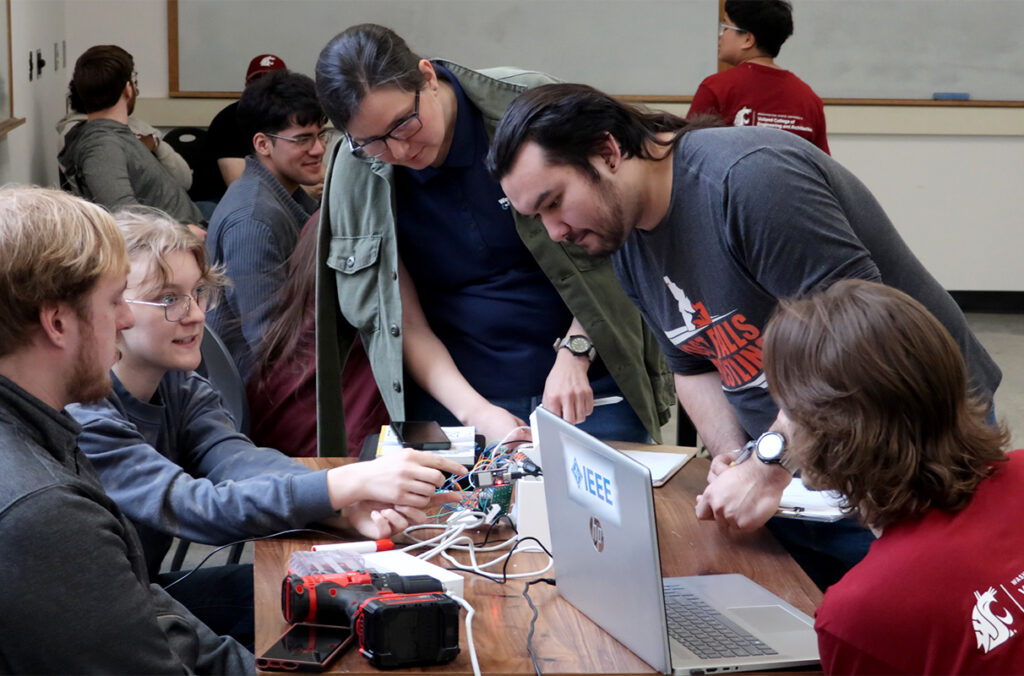
Professional educators have known for years about the benefits of using cooperative, hands-on, active or problem-based learning approaches. But in college, especially in engineering and the sciences, lecturing remains the most common teaching format. Faculty members also often don’t have access to lab space and the bulky equipment that active learning techniques require. For engineers, hands-on learning is particularly important, said Van Wie. The typical student interested in the field already tends to be better at learning while doing and at absorbing visual rather than verbal information.
Van Wie’s desktop modules allow students to match the math they are learning with what is actually happening physically. For instance, to understand the concept of heat transfer they will have in front of them a small working heat exchanger with temperature indicators at different spots. Equations explaining heat transfer concepts are written by the students on a small white-board immediately above this physical model or on a nearby tablet of paper. Students can plug numbers into the equation for the surface area, liquid temperatures, and heat transfer coefficients, but these numbers can only be determined by close inspection and analysis of the physical system in front of them. Instead of memorizing the equation, the students are learning the physical and phenomenological meaning behind the terms that make up the equation. Furthermore, because this hands-on apparatus also contains valves and flow measuring equipment, running conditions can be changed and observed, and temperature changes can be compared with what the equations predict. By developing the DLMs, the researchers hope that faculty will be more willing to use the new types of cooperative, hands-on, active, problem-based pedagogy and that students will learn both the core course concepts as well as ‘soft skills’ like team work and communication skills that are a necessary part of an engineering career.
Van Wie earned his Ph.D. in chemical engineering from the University of Oklahoma, Norman where he focused on blood-cell separations. In addition to his work in teaching techniques, Van Wie’s research focuses on bioprocessing and biomedical engineering with applications in biosensors and miniaturized diagnostic capabilities including designs at the micro and nanoscale, cell culture, and biomass processing.
Van Wie is one of approximately 800 U.S. faculty and professionals who will travel abroad through the Fulbright Scholar Program. Established in 1946 under legislation introduced by the late Senator, J. William Fulbright of Arkansas, the program’s purpose is to build mutual understanding between the people of the United States and the rest of the world.
The Fulbright Program, America’s flagship international educational exchange program, is sponsored by the United State Department of State, Bureau of Educational and Cultural Affairs. Since its inception, the program has exchanged approximately 273,500 people 102,900 Americans who have studied, taught, or research abroad and 170,600 students, scholars and teachers from other countries who have engaged in similar activities in the United States. The program operates in over 150 countries worldwide.
Recipients of the Fulbright Scholarship awards are selected on the basis of academic or professional achievement, as well as demonstrated extraordinary leadership potential in their fields. Among the thousands of prominent Fulbright Scholarship alumni are Craig Barrett, Chairman of the Board of Intel Corp, Mohamed Benaissa, Minister for Foreign Affairs, Morocco; Raoul Cantero, Justice, Florida Supreme Court; Luis Ernesto Derbez, Minister of Foreign Affairs, Mexico; Renee Fleming, soprano; Gish Jen, writer; Dolores Kendrick, Poet Laureate of the District of Columbia, Daniel Libeskind, architect; Aneesh Raman, CNN Baghdad correspondent; Robert Shaye, co-chairman and co-CEO, New Line Cinema; Ruth Simmons, President, Brown University; Javier Solana, Foreign Policy Chief, European Union; and Muhammed Yunus, Managing Director and Founder of the Grameen Bank.
Fulbright recipients are among over 30,000 individuals participating in U.S. Department of State exchange programs each year. For more than forty years, the Bureau of Educational and Cultural Affairs has supported programs that seek to promote mutual understanding and respect between the people of the United States and people of other countries. The Fulbright Scholar Program is administered by the Council for International Exchange of Scholars.
More information about the Fulbright Program or the U.S. Department of State’s Bureau of Educational and Cultural Affairs is available at
https://exchanges.state.gov
, or by calling Heidi Manley, Office of Academic Exchange Programs, (202) 453-8534 or
academic@state.gov
.