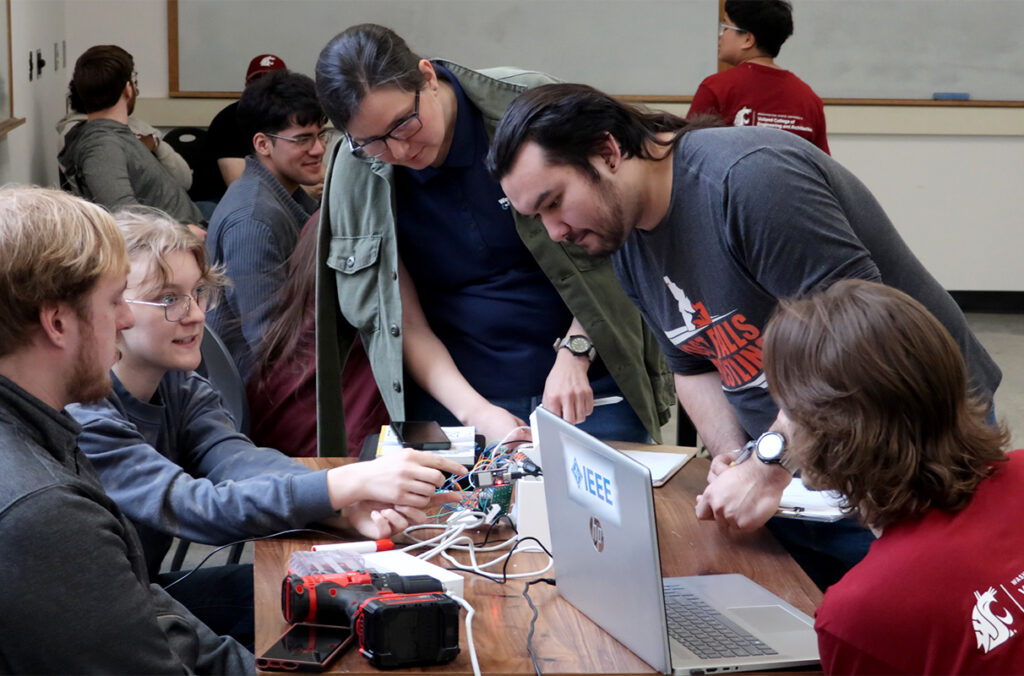
Photo: Daivd Kuehn likes technology and works with it for WSU. But he also is concerned with an over-reliance on educational technology. (Photo by Shelly Hanks, WSU Photo Services)
David Kuehn likes technology. He works for the Department of Information Technology Services as an IT specialist. However, he also is concerned with an over-reliance on educational technology at WSU.
As an example, he cites his experiences in an organic chemistry course. A substitute teacher, an emeritus professor, used a chalkboard instead of a PowerPoint presentation.
“Many of the students were unwilling to take notes from the chalkboard. They were vocal in their displeasure and some even left,” Kuehn said.
“They were used to just printing off PowerPoints and were incapable of adapting. Students should go to school to learn how to learn, and if all they can do is copy a PowerPoint, the technology is doing them a disservice.”
Norah McCabe, clinical assistant professor of molecular biosciences, echoes Kuehn’s concern.
“PowerPoint can be a useful tool, but it does not engage students and its wholesale use is not good,” she said.
“When the PowerPoints are put on the Web, students never need to go to class, which is the ultimate non-engagement. With the use of technology, I am afraid we will lose our ability to talk to each other.”
Ray Jussaume, chair of the Department of Community and Rural Sociology, agrees that in some cases faculty rely too much on technology.
“It’s just another tool,” he said. “Teachers need to know how to use technology effectively, not just how to use it.”
And that is exactly the point, according to Gary Brown, director of the Center for Teaching, Learning and Technology (CTLT).
“Technology will never replace good teaching, but good teachers can be more effective for more students using technology,” he said. “Right now, use of technology is skyrocketing at WSU.” (See Student use below)
Exposing students to the latest technology is vital, Brown said.
“Students need to meet the challenges of the future and need to be able to think through the use of new technological media. It would be a big disservice to not prepare students in technology.”
He cited several examples of effective faculty use of technology:
Bintong Chen, professor in the College of Business, creates learning communities in his online courses to encourage all students to contribute in an active, not reactive, manner. Chen notes that, with his monitoring and direction, the nontraditional students who take those courses readily form peer support networks and help teach the classes by sharing their own experiences.
Joan Anderson, assistant professor in apparel merchandising, uses a blogging tool called personal Web-based journaling to improve student understanding and writing skills. Anderson’s research indicates that using blogs is an effective way to improve writing skills due to the use of peer feedback and the journaling technique popular with students.
Willie J. Heggins III, assistant professor of educational leadership, requires his students to create e-portfolios that reflect their total learning experience through videos, papers and journals. Heggins explains that creating portfolios both teaches valuable technical skills and results in a “powerful showcase” of their university experiences to use as a resume for prospective employers.
Overall, new technology can enhance the teaching and learning experience if it is used creatively and effectively, Brown said. “It depends on implementation. Good teachers are still good; bad teachers are still bad.”
Student use of educational technology
This school year, the Center for Teaching, Learning and Technology (CTLT) provides support for:
*15,743 students in more than 1,000 course sections through the course management applications.
*2,600 students and faculty using CTLT-hosted blogs.
*6,386 students and faculty using WSU’s Wiki.
*508,203 online surverys and evaluations through the online survey system, CTL_Silhouette.