PULLMAN, Wash. — When the state of Washington was on the verge of legalizing recreational cannabis for adults in 2012, public health officials were concerned about how to limit its use among young people.
They called on researchers in Washington State University’s IMPACT Research Lab for help. The lab — whose acronym stands for Improving Prevention Through Action — is focused on closing the gap between science and real-world efforts at prevention. Drawing on their expertise in the prevention of social, emotional and behavioral health problems, the lab’s researchers developed a roster of programs with proven effectiveness — which was then adopted in community prevention programs for youth across the state.
It was just one of many seeds that have grown into the state’s Prevention Research Collaborative — a 25-year collaboration between researchers and prevention workers. The PRC laid the groundwork for a collaboration between the IMPACT Lab and the state Health Care Authority that evaluated community-based prevention efforts across Washington, and found they were slowing the rates of drinking and substance use among adolescents in some of Washington’s highest-needs communities.
The PRC includes members from WSU, the University of Washington and the Washington State Health Care Authority’s Division of Behavioral Health and Recovery, along with other prevention leaders from across the state. It aligns researchers and state agency leaders to identify community needs, study how to address those needs, and help practitioners tailor a response.
“We bring expertise to the table around the research and evaluation,” said Brittany Rhoades Cooper, a professor of human development in the IMPACT lab and co-author of a new journal publication highlighting the PRC’s work. “They bring expertise around what the community needs are and what their data is telling them about the risk and protective factors in communities. That has really been a strength of our partnership.“
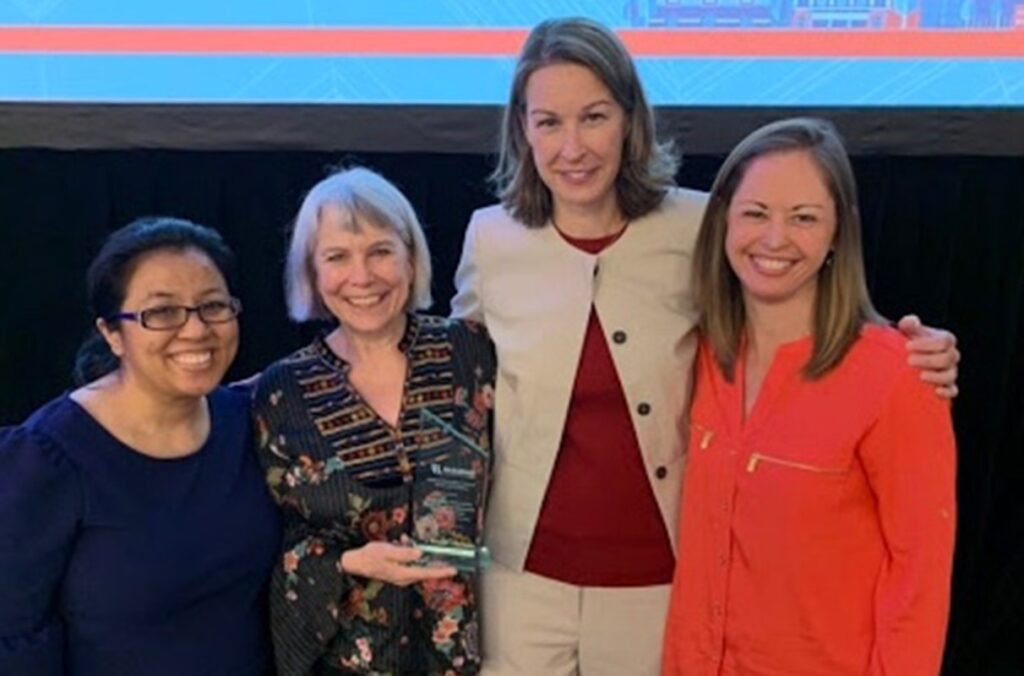
The new article, published in the journal Prevention Science, outlines the key factors in the 10-year partnership between the IMPACT Lab and the HCA, and details how the PRC set the stage for that effort. It also highlights evaluations by the IMPACT Lab that demonstrate the effectiveness of the state’s prevention programs in bringing down drinking and substance use among adolescents.
Cooper’s co-authors included Gitanjali Shrestha, research assistant professor in the IMPACT lab; Heather Terral, research associate and data analyst in the IMPACT lab; Laura Griner Hill, professor emerita in the WSU Department of Human Development; Jaymie Vandagriff, prevention systems manager with the Washington State Health Care Authority; and Sarah Mariani, substance use disorder prevention and mental health promotion section manager with the Washington State Health Care Authority.
The Prevention Research Collaborative was formed in 2001, beginning with smaller, single projects that evolved into a more formalized long-term relationship among many academic and state partners. The partners meet quarterly, with state agency officials sharing what’s happening in their communities and what they need from researchers, and researchers responding by providing answers, educational materials and evaluations of program effectiveness.
Over time, the collaborative has evolved beyond project-specific partnerships toward a broader, more flexible approach: Identify what’s needed and pursue it. That goal has driven the 10-year partnership between the IMPACT Lab and the Health Care Authority to evaluate the effectiveness of state’s Community Prevention and Wellness Initiative.“What’s been amazing about this partnership is the commitment to the relationship and the goal of serving children, youth, families and communities,” Mariani said. “We ebb and flow in the specific formal relationships that we have, but any one of us could come to the table at any time and say, ‘Hey, we’re exploring this. Are you up for exploring this?’ And everyone chips in and provides whatever resource they can.”
Led by the HCA, the CPWI has built a network of 90 community-based prevention coalitions across Washington, each implementing programs tailored to specific local needs.
The IMPACT Lab conducted an evaluation of the initiative’s effectiveness, based on the state’s annual Heathy Youth Surveys of youth behaviors across grade levels. They found that young people in CPWI communities showed a delayed onset in the use of alcohol, tobacco and cannabis when compared with other youths — which is a key goal for limiting future problems such as substance use disorder.
“We know that youth substance use will increase across those grades, developmentally, normally, and the evaluation was designed to see to what extent do communities that implement this community prevention wellness initiative see less of an increase over time?” Cooper said. “That’s essentially what we saw, was a kind of a slowed progression in increase in substance use.”
In surveys across grades 6, 8, 10 and 12, researchers also found reductions in other risky behaviors and attitudes. The results are even more encouraging given that the CPWI programs are located in some of the state’s communities with the highest levels of risk.
The authors of the journal article cited several factors that have contributed to the success of the partnership, including trust and relationship building; collaborative processes and shared decision making; shared vision, goals and mutual benefit; conducting rigorous, relevant research and sharing the results; and several others.
“It’s a uniquely collaborative partnership that transcends formal legal and financial structures,” Vandagriff said. “It is authentically centered on the vision, the mission and the relationships between the parties, and I think that is really special when it comes to an academic and state partnership.”