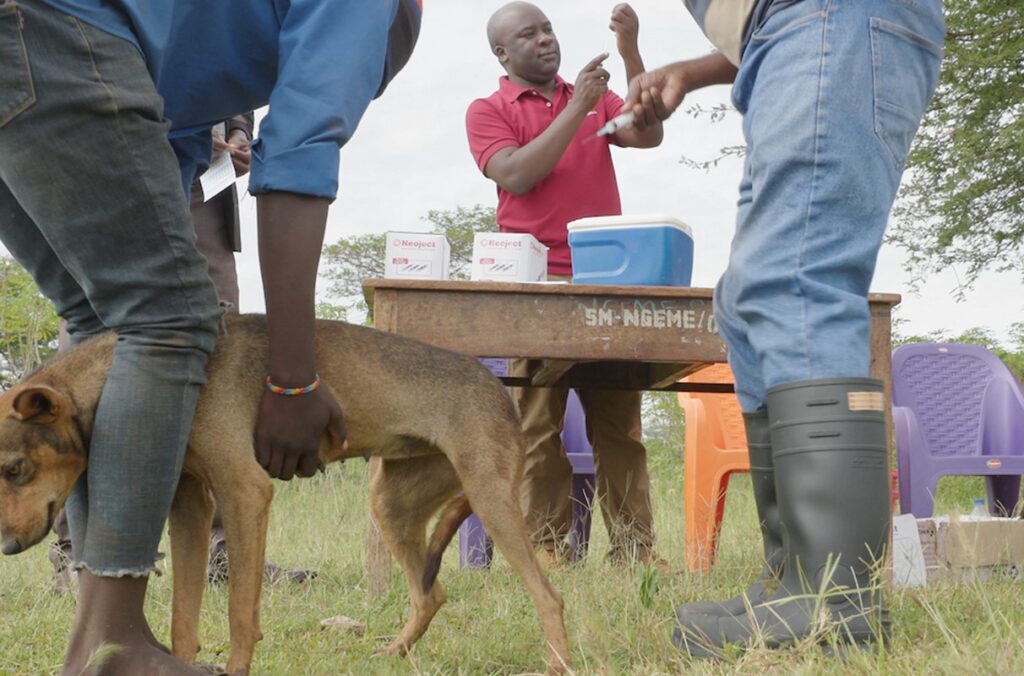
PULLMAN, Wash. – A community-based approach to vaccinating dogs against rabies could help protect countless children in Africa and other areas from one of the world’s deadliest infectious diseases, according to a new study led by Washington State University.
Conducted over three years in rural Tanzania, the National Institutes of Health-funded study found that community-based rabies vaccination programs kept significantly more dogs protected against the disease than traditional annual vaccination campaigns, which are typically led by teams of vaccinators who come from outside of the communities they serve. The new approach also maintained more consistent vaccination coverage throughout the year, reducing the risk that protection would fall below the level needed to prevent transmission. The findings of the study were published in the journal PLoS Neglected Tropical Diseases.

“The biggest finding from this study is that community-based approaches to disease control are effective and cost effective,” said Felix Lankester, a professor in the WSU’s College of Veterinary Medicine’s Paul G. Allen School for Global Health, director of the Rabies Free Africa Program, and senior author on the study. “Involving the community in implementing campaigns is a really effective way to achieve your disease control goals. With approaches like this, we have the tools to eliminate human rabies, however, it will take funding commitments and political will.”
Rabies is estimated to kill up to 160,000 people each year, primarily in Africa and Asia. More than 99% of human cases – most of which occur in children – are caused by bites from infected domestic dogs, making widespread dog vaccination one of the most effective tools for preventing human infections.
The study compared the standard model of rabies control with a new community-based system.
Traditional programs rely on vaccination teams traveling from village to village once a year, administering vaccines that must be stored under refrigeration and transported from centralized locations.
The new approach grew out of earlier research led by WSU showing that a commonly used rabies vaccine remains effective for up to three months when stored at 30°C (86°F) in specially designed clay pots known as zeepots. This allows communities to be able to store and administer vaccines year-round rather than waiting for annual vaccination campaigns.
The study found the community-based approach led to more dogs being vaccinated, maintained higher vaccination coverage throughout the year and reduced the cost per dog vaccinated. On the opposite side, traditional annual campaigns result in a spike in vaccination coverage immediately after dogs are vaccinated, followed by a steady decline as vaccinated dogs die, move away and new unvaccinated puppies are born.
The decline often causes coverage to fall below the 40% threshold needed to maintain herd immunity against rabies. The researchers found the probability of vaccination coverage dropping below that critical level was 60% using the traditional team-based approach, compared with just 18% under the community-based system.
“With the traditional approach, you get this waxing and waning of the vaccination coverage, which tends to lead to vaccination coverage dipping below the critical vaccination threshold,” Lankester said. “With the new approach, the risk of it dipping below the critical vaccination coverage was much lower, which meant that herd immunity would be maintained.”
The program began in Tanzania’s Mara region and has since expanded into other parts of northern Tanzania. Lankester said the community-based approach could be successful in other regions, but funding is an obstacle.
Lankester is advocating for rabies control to be considered a public health issue and not simply an animal health issue. Although dogs are vaccinated, the goal is protecting people, particularly children.
“It’s about childhood health. It’s about public health,” Lankester said. “The benefits to dogs are clear, but that is a secondary benefit. The primary goal is to protect children from rabies.”
World Rabies Day
September 28 is World Rabies Day, an effort to raise international awareness of efforts to eliminate rabies.
Media Contacts
- Felix Lankester, WSU Paul G. Allen School for Global Health, felix.lankester@wsu.edu
- Devin Rokyta, WSU College of Veterinary Medicine communications, 509-335-1911, devin.rokyta@wsu.edu