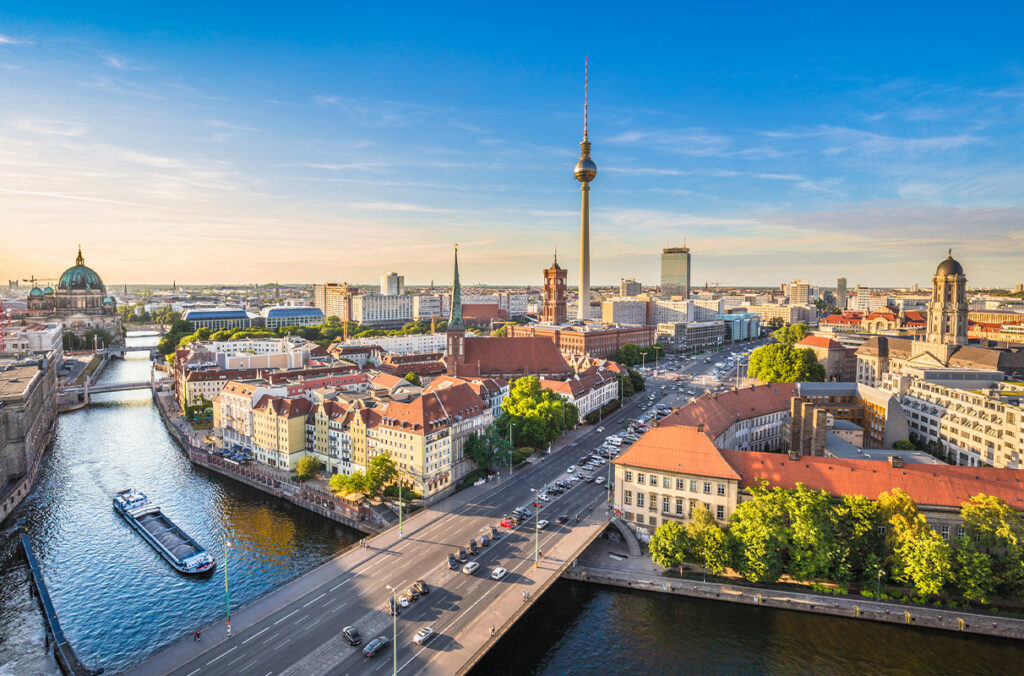
Berlin is known worldwide for its artistic energy and aesthetic inspiration. For a group of WSU students, the city became their classroom over three weeks in May. The Digital Technology and Culture (DTC) Department returned to Germany for their second annual Summer Study Abroad trip, leading students on an exploration of the creative and cultural landscape of one of Europe’s most dynamic cities.
“Berlin has been a large hub of design, influencing graphic styles and architectural design for the last hundred years,” said professor June T. Sanders. “There’s evidence of that everywhere with different art galleries or pop-up shows or street art. We show students more of that institutional level of design and let them see how they can combine that conceptually.”
Throughout three weeks in May, the students toured multiple art galleries, installations, and design exhibitions. They also participated in local trips around Berlin, including historical walking tours of the city’s rich history of counterculture and activism. One of the trip’s main highlights was visiting the Bauhaus School in Dessau and the Bauhaus Archive. Arguably one of the most influential design styles of the 20th century, the Bauhaus movement aimed to combine aesthetics and beauty with function and utility in both fine and applied arts.
Berlin has been a large hub of design, influencing graphic styles and architectural design for the last hundred years. There’s evidence of that everywhere with different art galleries or pop-up shows or street art.
June T. Sanders, professor
Washington State University
“It always feels significant to go and see the actual Bauhaus school, because it was a very radical, alternative style of education,” said Sanders. “Being able to witness that with students, while also crafting our own classroom together as a group, felt like an especially poignant moment.”
While some study abroad programs focus on project-based education during their travels, the DTC professors opt for a different approach. “As faculty we approach this trip as experiential learning for the students,” said professor Jacob Riddle. “The city itself is saturated with design and art, from the posters to murals to fashion. Within that, we try to think about what education looks like broadly through experience and exhibition.”
Sanders agrees: “We understand that a study abroad experience and traveling in a foreign country can be overwhelming, so we encourage students to think broadly about ideas and processes and experience the city in a new and exciting way.”
Travel abroad experiences require financial support, and this year’s Berlin excursion was supported by WSU alum Christian Schlect (Class of 1973), whose three children also attended WSU. “It’s important to support student travel experiences because it encourages students to experience a different culture during their college years,” said Schlect. “It’s the cultural exchange and the awareness of foreign languages, cultures, and ideas that helps them build confidence for their careers.”
Both Sanders and Riddle have seen the impact that travel and dialogue can have on their students. “While we might not see a lot of evidence during the trip of how students were influenced, when they come back into the classroom we can see that shift both aesthetically and mentally,” said Sanders.
Riddle had a couple of students from the 2024 study abroad trip to Berlin in his senior seminar class this past spring.
“Their whole approach to their thesis project felt like a continuation of the creative practice we explored in Berlin,” he said. “That approach was more refined and focused than before, not just in the process and practice but also in their output.”
The DTC study abroad trip to Berlin is open to all WSU majors and experience levels. As students prepare for the upcoming fall semester and consider the many opportunities available to WSU students, Coug alumni encourage them to seize the occasion. “If you have the opportunity to travel, do so,” said Schlect. “Taking advantage of these university opportunities and participating in these specialized programs is just a wonderful thing.”