A group of students in WSU’s School of Design and Construction are getting training that they hope will make a difference in tackling energy efficiency and climate challenges.
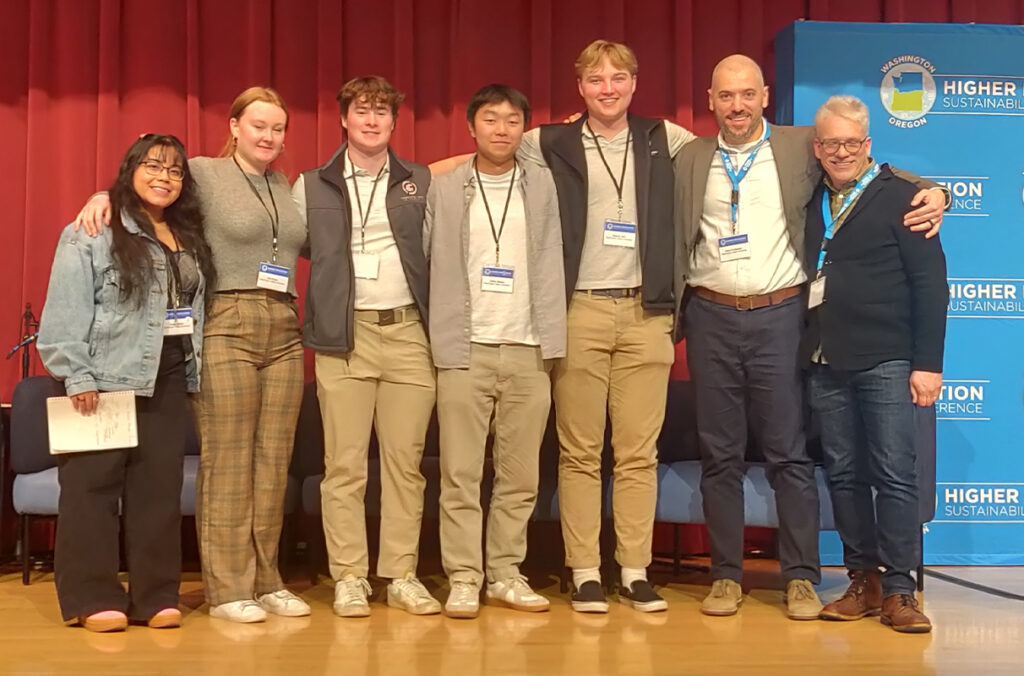
The students recently gave a presentation on WSU’s Energy Conscious Construction (ECC) program at the 2025 Washington Oregon Higher Education sustainability Conference. The conference, held annually, brings together university and community college representatives from the two states to report on sustainability initiatives.
“As a future landscape architect, I am on the front lines of this climate crisis,” said Ella Roney, a junior in WSU’s School of Design and Construction who will join the program in May. “The ECC program will take my existing knowledge and take it a step forward.”
The interdisciplinary ECC program offers courses in design and construction of energy-efficient residential buildings, with a focus on the state of Washington. WSU began offering the program’s new online master’s degree this year, offering a series of 10 courses and online learning modules. In the master’s program, students earn a total of 30 credits, following either a one-year or two-year path. There are also 15-credit undergraduate and 12-credit graduate certificate programs. The program, housed in the School of Design and Construction and offered through WSU Global Campus, is for students as well as for working professionals.
“The ECC program has been an eye-opening research and development opportunity,” said Magnus Neil, an architecture graduate student who has been involved in the program. “The program pinpoints major issues in the way we build our world and consequently harm it. It aims to show how the construction and design industry can and needs to be changed to reduce the current 40% of global carbon released that it is responsible for.”
Residential buildings account for 23% of the state’s energy consumption, and emissions from these buildings are the fastest growing source of greenhouse gases, said Omar Al-Hassawi, associate professor in the School of Design and Construction. The state of Washington’s Climate Commitment Act, which took effect last year, has set a cap on carbon pollution and greenhouse gas emissions.
“Energy conscious construction is becoming more important every year,” said Adrian Klinkenberg, who is studying construction management in the school and has taken some of the courses in the program. “The overall construction industry is trending towards a more sustainable future, and so are regulations. A certificate or master’s in ECC will prepare students for changes that are coming and are already implemented in the construction industry.”
Aissa Avalos, an interior design student, said sustainable design is going to become increasingly important in the future.
“The ECC program offers an amazing opportunity to dive deeper into solutions,” she said.
In the courses, students learn about building performance simulations; environmental control systems; building assemblies and structural systems; codes, standards, and rating systems; building performance measurement; and smart building technologies. The courses include a mix of mechanical engineering, architecture, design, and WSU Extension Energy courses. The program recently earned a Department of Energy Zero Energy Design designation which recognizes the program’s commitment to sustainable design practices.
Jeffrey Namba, who is studying for a Master of Architecture degree and has taken some of the coursework, said the ECC program bridges applied science and architecture, empowering designers to create projects that are more energy efficient with lower embodied carbon.
“Whether you’re a student passionate about sustainability or a professional looking to advance in the field, the ECC program provides essential expertise in building performance, energy efficiency, and resilient design, within residential architecture,” he said. “With firms increasingly prioritizing sustainable practices and the Climate Commitment Act driving change, gaining a strong foundation in sustainability has never been more critical.”
Roney and her co-presenters were excited to present at the conference.
“It was great to see how other schools are working to create sustainable strategies and programs,” she said. “It made me feel hopeful for the future.”
Students interested in the ECC are encouraged to apply on the School of Design and Construction website or contact Al-Hassawi.