By Tina Hilding, Voiland College of Engineering & Architecture
PULLMAN, Wash. – Washington State University engineering students Emily Willard and Katherine Brandenstein are hoping to save lives someday with a product they’ve developed to make injections safer in the developing world. Willard is from Everett, Wash., and Brandenstein from Woodinville, Wash.
The bioengineering students in the Gene and Linda Voiland School of Chemical Engineering and Bioengineering were selected to compete as one of 18 teams across Washington in the Health Innovation Challenge (HIC) March 3 in Seattle. Sponsored by the University of Washington’s Buerk Center for Entrepreneurship, the HIC is a tradeshow-style competition that will include more than 100 judges from the health care and Seattle entrepreneurial communities. Teams can win up to $10,000 in prize money to support their projects.
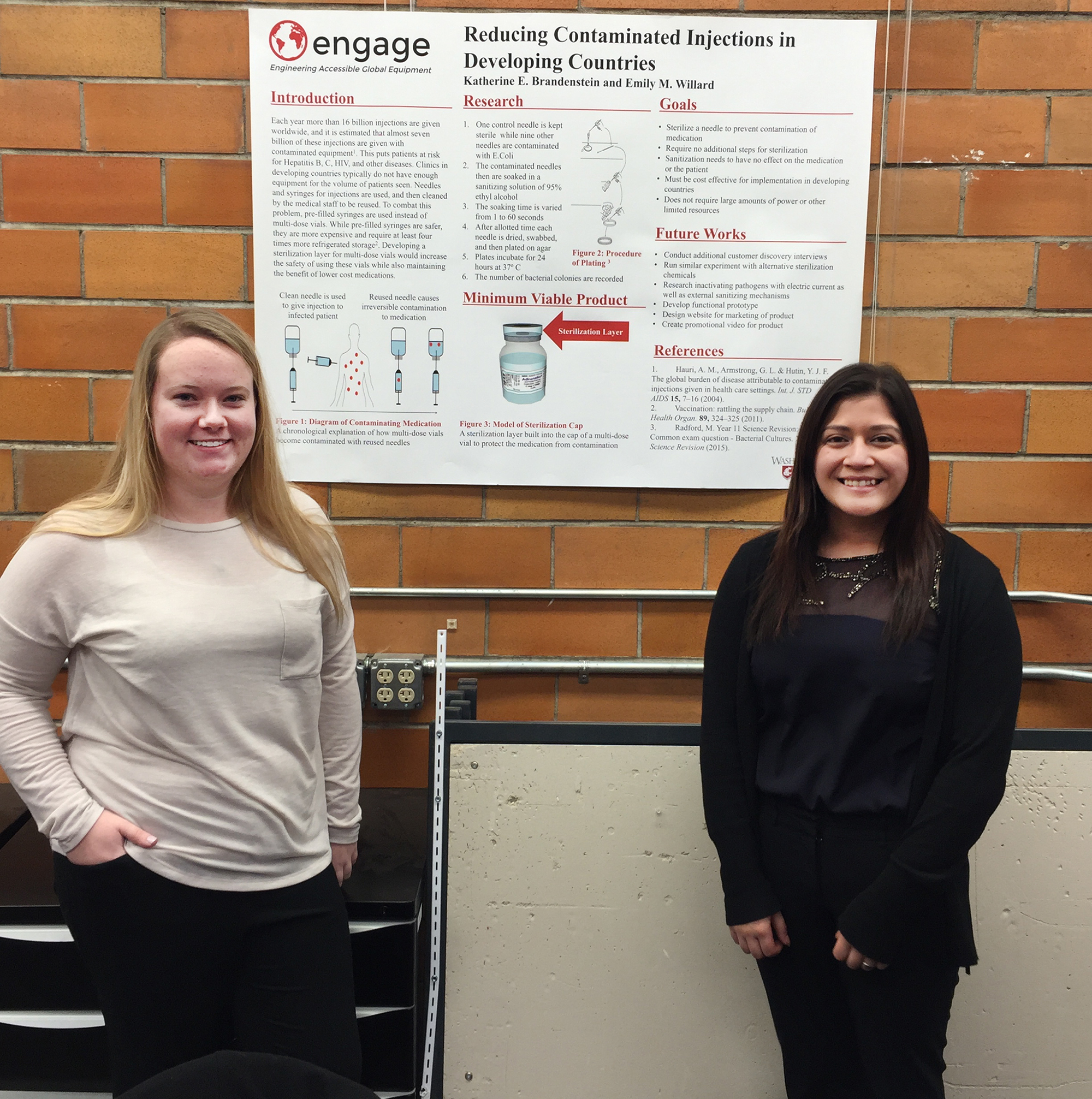
Willard and Brandenstein are devoting their senior year to doing a capstone project with social impact. As they scouted potential projects, they learned that contaminated injections are a huge problem in developing countries and a leading cause of death. Injections of antibiotics, vitamins and vaccines are commonly given at doctors’ offices, but nearly half, or seven billion injections each year, are done with contaminated equipment.
“Syringes and needles are usually just rinsed with water and then used with different patients,’’ said Willard.
The students designed a nonremovable cap that attaches to the top of multi-dose vials of medicine. The cap holds a layer of liquid to sterilize the needle each time it passes through. The liquid could stop the spread of contaminants commonly found on a reused needle, such as Hepatitis B, Hepatitis C and HIV.
The students chose ethyl alcohol as the sterilization liquid, particularly because it knocks out HIV and Hepatitis B. They have done some initial testing with E. coli bacteria and found that, after just one second in an ethyl alcohol bath, all of the bacteria died.
“This means that clinic workers wouldn’t have to let the needle soak in a solution for an extended amount of time, which was one of our biggest requirements for our product,’’ said Willard.
Willard and Brandenstein named their company Engage, which stands for Engineering Accessible Global Equipment. They have been busy developing their 3D-printed prototype, which they will display at Thursday’s event. They also hope to test more bacteria types in the future.
Contact:
Tina Hilding, communications coordinator, WSU Voiland College of Engineering and Architecture, 509-335-5095, thilding@wsu.edu